Chapter 7 · Heat, Cooling & Shelter
Shelter in place: what it means and which room to use
To shelter in place means to stay inside, but the right room depends on the danger. A tornado sends you low and inward, a chemical cloud sends you up into a sealed room, and fallout sends you to the middle of the building for at least a day. Here is how to tell them apart and get ready for all three.
Read first: Household plan
"Shelter in place" is one of the most common instructions officials give, and one of the least explained. Ready.gov puts it simply: there are times when it is safest to stay where you are rather than face what is happening outside. Ready.gov says it may be short, as in a tornado warning, and CDC says sheltering from a chemical release can last a few hours, possibly days.
What changes from one emergency to the next is where inside you go and what you do to the room. The advice for a tornado, a chemical release and a radiation emergency points in three different directions, and following the wrong one can put you in the worst room in the house. This page sets the three side by side, then covers the steps they share, how to seal a room, how long to stay, and what to keep ready.
Sheltering in place is not the same as staying at home, which Ready.gov describes separately as remaining indoors as much as possible and going out only when necessary. And it is not the right choice when officials order an evacuation: Ready.gov's hurricane page says that if you are in a mandatory evacuation zone and local officials tell you to evacuate, you go right away.
Which room, for which danger
| Danger | Where to go | Seal the room? | How long | Sources |
|---|---|---|---|---|
| Tornado, high wind | A safe room or storm shelter if you have one; otherwise a small, interior, windowless room or basement on the lowest level. Away from windows, doors and outside walls | No | Until the danger passes; keep listening to alerts | Ready.gov Tornadoes, Hurricanes |
| Hurricane | Shelter from high winds in a designated storm shelter or interior room; if rising water traps you, go to the highest level, but not into a closed attic | No | Until local officials say it's safe | Ready.gov Hurricanes |
| Chemical release | A room you can seal, above ground, with as few windows and openings as possible (Ready.gov). CDC adds: a large room, with water, on the highest floor you can | Yes | A few hours, sometimes days (CDC); until the all-clear | CDC, Ready.gov Hazmat, FEMA |
| Radiation or fallout | The basement or the middle of the building, as far as you can get from the outside walls and roof. Brick or concrete buildings are best | No: close it up and shut off outside air | At least 24 hours, unless officials say otherwise | CDC, Ready.gov, FEMA |
Why the rooms differ
- Wind and debris do their damage through windows and outside walls, so you put as many walls as you can between you and the outside, and get low. Ready.gov says to cover your head and neck with your arms, and to put furniture or blankets around or over you.
- Floodwater rises from below. Ready.gov's hurricane page says to go up if water traps you, and warns that a closed attic can become a trap. Flood behavior is covered in floods and storms in hurricanes.
- A chemical cloud gets in with the outside air, so the defense is to stop the air moving in. That is why chemical advice, alone of the three, calls for sealing the room, and why Ready.gov points you to an above-ground room and CDC to the highest floor you can reach.
- Radioactive fallout settles like dust. CDC explains that because it settles on the outside of buildings, the safest place is the one farthest from the walls and roof. Walls block much of the radiation, and CDC says radioactive material gets weaker over time, which is why staying put for the first day matters so much. Ready.gov says radiation levels fall quickly during the first 24 hours.
Radiation: where to go in different buildings
FEMA's 2021 shelter-in-place guidance for nuclear and radiological emergencies breaks the "middle of the building" rule down by type of building:
- Manufactured or mobile home: get to a brick or concrete building if you can. If you can't, shelter in the middle of the home, away from outside walls, windows and roof.
- One- or two-story house: go to the basement or lowest level. With no basement, use the first or middle floor, away from outside walls, windows and roof.
- Multistory building: go to the basement, a parking level or the lowest level.
FEMA's guidance also says plainly: don't stay outside or in a car.
The steps every kind of shelter shares
When officials say to shelter in place (Ready.gov, CDC):
- Get everyone inside, pets too. CDC says to bring pets in and make the room safe for them.
- Close and lock all outside doors and windows.
- Turn off fans, air conditioning and forced-air heating that pull in outside air, and close fireplace dampers. Ready.gov's hazmat page says a ventilation system can instead be set to 100 percent recirculation, so no outside air comes in. Learn how your system works before you need to; see utility shutoffs.
- Take your kit, medicines, phone and chargers to the room (CDC). Ready.gov says to leave the kit behind only if it may be contaminated.
- Go to the right room for the danger (table above) and shut the door.
- Stay tuned. Keep a radio or news app on, and let someone outside the area know where you are and that you're safe (CDC). A battery NOAA Weather Radio keeps working when power and cell service fail; the alerts that reach your phone are covered in phone alerts.
Sealing a room against chemicals
Only chemical emergencies call for sealing. CDC and Ready.gov describe the same method, and both say to prepare it ahead of time.
Get the sealing kit ready now
- Plastic sheeting. CDC says to use 2 to 4 mil thick sheeting from a home improvement store, cut to fit each window of the room in advance and labeled. Ready.gov says to cut each piece several inches larger than the opening.
- Duct tape and scissors.
- Towels, to stuff under the door or into vents. Ready.gov adds that wet towels, wax paper and aluminum foil can seal small gaps.
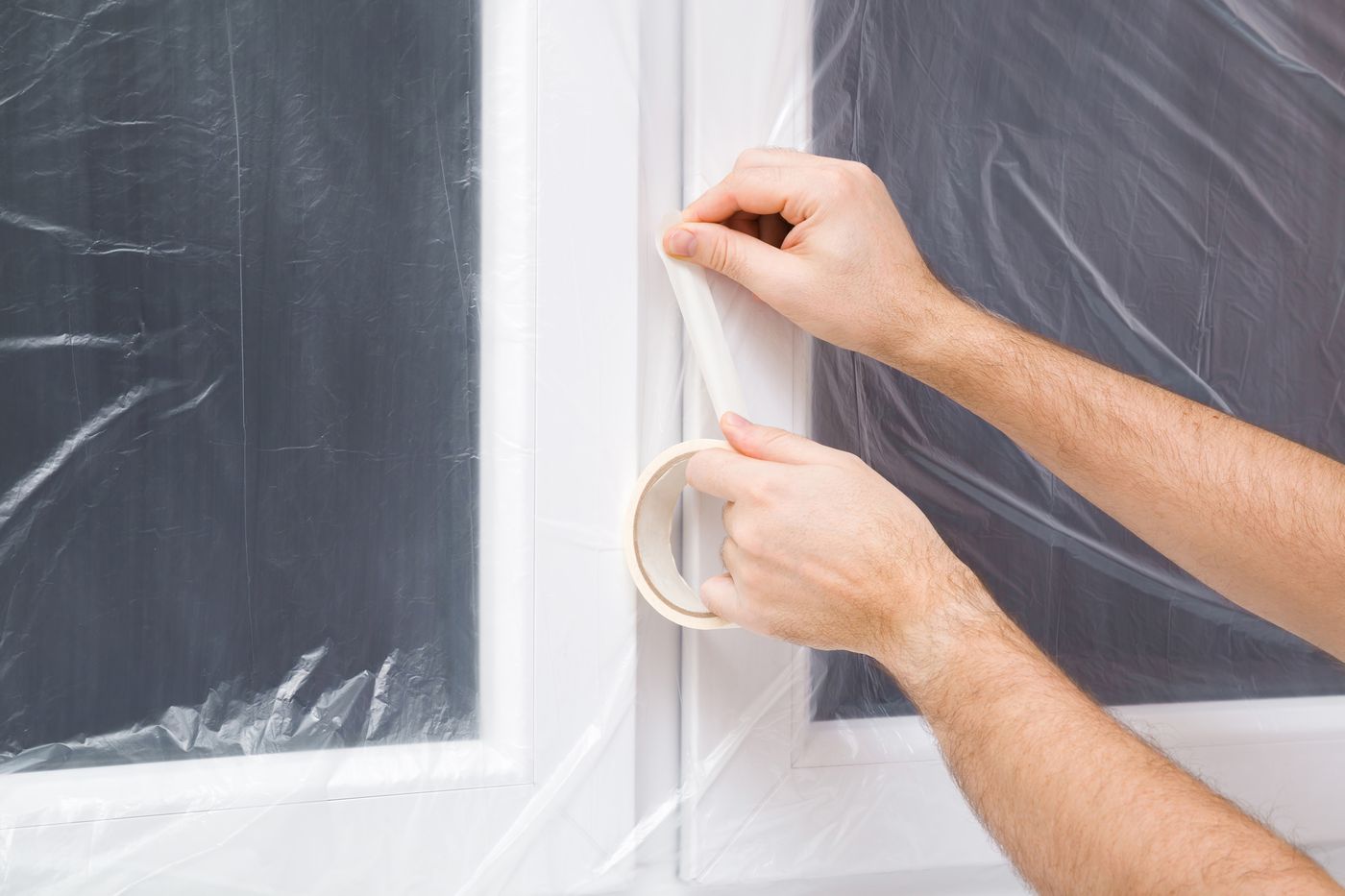
Photo: iStock.
Seal it
- Tape plastic over the windows. Ready.gov says to tape the corners first, then the edges.
- Close the vents and tape over them.
- Tape around the door.
- Seal the gaps the house's own fans and vents leave: window air conditioners, bathroom and kitchen exhaust fans, and stove and dryer vents (CDC, Ready.gov). CDC suggests practicing these at home.
- With no plastic, push towels, sheets or clothes into the vents and under the door (CDC).
If you think gas or vapors have already got in, Ready.gov says to take shallow breaths through a cloth or towel, and not to eat or drink anything that may be contaminated.
How long the air lasts
A sealed room is not airtight, and it is not meant for long stays. FEMA's guidance is to allow about 10 square feet of floor space per person, which it says gives enough air for up to 5 hours for people resting and breathing normally, before carbon dioxide builds up. Applied to a 10-by-12-foot bedroom (120 square feet), that works out to about twelve people. That sum is ours, not FEMA's, and it holds only within FEMA's limits: people resting, and up to 5 hours. It is a floor for air, not a comfortable fit, so a family of four in that room is well inside it. FEMA adds that many chemical releases thin out within a few hours, so officials usually ask people to shelter only until the cloud has passed.
Nothing that burns fuel in a sealed room
A sealed room traps every gas made inside it. Don't run a kerosene heater, camp stove, lantern, candle or anything else that burns fuel in it, and keep generators outdoors and well away from the house. Carbon monoxide can kill without warning; generator safety and staying warm give the rules. In cold weather, sheltering in a sealed room means blankets and layers, not a heater.
If you're caught outside or in a car
- Chemical release: CDC says vehicles may not be airtight enough to protect you; find the nearest shelter and go there, following police and fire officials. If you are in a car for now, Ready.gov says to keep the windows and vents closed and turn off the air conditioner and heater. If you are on foot, move upwind of the source to reach clean air, then get into the nearest building.
- Radiation: CDC says to get into a building right away. Any building is safer than staying outside; brick or concrete, multistory buildings and basements are best. Ready.gov says that after a nuclear detonation you may have 10 minutes or more before fallout arrives, enough to get inside. If you can't get in at once, CDC says to cover your nose and mouth with a mask, cloth or towel.
- Tornado: Ready.gov says there's no safe option in a vehicle, only less dangerous ones. If the tornado is far off and traffic is light, you may be able to drive out of its path at right angles. If you're caught, park out of traffic, stay buckled, keep your head below the windows and cover it; or, if you can get noticeably lower than the road, leave the car and lie there covering your head. Avoid sheltering under bridges.
Coming in from fallout
Radioactive material settles on clothing and skin like dust. CDC and Ready.gov say that if you were outside after it began to fall:
- Take off your outer layer of clothing before you come in, if you can. Ready.gov says this can remove up to 90% of the radioactive material. Do it gently so the dust doesn't shake loose, keep your hands away from your face, and put the clothes in a bag away from people and pets.
- Wash uncovered skin and hair with soap and water, then put on clean clothes. Without a shower, wipe skin and hair that weren't covered with a clean wet cloth, and seal used cloths in a plastic bag away from people and pets. Ready.gov says not to use household cleaning wipes on skin, and that hand sanitizer doesn't protect against radioactive material; see handwashing.
- Pets that were outside: brush them gently, then wash them with soap and water if you have it (Ready.gov, CDC).
Do the same for anyone you let in (CDC).
Food and water during a radiation emergency
Ready.gov says food and drink that were inside the building are safe. Sealed food that was outside is safe once you wipe the container with a damp cloth; seal the used cloth in a plastic bag. Don't eat garden produce or uncovered food or drink from outdoors until officials say it's safe.
Don't go out to collect family
CDC and FEMA are both direct about this: in a radiation emergency, stay where you are. Going out to find family members exposes you and them. Schools, day cares, hospitals and nursing homes have their own emergency plans and will keep children and residents inside. Reunite later. Our view, not the sources': the same reasoning applies to a chemical cloud. Agree on this in advance, so no one in the household is tempted to drive across town in the first hour; it belongs in the household plan.
When to come out
- Wait for the all-clear from police, fire or local officials, and follow their instructions when you go outside (CDC, Ready.gov).
- Leave earlier only for an immediate danger inside: Ready.gov's radiation guidance names fire, a gas leak, a collapsing building or a serious injury.
What to have ready
CDC's chemical-emergency plan asks for two go kits for each person, one at home and one in the vehicle, and two for each pet, plus a sealing kit. Ready.gov says to bring your emergency kit into the shelter room. Most of it is the 72-hour kit you should already have.
Shelter-in-place kit
- Water and food for at least three days: see how to store water
- Medicines for everyone, including pets
- A battery or hand-crank radio, a charged phone, chargers and a power bank
- Flashlights and spare batteries
- A first aid kit: see first aid kit
- Sealing kit: 2–4 mil plastic sheeting cut and labeled for the room's windows, duct tape, scissors, towels
- Large and small trash bags and several pairs of disposable gloves (CDC)
- Soap, hand sanitizer and a bucket toilet setup for a long stay: see emergency toilets
- Blankets and warm clothes, since the heating will be off
- Pet supplies: food, water, leash or carrier, and anything to block hiding spots (CDC); see pets in an emergency
- A written list of the room for each danger, posted where everyone can see it
Plan it once, before you need it
- Find out which dangers apply where you live, and plan for those first. Household risk assessment walks through it.
- Choose the room for each danger and write it down. In many houses the tornado room and the radiation room are the same: the basement or an interior room on the lowest floor. The chemical room is often different: upstairs, with water.
- Measure the chemical room and check it against FEMA's 10 square feet a person.
- Cut and label the plastic, then practice sealing it once (CDC).
- Agree who calls whom. CDC says to tell a friend or relative outside the area where you are, and to be ready to use text or social media if calls don't go through.
What not to do
- Don't shelter in a car during a chemical release, radiation emergency or tornado if a building is within reach (CDC, FEMA, Ready.gov).
- Don't leave the shelter to pick up children from school or day care (CDC, FEMA).
- Don't climb into a closed attic to escape floodwater (Ready.gov).
- Don't spend the first minutes taping up a room for a tornado or radiation. The sources call for sealing only in a chemical emergency; for the other two, the right room is what protects you.
- Don't run fuel-burning heaters, stoves or generators inside, and least of all in a sealed room.
- Don't come out before the all-clear unless the building itself becomes dangerous (CDC, Ready.gov).
- Don't stay put if you're told to evacuate (Ready.gov).
If officials call for evacuation instead, Ready.gov says you can find open public shelters by texting SHELTER and your ZIP code to 43362.
Sources
- Ready.gov — Shelter
- Ready.gov — Chemicals and Hazardous Materials Incidents
- CDC — What to Do to Shelter in Place for a Chemical Emergency
- FEMA — How long can I remain in a shelter-in-place room? (FAQ)
- CDC — What to Do: Get Inside (radiation emergencies)
- CDC — Where to Go in a Radiation Emergency (2014)
- FEMA — Shelter-in-Place Guidance for Nuclear/Radiological (2021)
- Ready.gov — Radiation Emergencies
- Ready.gov — Tornadoes
- Ready.gov — Hurricanes