Chapter 6 · Power & Light
Generator safety and carbon monoxide
Nearly every generator death is preventable, and the federal records show exactly how they happen: a generator inside, in the garage or by an open window, and no working alarm. Here is what the data says, and the setup that avoids every one of those mistakes.
Read first: Generator size
A portable generator is the most useful machine most households own for a long outage, and the one most likely to kill someone in the house. The danger is almost entirely carbon monoxide (CO), and the deaths follow a pattern so regular that the federal records read like a list of instructions in reverse.
This article goes through what those records show, how far from the house a generator really needs to be, the alarms that catch what your senses can't, and the electrical and fire hazards that come with the machine. How big a generator you need is in what size generator do you need; how to connect one to house circuits safely is in transfer switches and interlock kits.
Carbon monoxide from a generator can kill in minutes
- Never run a generator inside a home, garage, basement, crawlspace, shed or on a porch, even with doors and windows open or fans running (CPSC). ATSDR adds carports to the list.
- Outdoors only, at least 20 feet from the house, with the exhaust pointed away from your home and any building someone could be in (CPSC).
- Battery or battery-backup CO alarms on every level and outside sleeping areas (CPSC).
- If you feel dizzy, sick or weak, or an alarm sounds, get outside into fresh air at once, then call 911 (CPSC).
Why a generator is so dangerous
Every engine that burns fuel makes carbon monoxide, a gas with no color and no smell. A small generator makes a great deal of it. The CPSC says one portable generator can produce as much CO as hundreds of cars. In a closed space that builds to deadly levels within minutes, and the CPSC warns that the gas can hang in a room for hours after the engine has stopped.
CO is dangerous because the body takes it up in place of oxygen. The CPSC's fatality report notes that above about 40 percent carboxyhemoglobin (the share of the blood's hemoglobin carrying CO instead of oxygen), death becomes possible even in a healthy adult; in the deaths it studied where the level was known, 83 percent had levels of 50 percent or more.
You cannot rely on noticing it. The CDC says people who are asleep, or who have been drinking, can die before they have any symptoms. Infants, older adults and people with heart disease, anemia or breathing problems are more easily harmed.
How many people it kills
The agencies' yearly figures differ, because they count different years and different products. All of them agree it is a leading cause of CO death.
| Figure | Source |
|---|---|
| Nearly 80 deaths a year from generator CO | CPSC news release, February 2022 |
| More than 80 deaths a year | CPSC handout, 2022 |
| About 100 deaths a year | CPSC winter safety release, December 2025 |
| More than 100 of the 200-plus yearly consumer-product CO deaths involve portable generators | CPSC Carbon Monoxide Information Center |
| More than 400 deaths, 100,000 emergency visits and 14,000 hospital stays a year from all non-fire CO sources | CDC |
The CPSC also reports that Black Americans are about 12 percent of the U.S. population but 22 percent of generator CO deaths.
What the death records show
The CPSC investigates generator CO deaths in depth. Its report covering 2010 through 2020 counted 711 deaths from generators alone, and its findings are the best guide to what not to do.
Where the generator was. Of 553 generator deaths in fixed homes (houses, apartments, mobile homes and attached garages):
| Where the generator was running | Deaths | Share |
|---|---|---|
| Inside the home: living area, basement or crawlspace, closet or utility room, or unspecified | 392 | 71% |
| Attached garage, enclosed carport or attached barn | 103 | 19% |
| Outside, but near an open window, door or vent, or in a shared building hallway | 21 | about 4% |
| Unknown location at the home | 25 | about 5% |
The report's location rows add up to 541, twelve fewer than its stated total of 553, and the report does not explain the gap; the shares above are the CPSC's own, worked out of 553. Within the "inside" group, 203 deaths were in the living space itself and 119 in a basement or crawlspace. Where the report had the information, 68 percent of the home deaths involved no attempt at all to vent the exhaust. Most of the homes were under 1,500 square feet. Almost all the generators with a known fuel ran on gasoline.
Why the generator was running. Across all generator deaths, power outages, mostly from weather or problems with power distribution, accounted for 134, a utility shutting off power (for nonpayment, a dispute or another reason) for 146, and powering sheds, trailers, boats, campers, cabins and campsites for 126. The weather outages were mostly ice and snow storms and hurricanes or tropical storms. Forty-four percent of the CO deaths from engine-driven tools of all kinds happened in the four colder months, November through February.
Whether there was an alarm. For most deaths the report could not say whether an alarm was present. Of the 237 deaths from engine-driven tools where it could, only 36 (15 percent) had a CO alarm present. In 20 of those 36 deaths the alarm didn't work: no batteries, batteries put in wrong or run down, or no power to a plug-in unit. In 12 more, the alarm sounded but was misunderstood or switched off, or it sounded inside the house while the person died in the attached garage.
Read together, the lesson is simple: almost all of these people had the generator inside or attached to the house, and most had no working alarm (see Fig. 6-1).
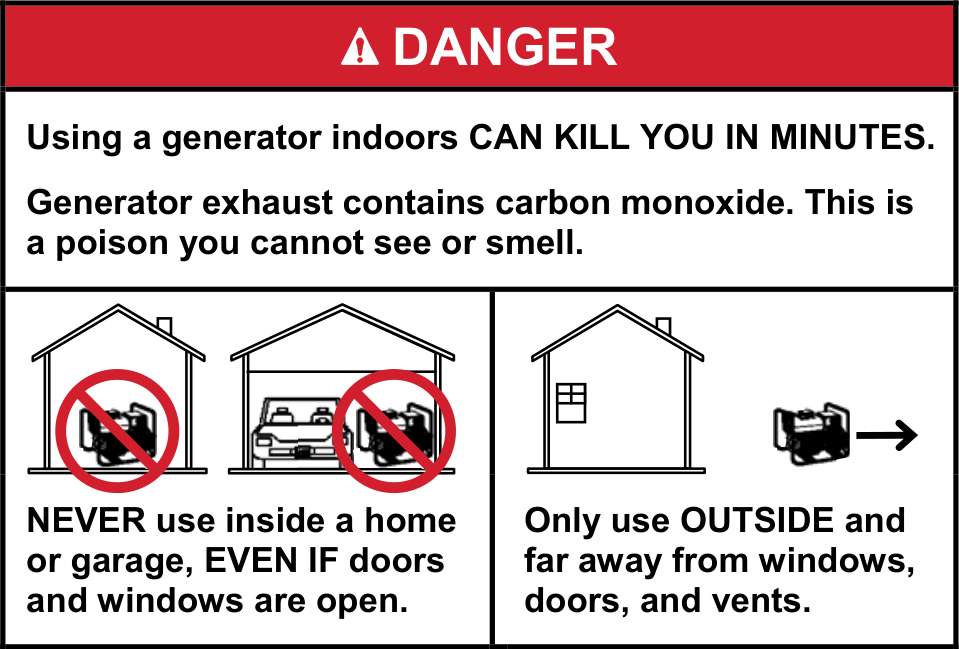
From U.S. Consumer Product Safety Commission, What to Know About Generators and Carbon Monoxide (2022), p. 1. Public domain; cropped. Not endorsed by CPSC.
How far away is far enough
The standard advice is at least 20 feet from the house. Sources phrase it slightly differently:
- CPSC: outdoors only, at least 20 feet from the house, exhaust pointed away from the home and other buildings.
- CDC: at least 20 feet from any doors, windows or vents. CDC's 2012 handout says more than 20 feet from your home, doors and windows.
- Ready.gov: at least 20 feet from windows, doors and attached garages.
Distance is not the only thing that matters. Two studies show why:
- Close outside still kills. NIST's report for the CDC notes that up to half of the nonfatal generator CO poisonings in the 2004 and 2005 hurricane seasons involved a generator outdoors but within seven feet of the home. After Hurricane Katrina, the CDC's review of 51 poisonings found generators had been run under a deck (28.6 percent of cases with a known location), near a window (26.2 percent), and in sheds, garages, carports and basements.
- Wind and exhaust direction matter. NIST's computer modeling of a two-story house found a generator had to be more than 15 feet away to avoid high indoor CO, and 30 feet, the next distance modeled, generally kept it low. Pointing the exhaust away from the house cut the highest indoor CO to 3 percent of what it was with the exhaust pointed at the house. But in one case, a wind of 5 meters per second (about 11 mph) pushed the exhaust plume down against the house without thinning it, and indoor CO stayed high even at the longer distance. NIST says its results apply to the houses and weather it modeled, not to every situation.
So treat 20 feet as a minimum, not a target. Farther is better where your cords and yard allow it.
Placing the generator
- Outdoors, at least 20 feet from the house, farther if you can
- Exhaust pointed away from the house and from neighbors' homes
- Not on a porch, under a deck, in a carport, or in a shed or garage, even with the door open
- Not near windows, doors, vents or an air-conditioner intake; CPSC suggests closing windows near the generator and sealing vent openings in the exhaust path
- 3 to 4 feet of clear space on all sides and above it (OSHA)
- On a dry surface where water can't pool or run underneath (CPSC)
- In an apartment or townhouse: never in a shared hallway or any other space inside the building; the CPSC records include deaths from a generator run in an apartment building's hallway
Carbon monoxide alarms
A CO alarm is the only thing that can warn a sleeping household. The CPSC's guidance:
- Install battery-operated CO alarms, or plug-in alarms with battery backup, on every level of the home and outside sleeping areas (see Fig. 6-2). A plug-in alarm without a battery is useless in an outage.
- Interconnected alarms are best: when one sounds, all of them sound.
- Choose alarms certified to UL 2034, IAS 6-96 or CSA 6.19.01.
- Test them monthly.
- Never ignore or disarm one. If it sounds, get everyone outside, then call 911.
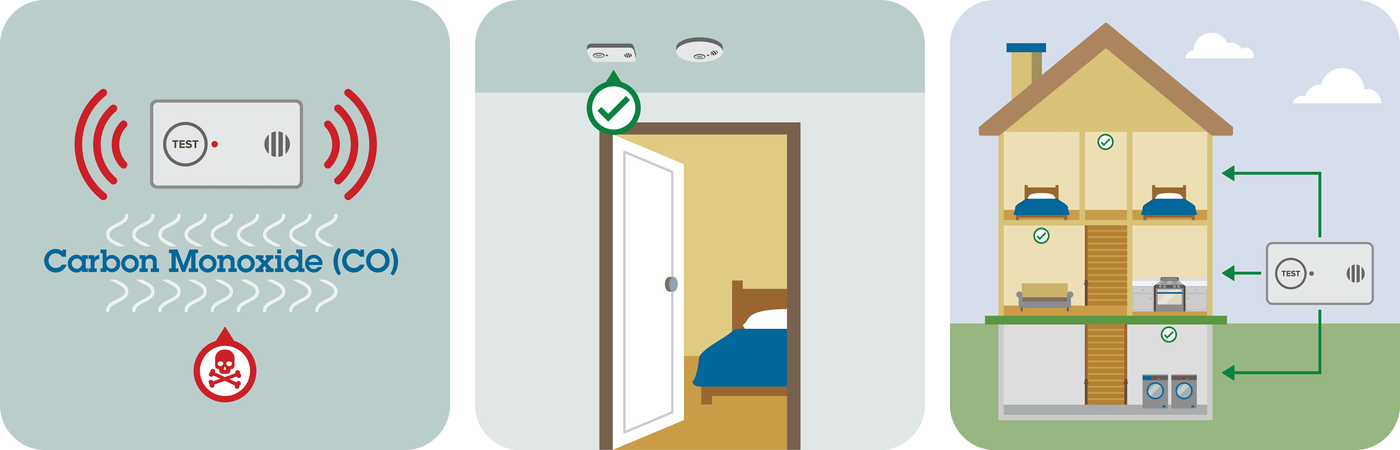
- The alarm sounds when carbon monoxide builds up; the gas itself can't be seen or smelled.
- Outside each sleeping area.
- On every level, including the basement.
From U.S. Fire Administration pictograph 29 (copyright-free). Not endorsed by FEMA or USFA.
Ready.gov adds that alarms should be in central locations on every level. An alarm only warns the people who can hear it: some of the deaths in the CPSC report happened in an attached garage while the alarm sounded inside the house, so nobody should be in the garage with a running engine at all.
Alarms before an outage
- At least one CO alarm on every level and outside each sleeping area
- Each runs on batteries or has battery backup
- Fresh batteries in, and a spare set in the kit
- Certification mark (UL 2034, IAS 6-96 or CSA 6.19.01) on each unit
- Tested this month; date written on the back
- Everyone in the house knows the sound, and that it means "get out, then call 911"
Knowing the symptoms, and what to do
The CDC lists headache, dizziness, weakness, upset stomach, vomiting, chest pain and confusion; the CPSC adds sleepiness. The CDC describes them as flu-like, and the Katrina review found many people mistook their poisoning for the flu. During an outage, if several people in the house, or the pets, feel ill at once while a generator or other fuel-burning device is running, assume CO.
- Get everyone outside into fresh air right away. Don't stop to find the source.
- Call 911 from outside.
- Don't go back in. OSHA's guidance is to stay out until trained, properly equipped responders say it is safe.
If someone is unresponsive or not breathing normally, start CPR while help is on the way; the first five minutes covers what to do first in any emergency.
Generators that shut themselves off
Since 2018 the two U.S. voluntary standards for portable generators, UL 2201 and ANSI/PGMA G300, have required a generator to shut off when CO builds up around it. UL 2201 also requires the engine to emit less CO in the first place.
CPSC staff modeled 511 real generator deaths and estimated that generators meeting UL 2201 would have averted nearly all of them, and generators meeting G300 nearly 87 percent. The CPSC found few generators on the market met UL 2201, though G300 conformance was more common. Makers' own pages are clear that the feature is a backup: Champion's description of its CO Shield system, on a unit it says meets G300, states it is not a substitute for an indoor CO alarm or for safe operation.
When you buy, the CPSC suggests looking for a CO shut-off feature and, if possible, reduced emissions, and checking the packaging for the standard it meets. Then place it exactly as if it had no such feature.
Electricity: shock, rain and cords
OSHA points out that generator power is as dangerous as utility power, with extra risk because people often bypass the circuit breakers built into a house's wiring.
Rain and snow. The CPSC says the shock risk is highest in wet conditions. Run the generator under an open, canopy-like cover on a dry surface where water cannot reach or drain under it, and dry your hands before touching it. Never move it indoors or close to the house to keep it dry. The CPSC's 2025 winter guidance adds two options: follow the maker's instructions, which may mean a non-combustible generator tent rated to NFPA standards, or wait for the rain or snow to pass. Ready.gov warns that touching a wet generator, or something plugged into it, can cause a shock. OSHA says not to touch a generator's electrical parts while you are wet or standing in water.
Cords.
- Plug appliances straight into the generator, or use heavy-duty extension cords made for outdoor use (CPSC), grounded with three prongs (OSHA).
- Each cord must be rated for more watts than everything plugged into it (CPSC). OSHA says to replace underrated cords with heavier-gauge ones and not to overload the generator, which can overheat it and start a fire.
- Check the whole length for cuts and tears before use (CPSC). Don't let it be pinched in a window or door.
- Use GFCI protection, built into the generator or the cord, around wet or damp areas (OSHA).
- Ground the generator as its manual directs (OSHA).
Flood-soaked equipment. OSHA says not to use electrical equipment that has been under water until it is thoroughly dried and checked, and to shut off anything that smells strange or starts smoking. See floods for the rest of the after-flood hazards.
Never plug a generator into a wall outlet
Plugging a generator into the house wiring through an outlet, called backfeeding, can electrocute utility workers and neighbors on the same transformer, and it bypasses the home's circuit protection (CPSC). The only safe way to feed house circuits is a transfer switch or interlock installed by a licensed electrician; see transfer switches and interlock kits.
Fire, burns and refueling
OSHA notes that a generator gets hot while running and stays hot for a long time after it stops, and that gasoline or kerosene spilled on hot engine parts can ignite.
- Turn it off and let it cool before refueling (CPSC, OSHA, Ready.gov). Plan your refueling for when you can spare the downtime, not in the dark with the engine hot.
- Refuel outdoors, where the generator stands; Ready.gov says fuel, like the generator, belongs outdoors and at least 20 feet from windows, doors and attached garages. OSHA warns that vapor from spilled fuel can travel a long way to a flame or spark, so keep smoking and open flames well away.
- Keep fuel out of the house, in labeled, non-glass safety containers, and away from fuel-burning appliances such as a gas water heater in a garage (CPSC).
How much fuel to keep, which containers are legal and how to keep gasoline from going stale are in fuel storage. If someone is burned, see burns.
Noise and neighbors
OSHA warns that generator noise and vibration can cause hearing loss and fatigue; keep the generator as far as practical from where people gather, and wear hearing protection if you have to work near it. Remember that your exhaust can reach the house next door as easily as your own: point it away from neighbors' windows too. The CPSC's 2022 handout asks everyone to check on neighbors during long outages, and a knock on the door of someone running a generator in a garage may save a life.
What not to do
- Don't run a generator in the house, garage, basement, crawlspace, shed, carport or on a porch, however briefly, with any number of doors open.
- Don't run it under a deck or beneath a window "just for tonight."
- Don't use a plug-in CO alarm with no battery backup during an outage.
- Don't silence or unplug an alarm because you think it is a false alarm.
- Don't refuel a running or hot generator.
- Don't backfeed through a wall outlet.
- Don't run a cord through a window you then can't close.
- Don't let a CO shut-off feature talk you into putting the generator closer.
A routine for every outage
Each time you start the generator
- Alarms: batteries in and tested
- Generator set out at least 20 feet from the house, exhaust pointed away from all homes
- Windows and vents on that side of the house closed
- Dry surface, open canopy if wet; hands dry
- Cords inspected, rated for the load, routed so doors and windows still close
- Loads brought on one at a time, within the generator's rating (see generator size)
- Fuel and funnel staged outside, away from the engine
- Everyone knows: any alarm, headache or dizziness means everyone outside, then 911
If a generator isn't practical, a battery power station or a small solar setup makes no exhaust and can run small loads indoors. And because the same CO danger applies to grills, camp stoves and heaters, see cooking without power, staying warm and home fire safety before an outage, along with the timeline in power outages.
Sources
- CPSC — Portable Generator Hazards (Safety Alert, Publication 5123)
- CPSC — What to Know About Generators and Carbon Monoxide (2022)
- CPSC — Fatal Incidents Associated with Non-Fire Carbon Monoxide Poisoning from Engine-Driven Generators and Other Engine-Driven Tools, 2010–2020 (June 2021)
- CPSC — New report finds voluntary standards can reduce CO risk from portable generators (February 23, 2022)
- CPSC — Winter storm safety tips to prevent carbon monoxide poisoning and fires (December 12, 2025)
- CPSC — Carbon Monoxide Information Center
- CDC — Carbon Monoxide Poisoning Basics
- CDC — Use a Generator Safely
- CDC — When the power goes out, keep your generator outside (2012)
- ATSDR/CDC — Proper use of generators in the home (2006)
- CDC MMWR — Carbon Monoxide Poisoning After Hurricane Katrina (2005)
- NIST Technical Note 1666 — Modeling the Effects of Outdoor Gasoline Powered Generator Use on Indoor Carbon Monoxide Exposures, Phase II (July 2010, hosted by CDC)
- OSHA — Using Portable Generators Safely (Fact Sheet FS-3286)
- Ready.gov — Power Outages
- Champion Power Equipment — 4500W Dual Fuel Open Frame Inverter (model 201321), CO Shield description