Chapter 15 · People
Pets in an emergency: kit, records, evacuation and shelters
If you have to leave, your pets leave with you. That takes a plan made in advance, because many shelters and hotels won't take them. Here is the kit, the paperwork, where animals can stay, and how to bring them through the days after.
Read first: Household plan
Every federal source on this subject opens with the same instruction: if you evacuate, take your pets. Ready.gov warns that pets left behind may end up lost, injured or worse. The CDC adds that this is likely even when you try to set up a safe spot for them at home, and that leaving pets out of the plan endangers first responders too.
That instruction is harder than it sounds, for one reason: many emergency shelters don't accept pets. Ready.gov says many public shelters and hotels turn them away. The CDC names Red Cross evacuation centers among the places that don't accept pets, and says local shelters may bar pets unless they are service animals. So the work of this page happens before the disaster: a kit for each animal, records that prove the animal is yours, and a place to go that will take you both.
Why the plan matters to everyone
The federal government treats pets as part of evacuation planning for a practical reason. FEMA explains that Congress passed the Pets Evacuation and Transportation Standards (PETS) Act in 2006 after disasters in which owners refused to evacuate because they couldn't be sure their animals would be cared for. That put the owners, the responders sent to reach them and the animals at risk. The law requires state and local planners to plan for household pets and service animals in evacuations and mass shelters, including veterinary care.
What that means for you: your county or city should have some plan for pets, but it may house animals apart from people, and it may not cover every kind of animal. FEMA tells planners to decide whether their area can shelter owners and pets together or must house them separately. Ask your local emergency management office what its plan is before you need it; the CDC suggests asking whether it offers accommodations for owners with pets, and Ready.gov points to the same office, or the local animal shelter or animal control, for advice.
The plan, step by step
The AVMA, Ready.gov and the CDC give overlapping steps. In order:
- Choose where you'll go. Pre-arrange a place outside the likely disaster area (AVMA): friends or relatives out of town, a boarding facility or animal hospital near where you'd evacuate, or a pet-friendly hotel along your evacuation route (CDC). The CDC lists hotel-finder websites on its page. Add the address to your household plan.
- Set up a buddy. Arrange for a neighbor, friend or relative to check on your animals and evacuate them if a disaster hits while you're away (Ready.gov, CDC). The AVMA suggests handing that person a letter, signed by you, that says they aren't liable if an animal gets hurt while they're evacuating it, and that says where the kit is kept.
- Plan the ride. Have a carrier, crate or harness for each animal, and pet seat belts if you use them (CDC). If you don't have a vehicle, arrange a ride ahead of time or ask your local government about transport (CDC).
- Practice. Get pets used to their carriers and to car rides. Learn where each pet hides when frightened and practice catching it. Rehearse the evacuation with the whole household (CDC, AVMA).
- Bring pets inside early. At the first sign or warning of a storm or other disaster, bring every animal indoors, so all of them are accounted for if you have to leave (Ready.gov, AVMA).
- Keep the kit by the door. The AVMA's advice is a waterproof container you can carry easily, kept near an exit so that rescuers or a neighbor can find it too.
The kit
Ready.gov suggests two kits: a larger one for staying home and a lighter one to take if you evacuate. Here is what goes in, combined from the CDC, AVMA and Ready.gov lists.
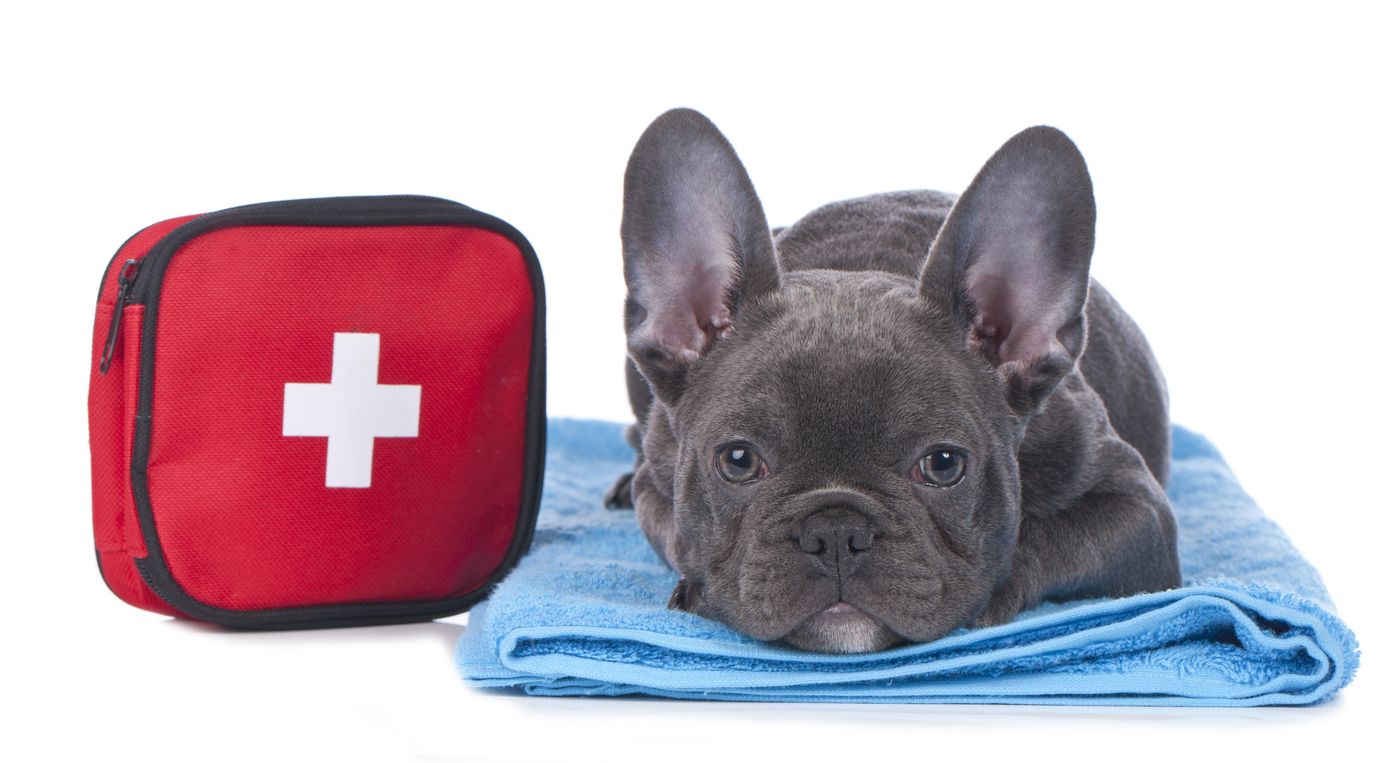
Photo: iStock.
How much food, water and medicine
The sources don't agree on amounts, so all three are given:
| Ready.gov | CDC | AVMA | |
|---|---|---|---|
| Food | Several days, in an airtight, waterproof container | Two weeks per animal, in waterproof containers | 3 to 7 days |
| Water | Several days | Two weeks per animal | At least 7 days |
| Medicine | An extra supply, in a waterproof container | Two weeks, with written instructions | Two weeks |
| Parasite prevention | Not stated | One month of flea, tick and heartworm preventive | Flea and tick prevention, in the first aid kit |
Which to follow? Two weeks is the CDC's figure and the most generous; it matches the two-week stage of household preparedness. The lighter evacuation kit can carry less if your destination can resupply you. The AVMA reminds owners that food and medicine must be rotated and replaced so they don't expire; add them to your rotation calendar. None of the three sources gives a daily water amount per animal, so ask your veterinarian how much your pet drinks and store accordingly.
Pet emergency kit
- Food for each animal, in waterproof containers, and a manual can opener for canned food
- Water, and spill-resistant or collapsible food and water bowls
- Written feeding instructions for each animal
- Medications, with written dosing instructions, in a waterproof container
- Flea, tick and heartworm preventive
- Collar with an ID tag, harness and leash, plus spares of each
- Crate or carrier for each pet, labeled with your name and phone numbers, with bedding, a blanket or a towel
- Litter, litter box and scoop for cats; waste bags for dogs
- Newspaper, paper towels, trash bags, liquid dish soap, and household chlorine bleach or another disinfectant
- Pet first aid kit and a pet first aid book; ask your veterinarian what to include
- Muzzle (AVMA), flashlight and spare batteries
- Grooming supplies
- Favorite toys, treats and familiar bedding to reduce stress
- The records pouch below
On the bleach: Ready.gov lists household chlorine bleach for the pet kit's sanitation needs, and the CDC and AVMA list a disinfectant. That bottle is for cleaning. Bleach for drinking water has stricter requirements; how to purify water sets out which bleach is suitable and how fresh it must be.
Records and identification
Records do two jobs: they let someone else care for your animal, and they prove it's yours if you're separated. Keep them in a waterproof container in the kit, with digital copies stored alongside your household's important documents (Ready.gov).
Pet records pouch
- Rabies certificate and vaccination history
- Medical summary and copies of prescriptions
- For dogs, the most recent heartworm test; for cats, the most recent FeLV/FIV test
- Registration, adoption or other proof of ownership
- A written description of each pet: breed, sex, color and weight
- Recent photos of each pet, and one of you with your pet
- Microchip number, and the chip company's name and phone number
- Your contact information, and addresses and phone numbers of people you might stay with
- Your veterinarian's details, and a veterinarian near where you'd evacuate
- A signed veterinary treatment authorization, so a vet can treat your pet in your absence (AVMA)
Sources: the CDC kit checklist, with additions from Ready.gov, the AVMA and the FTC.
The photo of you with the pet is there because, as Ready.gov notes, it documents that the animal is yours and lets others help you identify it if you're separated.
Microchips and tags
- Microchip each pet, and keep the registered address and phone number current with the chip company (Ready.gov, CDC). The chip only helps if the company can reach you through it.
- List an emergency contact who lives outside your area on the registration (Ready.gov). If your own phone is dead or your home is gone, the chip company can still reach someone.
- Collar and current tag on every pet, every day (Ready.gov, CDC).
The emergency contact list
The AVMA suggests a written list kept in the kit, because you and any rescuers may need it. It includes: numbers where you can be reached; the location of your evacuation site; a local and an out-of-state emergency contact; your veterinarian; an alternate veterinarian 30 to 90 miles away that offers boarding; local boarding and one 30 to 90 miles away; pet-friendly hotels within 90 miles; animal control; police and fire departments; the public health department; the local Red Cross chapter; the local animal shelter, humane society or SPCA; and lost-and-found pet websites. The AVMA also suggests that, if you use the Medical ID feature on your phone, one of the contacts listed there knows your pet plan.
At an evacuation center
If you go to a shelter that accepts animals, expect rules. The CDC describes what to be ready for:
- Proof of rabies vaccination for dogs, cats and ferrets on arrival. This is the single most important paper in the pouch.
- Cages or leashes. Pets are generally kept caged or leashed for everyone's safety. Birds are best housed apart from the general population.
- Parasite treatment. Dogs and cats should be treated for intestinal parasites, especially those under 6 months old, and kept on their usual flea and tick medicine.
- Hygiene. Wash hands after handling pets, their food or their waste. Keep pets out of food areas. Walk dogs on a leash in the designated area and clean up after them. Clean litter boxes at least once every 24 hours. Don't share food with pets or let them lick your face.
- Who shouldn't handle what. Children under 5 shouldn't handle reptiles, amphibians or poultry. Pregnant women should avoid litter boxes where possible and shouldn't handle pet rodents. Keep furred and feathered pets away from people with allergies or asthma triggered by them.
Bites and scratches
Stressed animals bite and scratch, even ones that are normally gentle. The CDC says to wash any bite or scratch right away with soap and water and see a healthcare provider. A bite from a dog, cat or ferret needs a doctor right away to decide whether rabies shots are needed, and the CDC says to report every bite wound to medical staff immediately. For cleaning and dressing a wound, see wounds.
Service animals
Service animals are handled differently from pets. The CDC says local shelters may not allow pets unless they are service animals. Under the Americans with Disabilities Act, the Justice Department defines a service animal as a dog individually trained to do work or perform tasks for a person with a disability. Emotional support animals that comfort by their presence alone are not service animals under the ADA, though some state and local laws give them access.
Where a dog's role isn't obvious, staff may ask only two questions: whether the dog is required because of a disability, and what task it has been trained to perform. They can't demand documentation, a demonstration or details of the disability. A service animal can be excluded only if it is out of control and the handler doesn't correct it, isn't housebroken, poses a direct threat based on its actual behavior, or its presence would fundamentally change the service; even then the person must still be served without the animal. Service animals must still meet local vaccination and licensing rules, so carry the rabies certificate anyway (ADA.gov).
Sheltering at home
When officials say to stay inside rather than leave (see shelter in place), the CDC suggests:
- Choose an interior room with few or no windows that is safe for pets.
- Remove toxic chemicals and plants from it.
- Block small spaces where a frightened cat could get stuck.
- Bring the kit into the room with you.
The CDC says never to leave pets chained outdoors.
After the disaster
The days after can be as dangerous for animals as the event itself. The CDC and AVMA give the same core advice:
- Check the house and yard first. Look for sharp objects, spilled chemicals, exposed wiring, downed power lines, contaminated water and wildlife, including snakes after flooding, before letting pets in or out (CDC, AVMA).
- Keep pets leashed or carried outside. Familiar scents and landmarks may have changed, and pets get confused and lost (CDC, AVMA). The AVMA says to let cats, dogs and other small animals loose indoors only, and to release birds and reptiles only when calm and in a closed room.
- Keep them out of floodwater and standing water. The CDC names leptospirosis, a bacterial infection spread through contaminated urine, water, soil or food, which can damage the kidneys. Don't let pets drink or play in contaminated water. See floods for the hazards to people.
- Feed gradually. If animals have gone without food for a long time, the AVMA says to start with small servings and work up to full portions.
- Expect behavior changes. Pets that are normally calm may be irritable after storms or floods (CDC). Let them rest, and get back to a normal routine as soon as you can; the AVMA calls disrupted routine the biggest cause of stress for pets.
- Call your veterinarian if a pet shows injury, stress, discomfort or illness (CDC, AVMA). Keep pets away from wildlife and strays, which the CDC links to rabies and to diseases carried by fleas, ticks and mosquitoes, and ask your veterinarian about regular flea, tick and parasite prevention (CDC).
Pet first aid
The CDC and AVMA both say first aid is not a substitute for veterinary care, but it may save a pet's life until it gets there. An injured animal may bite even if it never has before. The CDC's advice: don't hug it, keep your face away from its mouth, move slowly, stop if it becomes more agitated, and get to a veterinarian as soon as it's safe. The CDC points owners to the AVMA's first aid guidance, which covers poisoning, seizures, fractures, bleeding, burns, choking, heatstroke and breathing emergencies.
If a pet is lost
- Make sure your family is safe before you search (CDC).
- Go to animal control and animal shelters in person, every day. The AVMA stresses physically checking, daily.
- Report the pet missing to the microchip company and confirm your contact details are current (CDC, AVMA).
- Give missing-pet flyers to shelter staff and post waterproof notices once it's safe (CDC, AVMA). The CDC offers a flyer template.
- Tell local humane societies, animal welfare groups, county or state animal response teams, animal control, veterinarians, law enforcement and your neighbors (CDC, AVMA).
- Check lost-and-found pet sites and social media; some emergency agencies post found animals there (AVMA).
Livestock and horses
Large animals need a longer lead time, because they need trailers and handlers. Ready.gov's guidance for horses, goats, pigs and other livestock:
- Give every animal some form of identification.
- Evacuate early when you can, and map a primary and a secondary route in advance.
- Line up vehicles and trailers suited to each kind of animal, with experienced handlers and drivers.
- Confirm that your destination has food, water, veterinary care and handling equipment.
- If evacuation isn't possible, decide in advance whether the animals are safer moved into a barn or turned loose outside.
The AVMA publishes separate disaster guidance for horses and livestock on small farms, and emergency contact cards for livestock.
Before the season starts
- A place to go that accepts your pets, and a backup
- A buddy who has a key, the kit's location and a signed letter
- Kit packed by the door, with food and medicine dated for rotation
- Rabies certificate and records in a waterproof pouch, with digital copies
- Microchip registration checked, with an out-of-area contact
- Carriers labeled; pets practiced in them
- Your local emergency management office's pet sheltering plan, asked about and written down
The rest of your household's evacuation kit is in the 72-hour kit; for storm timing, see hurricanes.
Sources
- Ready.gov — Prepare Your Pets for Disasters (updated March 20, 2026)
- CDC — Pet Disaster Preparedness and Recovery (April 9, 2024)
- CDC — Pet Disaster Preparedness Kit (April 9, 2024)
- CDC — Pets in Evacuation Centers (January 30, 2025)
- American Veterinary Medical Association — Pets and disasters
- FEMA — Key Planning Factors: Service Animals and Household Pets
- U.S. Department of Justice ADA.gov — Frequently Asked Questions about Service Animals and the ADA
- FTC — How To Organize Your Important Papers Before a Disaster Strikes (November 2023)