Chapter 5 · Sanitation & Hygiene
Emergency toilets: what to do when the toilet can't be flushed
When the toilet can't be flushed, waste that isn't contained soon becomes a health problem. Here is how to tell when not to flush, the two simple toilets that replace it, and how to handle the waste safely.
Read first: The 72-hour kit
When the water is off or the sewer is broken, most people's first thought is drinking water. The toilet comes a close second, usually within hours. Waste that isn't contained spreads the germs that cause diarrheal disease, and the Army's field hygiene manual, FM 21-10, notes that poor sanitation has historically led to epidemics of diarrheal disease that put many soldiers out of action. At home the stakes are the same, only smaller in number: one sick child in a house without running water is hard work.
The good news is that a safe emergency toilet costs very little: a bucket or two, strong bags, something dry to cover the waste, and a plan for where it goes. Ready.gov's basic kit already includes moist towelettes, garbage bags and plastic ties "for personal sanitation", and FEMA's CERT training manual adds a plastic bucket with a tight lid, household chlorine bleach and disinfectant to its supply list. This page turns those items into a working toilet.
When not to flush
There are two different situations, and they call for different responses.
The water is off, but the sewer works. This happens when a water main breaks or a well pump has no power. In a long outage, water for flushing competes with water for drinking; see water at home for what is in the house already.
The sewer may be damaged. This is the dangerous case, because flushing sends waste into pipes that may not carry it away.
- North Carolina's health department says heavy rain and severe flooding can damage sewer systems, and that if your toilet won't flush, you have no water, or the sewage system isn't working, you need another way to go.
- After a large earthquake, WREMO, the Wellington, New Zealand, emergency management office, says don't flush, even if water still runs, because the wastewater pipes are likely broken. It tells households to plan on managing their own waste for at least 30 days.
- Septic systems: WREMO says a septic tank can still be used if it is confirmed to be working and its drainage field is undamaged. Washington County, Oregon, advises checking a septic system after an earthquake and finding where yours is before a disaster.
Listen to your utility and local officials. If you aren't sure the sewer is sound, don't flush.
Human waste spreads disease
Untreated human waste carries the germs that cause diarrheal illness, and it can contaminate water and food. Keep emergency toilets and stored waste away from food preparation and drinking water (WREMO, Washington County), and keep stored waste away from children and animals and safe from pets, flies and rats (Washington County). Wash or sanitize hands after every use. CDC says to clean and disinfect toilets and surfaces soiled with feces, using 1 part household bleach to 9 parts water. Anyone with vomiting or diarrhea should have a separate bucket (WREMO); watch them for dehydration and get medical help if it doesn't settle.
Option 1: a bag in the toilet or a bucket
This is the simplest emergency toilet and the one most U.S. guidance starts with. North Carolina's health department gives these steps:
- Shut off the toilet's water valve and flush to empty the bowl. It should not refill, so the bag sits in a dry bowl.
- Line the bowl with a plastic bag set inside a second kitchen garbage bag. Two bags protect against a tear.
- Add something absorbent if you have it, to soak up liquid and cut odor. NC DHHS lists kitty litter, peat moss, lime, bleach or disinfectant.
- Tie off used bags and put them in a garbage can, away from children and animals.
NC DHHS also allows a five-gallon bucket set up the same way, with a toilet seat on top if you have one; disinfect the bucket with bleach or throw it away afterward. Its first option is simpler still: use a neighbor's, friend's or local business's working toilet if one is available.
The sources disagree on the bowl method. WREMO calls a bag in the toilet bowl a last resort, for people with mobility problems who can't use a bucket. Its concern is spills: the bag has to cover the whole bowl, and it should hold dry material to soak up liquid. If you use the bowl, make sure the water is shut off and the bowl is empty first, so the bag isn't sitting in water.
Option 2: the two-bucket toilet
The two-bucket toilet separates urine from feces, and both WREMO and Washington County, Oregon, describe it in detail. Washington County credits the method's use in Christchurch, New Zealand, after the 2011 earthquake.
Why two buckets? WREMO explains that urine carries far fewer germs than feces, and that keeping them apart cuts smell and germs. A dry feces bucket smells much less and holds much more before it needs emptying.
What you need
- Two sturdy buckets with lids. WREMO says 15 to 20 liters each; Washington County says 5-gallon buckets, which is about 19 liters, so the two agree.
- A permanent marker to label them. WREMO uses "wee" and "poo"; use whatever words your household will read correctly at 3 a.m., and pictures for small children.
- Heavy-duty garbage bags. Washington County specifies 13-gallon bags for the feces bucket.
- Dry carbon-based cover material: sawdust, dry leaves, straw, grass, shredded paper or shredded newspaper (Washington County and WREMO). Soil also works (WREMO).
- Toilet paper, disposable gloves, and bags for used gloves.
- Soap and water, or hand sanitizer with at least 60% alcohol (Washington County, CDC).
- A toilet seat, optional: WREMO suggests one unscrewed from an existing toilet, or a hole cut in a garden chair, and padding the bucket rim with foam or a pool noodle.
The urine bucket
- WREMO says to put 2 to 3 centimeters (about an inch) of water in the empty bucket before use.
- Urine only. Toilet paper goes in the other bucket.
- Close the lid after each use.
- Empty it daily (WREMO). Both WREMO and Washington County say to dilute it with water that isn't needed for drinking and pour it on a lawn, an unused part of the garden or other ground.
The feces bucket
- Line it with a heavy-duty 13-gallon bag (Washington County), and put a layer of cover material in the bottom (WREMO).
- Feces and toilet paper go here.
- After each use, cover it with a large cup or handful of dry material (WREMO). This dries the waste and controls odor and flies.
- Keep it as dry as possible; no urine, no water.
- Don't let it get too full. Washington County says fill the bag no more than half full. WREMO says empty it at least every three days, or sooner if full.
- When it's time, tie the bag with as much air out as you can, double-bag it, and store it as described below.
What goes where
| Item | Where it goes | Source |
|---|---|---|
| Urine | Urine bucket; diluted and poured on soil daily | WREMO, Washington County |
| Feces | Feces bucket, covered each time | WREMO, Washington County |
| Toilet paper | Feces bucket | WREMO, Washington County |
| Menstrual cup contents | Feces bucket | WREMO |
| Pads, tampons, diapers, wet wipes | Ordinary trash, bagged (not biodegradable) | WREMO |
| Used gloves | Their own bag | Washington County |
| Vomit or diarrhea of a sick person | A separate bucket, disinfected | WREMO |
Where the waste goes
This is where advice differs most, because it depends on where you live.
U.S. guidance is to hold the waste and follow local instructions:
- Washington County, Oregon, says to keep double-bagged waste in a secure place away from food, water, children and animals, separate from other garbage, and safe from pets, flies and rats, and to follow the instructions of your local waste hauler.
- NC DHHS says to put used bags inside a garbage can.
New Zealand guidance is different. WREMO tells Wellington households to deal with waste on their own property until the sewers are repaired: bury the feces bucket's contents in the garden, or, without a garden, double-bag it and put it in a lidded outdoor bin such as a wheeled trash bin (apartment dwellers use the shared bin). That fits Wellington's rules and its 30-day plan. U.S. towns set their own rules on burying human waste and on putting it out with the trash, so don't assume WREMO's method is allowed where you live.
Ask your health department or trash hauler how it wants bagged waste handled, and store it securely until you know.
Where you have land and local rules allow, burying is an option. The figures below come from CDC's cholera-prevention page (written for places with an outbreak and no working toilets), WREMO (New Zealand) and the Army field manual; none of them is a U.S. household rule, so check with your health department first.
| Guidance | Depth | Distance from water | Other placement |
|---|---|---|---|
| CDC (cholera prevention) | Pit at least half a meter (1.6 feet) deep | At least 30 meters (100 feet) from any body of water, including wells | Bagged waste may also be buried |
| WREMO, long-drop pit | Up to 1 meter (about 3 feet) deep and 30–40 centimeters wide; fill in with soil when waste is 30 centimeters (1 foot) from the top | Away from all water sources, streams and groundwater | Away from vegetable gardens and neighbors' boundaries; keep it covered with a board between uses |
| WREMO, burying bucket contents | A 50-centimeter (about 20-inch) hole | As above | — |
| U.S. Army FM 21-10 | — | At least 30 meters, and downslope from wells, springs and streams | As far as possible from food, 100 meters or more; on level ground, never uphill from water supplies |
FM 21-10 also reminds its own readers to check local, state and federal rules before using any improvised waste disposal, which applies to households too.
What the Army manual adds
FM 21-10 is written for soldiers in the field, and most of its latrines are not home advice: the burn-out latrine, which burns waste in drums with fuel, and the trenches and pits sized for a unit are military methods. Two pieces carry over.
- The pail latrine is the Army's answer when the ground is too hard to dig or the water table is too high, which is exactly the problem in a flooded or paved neighborhood. It is a seat box set over a pail (see Fig. 5-1), and the manual's rule is that pail latrines are emptied and cleaned daily. That is stricter than WREMO's three days for a dry, covered feces bucket; if you aren't separating urine or using cover material, follow the Army's daily schedule.
- Handwashing is part of the toilet. The manual makes a handwashing device at every latrine mandatory. At home, set up a jug of water with a spigot, soap and a towel next to the buckets. Handwashing without running water shows how. CDC's standard is soap and water for at least 20 seconds, or sanitizer with at least 60% alcohol when there's no soap and water; sanitizer works less well on visibly dirty hands.
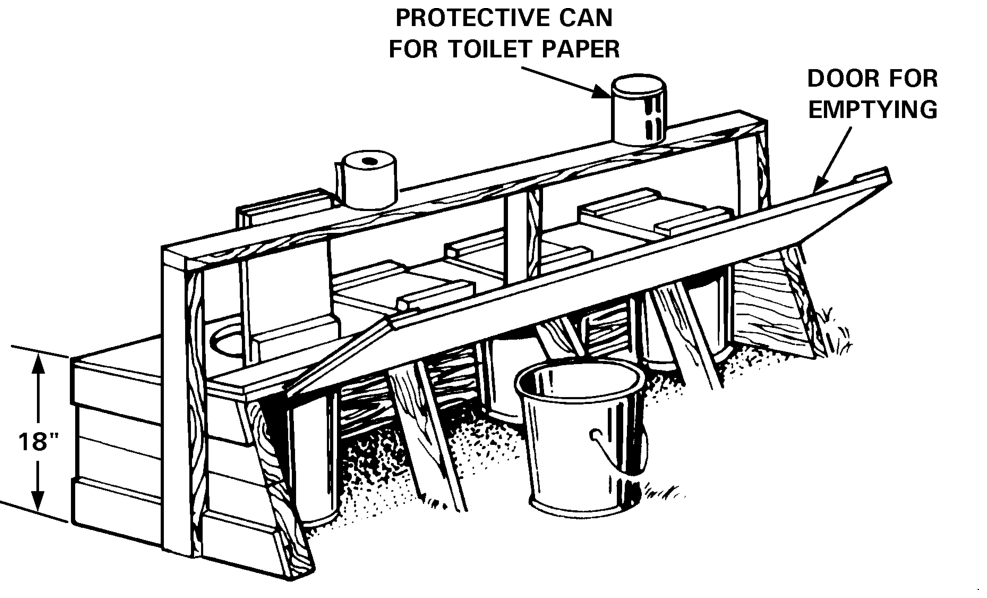
From U.S. Army FM 21-10, Field Hygiene and Sanitation (2000), p. A-42. Public domain; cropped. Not endorsed by the U.S. Army or Department of Defense.
The manual also has one small, practical habit: check under a field toilet seat before sitting, because spiders and scorpions shelter there. A bucket that has sat in a garage for a year deserves the same look.
Making it work for everyone
- Children: WREMO says to keep the gap between the seat and bucket as small as possible, to seal the normal toilet shut so no one uses it by habit, and to use pictures to show which bucket is which.
- People with limited mobility: WREMO suggests a commode with a bag in its pail, a chair with a hole cut over a bucket, or, as a last resort, the bag in the toilet bowl.
- Privacy: put the buckets in the bathroom or laundry room (WREMO). Outdoors, a tarp makes a screen (suggested).
- In the car: the National Weather Service's winter car kit includes a large empty can as an emergency toilet, with tissues, toilet paper and paper towels. See the car kit.
- Away from home: bags and a small bottle of sanitizer belong in a get-home bag and a bug-out bag too.
How much to store
CDC's archived guidance on sanitation in emergency responses (last reviewed in 2021) puts single-use toilet bags at about one bag per person per day. A shared two-bucket toilet uses far fewer, because the feces bag is changed every few days. The table is the Almanac's planning estimate from those figures, for a household of four.
| Supply | 3 days | 2 weeks | Basis |
|---|---|---|---|
| Heavy-duty 13-gallon bags, bag-in-bucket toilet (one per person per day, doubled) | 24 | 112 | CDC's one per person per day; NC DHHS's two layers |
| Heavy-duty 13-gallon bags, two-bucket toilet (changed every 3 days, doubled) | 2–4 | About 10, plus spares | WREMO's three days; Washington County's double bag |
| 5-gallon buckets with lids | 1–2 | 2, plus a third for anyone sick | NC DHHS, WREMO |
| Cover material | A small bag of sawdust or litter | Several large bags, or a source of dry leaves or shredded paper | WREMO: a cupful or handful after each use |
| Disposable gloves | 1 box | 1 box | Washington County |
| Household bleach | 1 bottle | 1 bottle | CERT; mix 1 part to 9 parts water to disinfect (CDC) |
| Toilet paper | Your normal use | Your normal use, plus extra | — |
Four people filling half a bag faster than every three days will use more; buy a full box of bags (suggested), since they also line trash cans.
Emergency toilet kit
- Two 5-gallon buckets with tight lids, labeled for urine and feces
- A snap-on toilet seat or a spare seat (optional)
- A box of heavy-duty 13-gallon garbage bags, and ties
- Cover material: sawdust, kitty litter, peat moss, shredded paper or dry leaves
- A cup or scoop for the cover material
- Toilet paper and moist towelettes
- Disposable gloves, and a bag for used ones
- Household bleach (unscented) and a marked bottle for 1-to-9 disinfectant
- Soap, a water jug with a spigot, and a towel for handwashing
- Hand sanitizer with at least 60% alcohol
- A secure, lidded outdoor bin for bagged waste
- Feminine supplies and diapers, with bags for them
- A printed copy of these steps, kept with the buckets
Keeping it ready
Store the buckets nested with the bags, seat, gloves and a bag of cover material inside, so the whole kit lives in one place. Check once a year that the bags haven't gone brittle and replace the bleach, which loses strength with age (see how to purify water). If you live where earthquakes or floods are likely, build the kit for WREMO's 30 days rather than three.
Where to go next
Clean hands are the other half of sanitation: see handwashing without running water. For the water side of an outage, see water at home and how to store water. After a flood, see floods before trusting the sewer again.
Sources
- NC Department of Health and Human Services — Toilet Use During an Emergency (October 2024)
- Washington County, Oregon, Emergency Management — Disaster Sanitation
- Wellington Region Emergency Management Office (New Zealand) — Emergency Toilets
- Wellington Region Emergency Management Office (New Zealand) — After a Large Earthquake, Don't Flush! (infographic)
- CDC — How to Prevent Cholera
- CDC — Potential Sanitation Solutions During an Emergency Response (archived, reviewed 2021)
- CDC — Guidelines for Personal Hygiene During an Emergency
- U.S. Army FM 21-10 — Field Hygiene and Sanitation (2000)
- FEMA — CERT Basic Training Participant Manual (2019), Unit 1, Disaster Supply Items
- Ready.gov — Build a Kit
- NWS — Winter Safety: Before a Storm