Chapter 8 · Fire & Cooking
Home fire safety: alarms, escape plans and outage fire risks
A home fire can turn deadly in about two minutes, which is less time than most people think they have. Working alarms buy the warning, a practiced plan uses it, and a few habits during outages keep the fire from starting at all.
Read first: Start here
Most of preparedness is about the slow emergencies: days without power, weeks without a store. A house fire is the fast one. It needs no storm and no warning, and it happens to ordinary households every day. It also gets more likely during the slow emergencies, because outages bring candles, heaters, generators and cooking in unusual ways into the house all at once.
This page covers the three things that decide how a home fire ends: whether the alarm wakes you, whether everyone knows the way out, and whether the fire started in the first place.
How fast a fire moves
The numbers from the fire services are the reason for everything else on this page.
- You may have less than two minutes to get everyone outside once a smoke alarm sounds (U.S. Fire Administration). NFPA puts it at as little as one or two minutes.
- Ready.gov says a small flame can become a major fire in under 30 seconds, a fire can become life-threatening in about two minutes, and a house can be engulfed in flames in about five.
- The heat is a bigger threat than the flames, in Ready.gov's words. It gives room temperatures of about 100°F at floor level and 600°F at eye level. Breathing superheated air can scorch the lungs.
- Smoke and gas are the bigger killers. Ready.gov says they kill more people than the flames, leave you confused and drowsy, and that the bright early flames soon give way to thick black smoke you can't see through. CERT's manual calls smoke inhalation the leading cause of fire-related deaths.
Two minutes is not long enough to wake up, think about what to do, look for shoes and decide on a route. It is only long enough to carry out a plan you already have. That is why the alarm and the plan come before anything else.
Smoke alarms
A smoke alarm is the warning that turns a fire you sleep through into one you escape. Ready.gov says a working alarm greatly improves your chance of surviving.
Where they go
The U.S. Fire Administration (USFA) says to install alarms (see Fig. 8-1):
- inside each bedroom, and outside each sleeping area;
- on every level of the home (Ready.gov adds: including the basement);
- on the ceiling or high on a wall. Smoke rises, so high is where it arrives first.
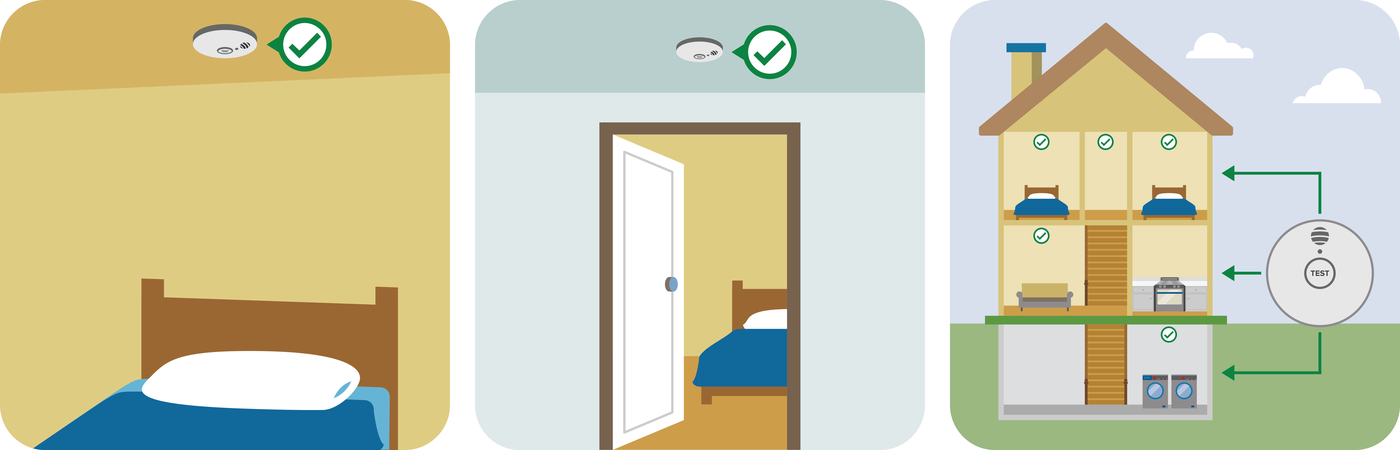
- Inside each bedroom.
- Outside each sleeping area.
- On every level, including the basement.
From U.S. Fire Administration pictograph 01 (copyright-free). Not endorsed by FEMA or USFA.
Hardwired alarms should be installed only by a qualified electrician (USFA).
Interconnect them. USFA recommends interconnected alarms, so that when one sounds, they all sound. NFPA says its alarm code, NFPA 72, requires interconnected alarms throughout the home. The reason is simple: an alarm in the basement that you can't hear from a closed bedroom upstairs is not much of a warning.
Which kind
There are two sensing types, and they detect different kinds of fire: ionization and photoelectric. USFA recommends having both, or buying dual-sensor alarms that contain both. For anyone with hearing loss, alarms are made with strobe lights, vibration, or both, and Ready.gov notes alarms with audible tones for people who are visually impaired.
Testing and replacement
| Alarm type | Test | Battery | Replace the alarm |
|---|---|---|---|
| 9-volt battery | Monthly | At least once a year (USFA) | Every 10 years |
| 10-year sealed lithium ("long-life") | Monthly | Not replaceable | When the maker says, 10 years from the date of manufacture |
| Hardwired with backup battery | Monthly | Backup battery at least once a year (USFA) | Every 10 years |
Alarms are dated from when they were made, not when you put them up, so check the date on the back (USFA).
The sources differ on how often to change batteries
USFA says to replace a 9-volt battery at least once a year. Ready.gov says to replace batteries twice a year, unless the alarm uses a 10-year lithium battery, and FEMA's CERT manual suggests changing them when the clocks change in spring and fall. Twice a year meets both. Tying it to the clock change makes it easy to remember.
USFA gives rough prices: ionization or photoelectric alarms from $6, dual-sensor from $24, microprocessor alarms (faster alerts, fewer false alarms) from $30, and wireless interconnected alarms from $40. USFA notes that some fire departments will install battery-operated alarms at no cost, so it is worth a call.
Don't pull the battery when cooking sets it off. USFA says to open a window or door, press the hush button, or wave a towel at the alarm instead. If one alarm goes off every time you cook, USFA suggests moving it several feet farther from the kitchen or bathroom. Ready.gov is blunt: never disable an alarm while cooking. A disabled alarm is the one that fails on the night it matters.
Carbon monoxide alarms
Carbon monoxide is not smoke and a smoke alarm won't detect it unless it is a combination unit. FEMA's CERT manual says to put CO alarms near each separate sleeping area, with more on every level and in every bedroom, not within 15 feet of heating or cooking appliances and not in humid places like bathrooms, and to test them monthly. Ready.gov's outage guidance asks for battery-backup CO alarms on every level, because a plug-in alarm goes dark with the grid. The full rules for generators and CO are in generator safety.
The escape plan
The household plan in Start Here covers storms and evacuations. A fire plan is a smaller, sharper piece of it, because there is no time to look at a sheet of paper.
Making it
USFA's steps, with NFPA's details where they add something (see Fig. 8-2):
- Draw a map of each floor, marking every door and window.
- Find two ways out of every room. The second way is the one you'll need if fire or smoke blocks the door. In a bedroom it is usually a window.
- Check that both ways work. USFA says doors and windows must not be blocked, and NFPA says to check that they open easily. Ready.gov adds that screens should come out quickly and that security bars must open properly. NFPA says bars need an emergency release on the inside.
- Pick a meeting place outside, in front of the house and a safe distance away: NFPA suggests a neighbor's house, a light post, a mailbox or a stop sign. It is how you know everyone got out, and it is what stops anyone going back in to look.
- Assign helpers. NFPA says someone should be named to help each infant, older adult or person with limited mobility, with a backup in case that person isn't home. Ready.gov adds that if someone uses a walker or wheelchair, every exit should be wide enough.
- Upper floors. NFPA says everyone must be able to get out from second-floor rooms, and suggests an escape ladder stored near the window. Practice setting it up from a first-floor window only; children practice only with an adult.
- Make the house findable. NFPA suggests checking that your street number can be seen from the road.
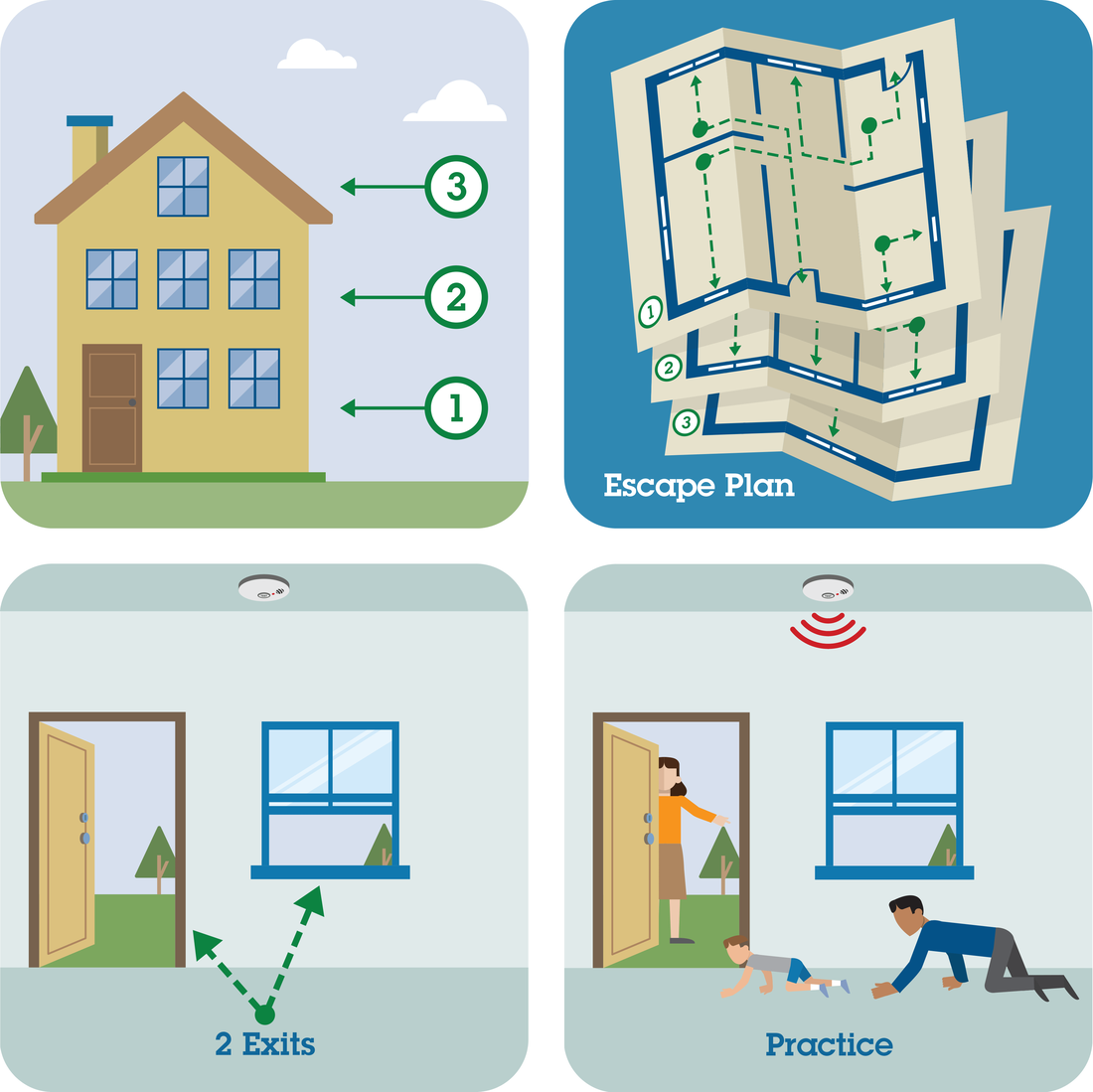
- A plan for every floor of the house.
- The map, with a way out marked from every room.
- Two ways out of each room, usually a door and a window.
- Practice when the alarm sounds: get low and get out.
From U.S. Fire Administration pictograph 05 (copyright-free); panels set two by two. Not endorsed by FEMA or USFA.
Practicing it
NFPA and Ready.gov both say to practice the plan twice a year. USFA's drill starts by pressing the alarm's test button and ends at the meeting place.
- Practice getting low and going under the smoke (NFPA), and finding the way out in the dark or with eyes closed (Ready.gov).
- Run at least one drill to see whether children and heavy sleepers actually wake to the alarm. NFPA notes that some don't; if so, someone is assigned to wake them. NFPA also suggests telling children about a night drill beforehand. The point is practice, not fright.
- Ready.gov says to teach children not to hide from firefighters.
- Tell overnight guests the plan.
Fire escape plan
- A map of each floor with every door and window marked
- Two ways out of every room, both checked and clear
- Windows open, screens come out, security bars release from inside
- A meeting place in front of the house, named and known
- A named helper (and a backup) for each person who needs help
- An escape ladder by each upstairs bedroom window, if needed
- A drill twice a year, one of them at night
What to do in a fire
These are the actions from Ready.gov, USFA and NFPA. Learn them now; there is no time to read them then.
- Get out at once when the alarm sounds. NFPA says not to delay.
- Stay low. Smoke and gases collect near the ceiling first, so drop and crawl under them (Ready.gov).
- Feel the door before you open it. Ready.gov says to feel the knob and the door; if either is hot, or smoke is coming around it, keep it closed and use the second way out (see Fig. 8-3). CERT's manual adds to use the back of the hand, starting low and working up, and to leave the door shut if air is being sucked under it. Open doors slowly, ready to shut them again.
- Close doors behind you. NFPA says a closed door may slow smoke, heat and fire, and USFA tells apartment residents to shut theirs on the way out. It is also why Ready.gov suggests sleeping with bedroom doors closed.
- Go to the meeting place and call 911 (or the fire department) from outside.
- Stay out. NFPA says never to go back into a burning building. If someone is missing, tell the dispatcher where they are likely to be. Ready.gov says to tell firefighters about trapped pets too.
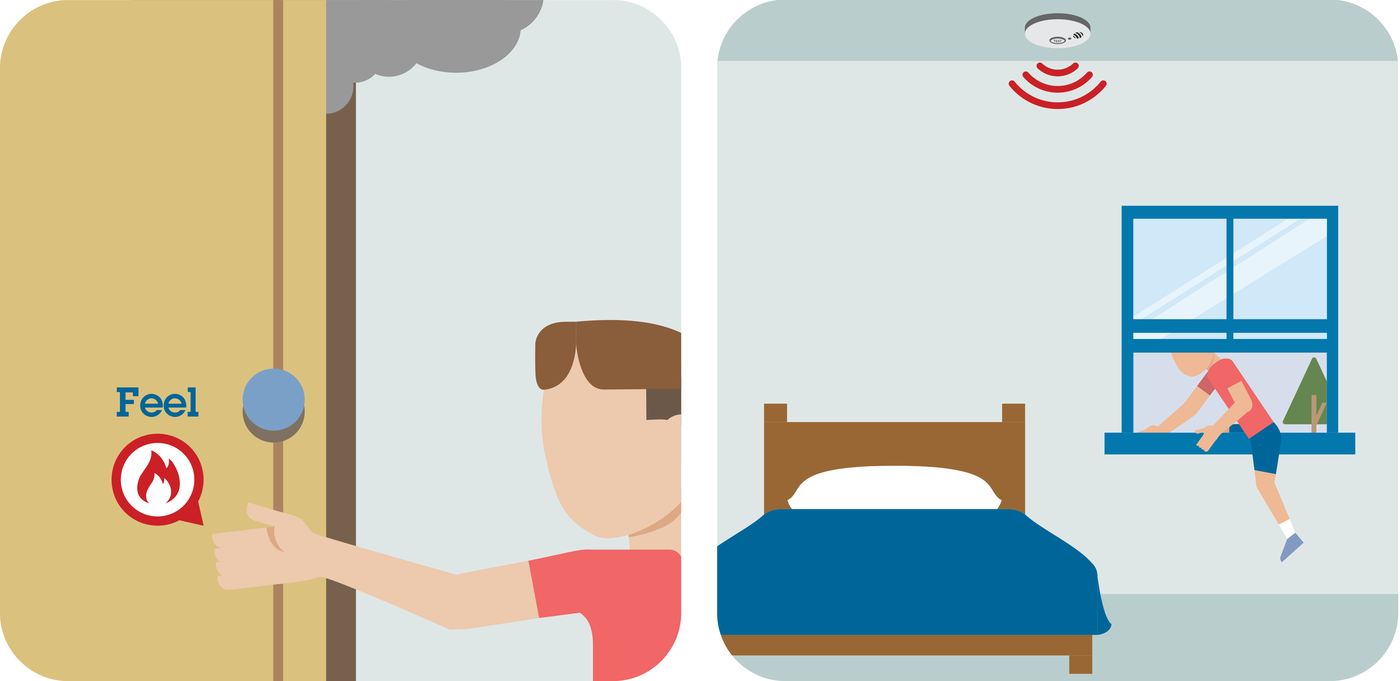
From U.S. Fire Administration pictograph 15 (copyright-free). Not endorsed by FEMA or USFA.
If you can't get out, NFPA and Ready.gov describe sealing yourself in: close every door between you and the fire, stuff the cracks and cover vents with towels or tape, call 911 and say exactly where you are, and signal from the window with a flashlight or a light-colored cloth. NFPA says to open the window at the top and bottom, if you can, for fresh air.
High-rise and apartment buildings are different. USFA says to leave and close your door behind you, pull the fire alarm on the way out, and take the stairs, not the elevator, unless the fire department tells you otherwise. NFPA notes that in some high-rise buildings residents may be safer defending in place; follow your building's plan.
If your clothes catch fire: stop, drop and roll, covering your face with your hands, until the flames are out (Ready.gov). Then treat the burn: cooling, covering and when to call 911 are in burns.
Fighting a small fire, or not
A fire extinguisher is for a fire that has just started. It is not a reason to stay.
USFA says to use one only if all of these are true: everyone else has been alerted, someone has called the fire department, you are physically able to use it, the fire is small and confined to one object such as a pan or a wastebasket, you are clear of the smoke, and you have a clear way out behind you. USFA adds that young children and older adults should not use extinguishers. CERT's manual adds a time limit: if you haven't put it out within about five seconds of using the extinguisher, it is too big. Leave, closing doors behind you.
To use it, USFA's PASS: Pull the pin, Aim low at the base of the fire, Squeeze the lever slowly and evenly, Sweep side to side. CERT's manual says a household dry-chemical extinguisher empties in about 10 to 20 seconds with a range of about 8 to 12 feet, which is why aiming at the base, not the flames, matters: there isn't enough to waste.
| Class | What's burning | Home extinguisher |
|---|---|---|
| A | Wood, paper, cloth, many plastics | A-B-C multipurpose |
| B | Flammable liquids: gasoline, oil, grease, oil-based paint | A-B-C or B-C |
| C | Electrical equipment that's plugged in | A-B-C or B-C (the C means it is safe on electrical fires) |
| D | Burning metals | Special agent (factories) |
| K | Cooking oils and fats | Class K (commercial kitchens) |
Classes from USFA and CERT. USFA explains the label: the number before the A is a multiple of 1.25 gallons of water, and the number before the B is roughly the square feet of liquid fire it can handle, so a 1A:10B:C unit equals 1.25 gallons of water on ordinary fires, handles about 10 square feet of liquid fire, and is safe on electrical fires. USFA says to buy a UL-listed one, the largest you can handle safely and comfortably; many have a gauge that shows when the pressure is too high or too low, and the can, hose and nozzle should be free of dents, damage and rust.
Kitchen fires
USFA calls cooking by far the leading cause of home fires. NFPA's yearly averages for 2020–2024: cooking was involved in 48% of home structure fires and 16% of home fire deaths, and unattended cooking was a factor in a quarter of cooking fires and half of the deaths from them.
- Stay with the pan when frying, grilling, boiling or broiling (NFPA); USFA says to turn the burner off if you leave the kitchen, and Ready.gov says the same even for a short time.
- Grease fire in a pan: slide a lid or baking sheet over it and turn off the burner. Leave the lid on until the pan is completely cool, because the fire can restart (NFPA).
- Oven fire: turn off the heat and keep the door closed (NFPA).
Never put water on a grease fire
NFPA says never to throw water on a cooking-oil fire. If the fire doesn't go out, or you aren't comfortable putting a lid on it, get everyone out and call the fire department from outside.
Fire risks during a power outage
An outage changes how a house is lit, heated and powered, and almost every substitute is a fire risk the house doesn't normally have. These are the ones the fire services warn about.
| Substitute | The risk | What the sources say to do |
|---|---|---|
| Candles for light | Knocked over, left burning, too close to curtains or bedding. NFPA counts about 20 home candle fires reported every day (via USFA) | USFA: use flashlights, not candles, in an outage (see Fig. 7-2). If you burn candles at all, keep them 12 inches from anything that burns, in a stable holder, never in bedrooms, and blow them out when you leave the room |
| Space heaters | Heat igniting nearby furniture, bedding or curtains | Keep anything that burns at least 3 feet away (USFA, Ready.gov). Buy one evaluated by a recognized lab such as UL, with a thermostat and tip-over shutoff (Ready.gov). Turn it off when you leave the room or go to bed (USFA) |
| Kerosene heaters | Wrong fuel, overfilling | Use only clear K-1 kerosene, never overfill, and run it in a well-ventilated room away from curtains (Ready.gov) |
| Oven or gas stove for heat | Fire, burns and carbon monoxide | Never heat the house with a range or oven (USFA, Ready.gov) |
| Fireplace or woodstove | Chimney fires, rolling logs | Have the chimney inspected and cleaned every year (USFA, Ready.gov); use a screen sturdy enough to stop rolling logs; put the fire out completely before bed (Ready.gov) |
| Portable generator | Fuel spilled on a hot engine catches fire; carbon monoxide | Run it outdoors only, at least 20 feet from windows, doors and attached garages, and let it cool before refueling (Ready.gov); never refuel it while it runs (USFA). See generator safety |
| Extension cords | Overheating under load | Heavy-duty cords for generators (Ready.gov, USFA). Plug major appliances straight into the wall, not an extension cord, and keep cords out from under rugs (USFA) |
| Battery packs and power stations | Lithium-ion batteries overheating | Charge them between 32°F and 105°F; stop using one that gives off an odor, changes color or shape, leaks, gets too hot or makes odd noises (USFA) |
| Power coming back | Surges damaging appliances | Turn off or unplug appliances and electronics during the outage (Ready.gov, USFA) |
The fuel side of generators (cans, storage, how much to keep) is in fuel storage. Ways to stay warm without any of these are in staying warm, and cooking safely without the grid is in cooking without power. For light, a battery lantern or a power station does the job without a flame.
Fuel and fire
USFA warns that gasoline spilled on a hot engine can start a fire, so never refuel a running generator; Ready.gov says to let it cool first. How to store the fuel itself is in fuel storage.
After a fire
- Wait for the fire department to say the house is safe to enter (Ready.gov).
- Don't reconnect utilities yourself. Ready.gov says the fire department should confirm the utilities are safe or disconnected. How each utility is shut off, and who turns it back on, is in shutting off gas, water and power.
- Call the fire department even for a small fire you put out. CERT's manual says they can check for hidden fire, and your insurer may want a report.
- Contact a relief organization such as the Red Cross for shelter, food and medicine; list damaged property before you throw anything away; keep receipts; and tell your mortgage company (Ready.gov).
The recovery is far easier with copies of your papers kept somewhere other than the house. Ready.gov suggests digital copies of documents such as birth certificates; documents covers what to copy and where to keep it.
Fire safety calendar
- Monthly: press the test button on every smoke and CO alarm
- Monthly, with the alarm test (our suggestion): glance at the extinguisher's gauge and check that nothing blocks it
- Twice a year (when the clocks change): change alarm batteries and run a fire drill, one of them at night
- Yearly: have the chimney and heating equipment inspected and cleaned
- Yearly: check the date on every alarm and replace any 10 years past its manufacture date
- Before storm season: flashlights and spare batteries in every bedroom, no candles in the outage kit
Sources
- U.S. Fire Administration — Smoke alarms
- U.S. Fire Administration — Home fire escape plans
- U.S. Fire Administration — Fire extinguishers
- U.S. Fire Administration — Severe weather fire safety
- U.S. Fire Administration — Candle fire safety
- U.S. Fire Administration — Heating fire safety
- U.S. Fire Administration — Cooking fire safety
- U.S. Fire Administration — Appliance and electrical fire safety
- U.S. Fire Administration — Lithium-ion battery fire safety
- Ready.gov — Home Fires
- Ready.gov — Power Outages
- FEMA — CERT Basic Training Participant Manual (2019), Units 1 and 6
- NFPA — Home fire escape planning
- NFPA — Cooking safety