Chapter 2 · Water
Finding water at home: the heater, the pipes, the tub and the ice
Most houses hold dozens of gallons of clean water that nobody thinks of until the tap stops. The trick is to protect it before it's contaminated, drain it without scalding yourself or wrecking the heater, and know which water is for drinking and which is only for flushing.
Read first: Store water
When the water main breaks or the treatment plant floods, the water already inside your house is the cleanest water you have. It came through the utility's treatment before the trouble started, and it is sitting in a closed tank and closed pipes. FEMA counts the water heater tank, the pipes and ice cubes as safe sources inside the home, and CDC adds the liquid in canned fruit and vegetables.
How to store water gives the short version of how to reach that water. This page is the full procedure: what to do first so the water stays clean, how to drain a water heater safely, what to fill before a storm, which water is only for flushing, and how to live with a boil-water advisory once the tap comes back.
Step one: keep outside water out
The water in your pipes is only as good as the last water that entered them. If a main breaks or a sewer line backs up, contaminated water can flow into the house plumbing and spoil the supply you were counting on.
FEMA's rule: if you hear reports of broken water or sewage lines, or local officials warn of a problem, close your home's main water valve. CDC gives the same advice: follow local officials, and you may need to shut the main valve to keep contaminants out of your pipes.
Two things make this work:
- Find the valve now. FEMA says everyone in the household should know beforehand where the main valve is and how to close it. Where to look and what tools you need are in shutting off gas, water and electricity.
- Close it early. Once the valve is shut, the water in the pipes and the heater tank is sealed off from the street. If you wait until the tap runs brown, dirty water may already be in the pipes.
If there is any chance outside water got in before you closed the valve, treat what you draw out. EPA's emergency sheet names melting ice and draining the hot water tank or pipes as ways to find water, and gives boiling and bleach methods for water of doubtful quality. The doses are in how to purify water.
What your house holds, and what each source is good for
Water inside the home, by source
| Source | Drinking? | Notes |
|---|---|---|
| Water heater tank (the one feeding faucets and showers) | Yes (FEMA, CDC) | Drain from the valve at the bottom. Power or gas off first. Not the separate tank some older homes use for radiators (CDC) |
| Water in the pipes | Yes (FEMA) | Open the highest faucet, collect from the lowest |
| Ice cubes | Yes, if made from uncontaminated water (CDC) | Not ice from a refrigerator ice maker during an advisory (CDC) |
| Liquid in canned fruit and vegetables | Yes (CDC) | Use it in meals rather than pouring it out |
| Toilet tank (never the bowl) | Sources disagree; see below | CDC allows it only if clear and not treated with colored cleaners; FEMA's 2004 guide rules it out |
| Bathtub filled before a storm | No (NWS) | NWS says tub water is for cleaning and flushing only |
| Swimming pool or spa | No (FEMA, CDC) | CDC allows it for personal hygiene and cleaning, not drinking |
| Waterbed | No (FEMA) | |
| Radiator or boiler (home heating system) | No (FEMA, CDC) |
When the label says "yes," it means the water was clean when it entered the house. If you can't be sure of that, treat it.
Draining the water heater
A tank water heater is the largest store of clean water in most houses. Check the label on your tank for its capacity. If you have a tankless (on-demand) heater, there is no tank to drain, and this source doesn't exist for you.
FEMA's emergency method, step by step
- Turn off the electricity or gas to the heater. FEMA puts this first. A. O. Smith explains the reason for an electric heater: if the heating element is switched on without enough water around it, the element burns out. For a gas heater, A. O. Smith's maintenance guide says to set the thermostat dial to OFF, which puts out the pilot.
- Close the cold-water intake valve at the tank, so nothing new flows in. This matters most if the city water may be contaminated: you want the clean water already in the tank, not whatever is in the street main.
- Open a hot-water faucet somewhere in the house. This lets air into the tank. Without it, the water drains slowly or not at all, the same way a finger over a straw holds liquid in.
- Open the drain valve at the bottom of the tank and collect the water in clean containers.
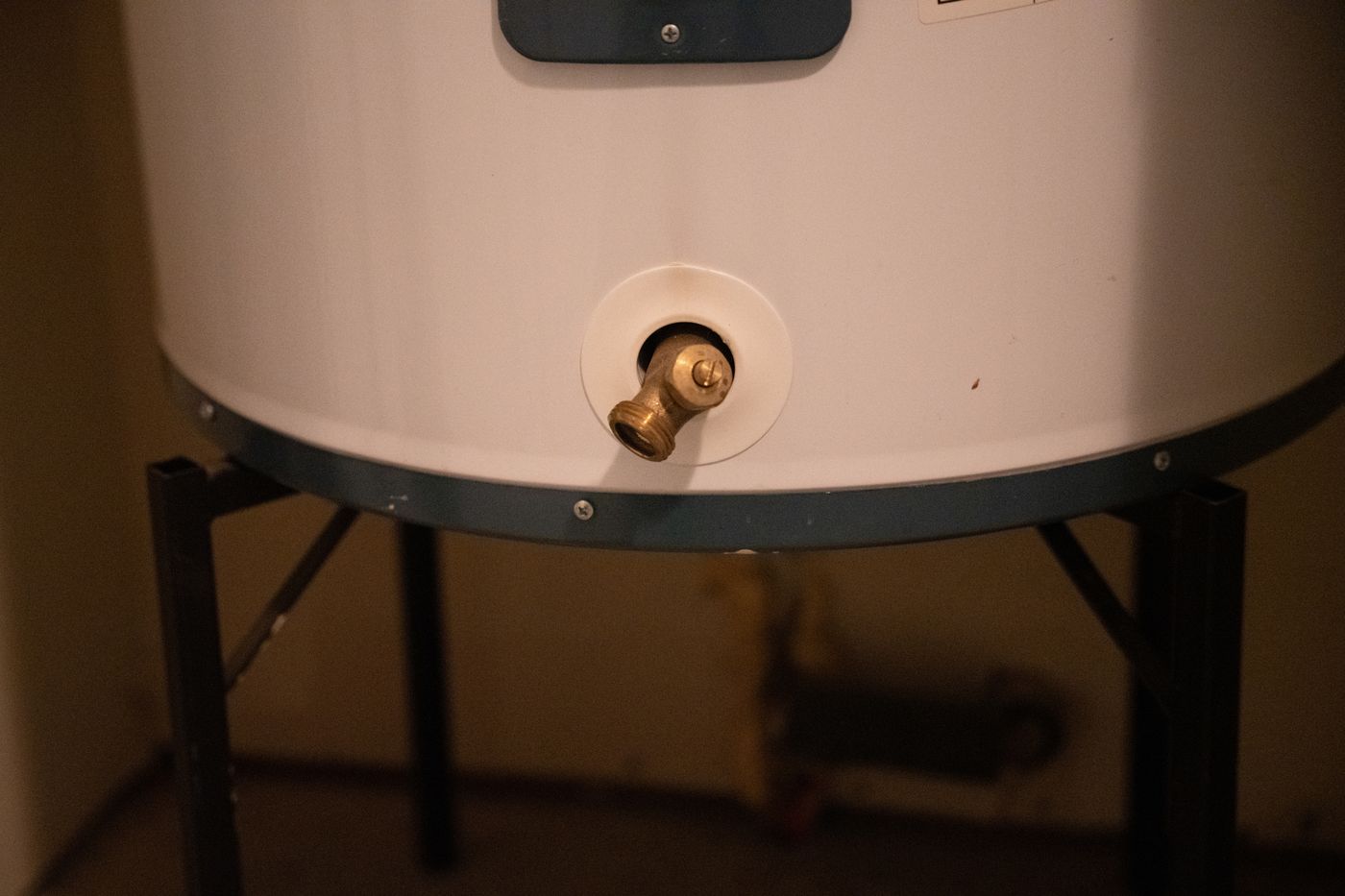
Photo: iStock.
Doing it without getting burned
A heater that was running has water hot enough to scald. A. O. Smith's guide for routine draining says to turn the unit off a few hours ahead so the water cools, to wear thick gloves and safety goggles, and to run a garden hose from the drain valve to somewhere that can take several gallons of hot water. In an outage the heater may already have cooled, but test the first water carefully before you put your hands near it.
Sediment
Tanks collect sediment: A. O. Smith's maintenance guide has you flush a tank until no more sediment comes out of the drain valve, so expect the first water you draw to carry some. For drinking water, let the containers stand so the grit settles, then pour off the clear water above it, the same settling step EPA gives for any cloudy water before treatment.
Before the power or gas comes back on
FEMA says to refill the tank before turning the power or gas back on. A. O. Smith is blunt about electric heaters: the tank must be full before the power goes back on, or the element can burn out. Close the drain valve, open the cold inlet, and let a hot faucet run until it delivers water instead of air.
FEMA adds that if the gas is turned off, a professional will be needed to turn it back on. That is covered in utility shutoffs.
Before you drain the heater
- Electric heater: switch off the breaker first. Restoring power to an empty or partly empty tank burns out the element (A. O. Smith).
- Gas heater: turn the gas control to OFF. Don't relight a pilot or turn the gas back on if you aren't sure how; FEMA says that if the gas is turned off, a professional will be needed to turn it back on.
- Hot water scalds. Let the tank cool and wear gloves and eye protection (A. O. Smith).
- Refill completely before power or gas goes back on (FEMA, A. O. Smith).
Water in the pipes
FEMA's method uses gravity. Open the faucet at the highest point in the house, which lets air into the plumbing; a little water will trickle out. Then collect from the lowest faucet in the house, such as a basement laundry tap or an outside spigot low on the wall. The water in the pipes runs downhill to it.
The amount depends on how much pipe your house has, so don't count on it for more than a few containers. Its real value is that it comes first, before you open the heater.
Ice, the freezer and canned food
- Ice cubes and bagged ice melt into usable water if the ice was made from water that wasn't contaminated (CDC). Melt it in a clean, covered container.
- Refrigerator ice makers and dispensers are a different case. During any drinking-water advisory, CDC says not to use water or ice from refrigerator or freezer dispensers, or from any appliance connected to your water line. The ice in the bin may have been made from the water you're being warned about.
- Canned fruit and vegetables are packed in water or juice that CDC counts as a source. Drink it or cook with it instead of draining it down the sink.
The toilet tank: the sources disagree
FEMA's 2004 guide says not to use water from toilet flush tanks or bowls. CDC's current page allows water from the tank, never the bowl, and only if it is clear and has not been treated with cleaners, such as those that color the water.
If you use tank water for drinking, treat it first. The more common use for it is the obvious one: it is already in the toilet. When the water is off, the tank holds one more flush. After that, flushing means pouring water into the bowl by hand, and once the water to pour runs short, the household moves to an emergency toilet. That is covered in emergency toilets.
Fill the tub before a storm, for flushing
The National Weather Service's hurricane checklist says to fill the bathtub and large containers with water in case tap water becomes unavailable, and to use the bathtub water for cleaning and flushing only, not for drinking. CDC's hurricane page says the same in its own words: fill clean containers with drinking water, and you can also fill sinks and bathtubs with water for washing.
Why not drink it? NWS doesn't say; the plain reasons are that a tub isn't a food-grade container and it sits open to the room. Its job is to spare your stored drinking water from being poured into the toilet. Hurricanes in general are covered in hurricanes, and long outages in power outages.
What not to drink
- Radiators and boilers from a home heating system (FEMA, CDC).
- Waterbeds (FEMA).
- Swimming pools and spas. CDC allows them for hygiene and cleaning, not for drinking.
- The toilet bowl, ever (FEMA, CDC).
- Tub water saved before a storm: for cleaning and flushing only (NWS).
- Water contaminated by fuel or toxic chemicals. CDC says it cannot be made safe, and not to drink it or bathe in it. Boiling and bleach don't remove chemicals (EPA).
- Floodwater. FEMA says not to drink it. See floods.
When the tap works but can't be trusted: drinking-water advisories
Sometimes the problem isn't that the water stops, but that the utility warns you about it. CDC describes three kinds of advisory, and the difference between them decides whether boiling helps.
| Advisory | What it means (CDC) | Does boiling make the water safe? |
|---|---|---|
| Boil water | Germs may be in the water | Yes: a full rolling boil for 1 minute (3 minutes above 6,500 feet) |
| Do not drink | Chemicals or toxins are the concern | No. Use bottled water for drinking and cooking |
| Do not use | Rare; contact with skin, eyes or lungs may also be harmful | No. Use bottled water for everything |
Living under a boil-water advisory
CDC's household guidance, in practice:
- Drinking, cooking, brushing teeth: bottled or boiled water. CDC says to boil even water that has gone through a home filter or filtering pitcher.
- Infants: CDC says breastfeeding is best; if you use formula, use ready-to-use formula if possible.
- Bathing: don't swallow the water. CDC suggests sponge baths for babies and young children.
- Handwashing: tap water and soap are often fine, but follow local officials. Scrub with soap for at least 20 seconds; if soap and water aren't available, CDC's household page says to use a sanitizer with at least 60% alcohol. CDC's guidance for businesses adds that alcohol gels don't kill Cryptosporidium, so soap and safe water are the better choice when you have them. More in handwashing.
- Dishes: a dishwasher is generally safe if it has a sanitizing cycle or a final rinse of at least 150°F (66°C). To wash by hand, wash and rinse in hot water as usual, then soak the dishes for at least 1 minute in warm water with 1 teaspoon of unscented bleach per gallon, and let them air-dry completely (CDC).
- Laundry: wash as usual (CDC).
- Pets: bottled water, or boiled water that has cooled (CDC).
- Ice and dispensers: don't use them (CDC).
When the advisory ends
The utility decides when the advisory is lifted, and its notice is the instruction to follow. CDC's checklist for businesses after a boil-water advisory gives a sense of what's involved, and most of it has a household counterpart:
- Run cold-water faucets continuously for at least 5 minutes.
- Replace water filters on the house supply and at the tap, including filters inside appliances.
- Flush, clean and sanitize equipment connected to the water line, such as ice machines and auto-fill coffee makers, following the maker's instructions.
- Run water softeners through a regeneration cycle.
- Drain and refill water heaters set below 113°F.
That checklist was written for commercial buildings, not homes. If your utility's notice says something different, follow the notice.
Water already in the house
- Main water valve located, tool beside it, everyone shown how to close it
- Water heater type known (tank or tankless) and capacity read from its label
- Breaker or gas control for the heater located and labeled
- Water heater drain valve found; a short garden hose and clean containers kept nearby
- Gloves and eye protection for draining a hot tank
- Highest and lowest faucets in the house identified
- Clean, covered containers for water drawn from pipes, heater and melted ice
- Bathtub and large containers filled before a forecast storm, marked "flushing and cleaning only"
- Toilet tanks kept free of colored cleaners if you might use the water
- Unscented bleach and a dropper for treating anything doubtful
- A printed copy of the boil-water advisory steps
Where to go next
The water in your house is a backstop, not a supply plan: start with how to store water. To make doubtful water safe, see how to purify water. If your house runs on a private well, the pump stops with the power and floods bring their own problems: see wells and well shock. For a longer-term outside source, see rain catchment.
Sources
- FEMA — Food and Water in an Emergency (FEMA 477, 2004)
- CDC — How to Find Clean Water in an Emergency
- CDC — Drinking Water Advisories: An Overview
- CDC — Preventing Crypto at Home During a Boil Water Advisory
- CDC — Preventing Crypto in Commercial Settings During a Boil Water Advisory
- CDC — Preparing for Hurricanes or Other Tropical Storms
- NWS — Hurricane Safety checklist
- EPA — Emergency Disinfection of Drinking Water (EPA 816-F-15-003, 2017)
- A. O. Smith — Water Heater Maintenance Guide