The Minuteman Almanac
Field Manual
Chapter 5
Sanitation & Hygiene
Emergency toilets, waste, handwashing and laundry without running water, and pests.
Edition of November 3, 2026 · 2 articles
This manual is rebuilt whenever the chapter changes; the current edition is always at minutemanalmanac.com/print/sanitation/. It is for planning and learning, not medical, legal or electrical advice. In an emergency, follow official instructions.
Contents
5.1 · Chapter 5, Sanitation & Hygiene
Emergency toilets: what to do when the toilet can't be flushed
When the toilet can't be flushed, waste that isn't contained soon becomes a health problem. Here is how to tell when not to flush, the two simple toilets that replace it, and how to handle the waste safely.
When the water is off or the sewer is broken, most people's first thought is drinking water. The toilet comes a close second, usually within hours. Waste that isn't contained spreads the germs that cause diarrheal disease, and the Army's field hygiene manual, FM 21-10, notes that poor sanitation has historically led to epidemics of diarrheal disease that put many soldiers out of action. At home the stakes are the same, only smaller in number: one sick child in a house without running water is hard work.
The good news is that a safe emergency toilet costs very little: a bucket or two, strong bags, something dry to cover the waste, and a plan for where it goes. Ready.gov's basic kit already includes moist towelettes, garbage bags and plastic ties "for personal sanitation", and FEMA's CERT training manual adds a plastic bucket with a tight lid, household chlorine bleach and disinfectant to its supply list. This page turns those items into a working toilet.
When not to flush
There are two different situations, and they call for different responses.
The water is off, but the sewer works. This happens when a water main breaks or a well pump has no power. In a long outage, water for flushing competes with water for drinking; see water at home for what is in the house already.
The sewer may be damaged. This is the dangerous case, because flushing sends waste into pipes that may not carry it away.
- North Carolina's health department says heavy rain and severe flooding can damage sewer systems, and that if your toilet won't flush, you have no water, or the sewage system isn't working, you need another way to go.
- After a large earthquake, WREMO, the Wellington, New Zealand, emergency management office, says don't flush, even if water still runs, because the wastewater pipes are likely broken. It tells households to plan on managing their own waste for at least 30 days.
- Septic systems: WREMO says a septic tank can still be used if it is confirmed to be working and its drainage field is undamaged. Washington County, Oregon, advises checking a septic system after an earthquake and finding where yours is before a disaster.
Listen to your utility and local officials. If you aren't sure the sewer is sound, don't flush.
Human waste spreads disease
Untreated human waste carries the germs that cause diarrheal illness, and it can contaminate water and food. Keep emergency toilets and stored waste away from food preparation and drinking water (WREMO, Washington County), and keep stored waste away from children and animals and safe from pets, flies and rats (Washington County). Wash or sanitize hands after every use. CDC says to clean and disinfect toilets and surfaces soiled with feces, using 1 part household bleach to 9 parts water. Anyone with vomiting or diarrhea should have a separate bucket (WREMO); watch them for dehydration and get medical help if it doesn't settle.
Option 1: a bag in the toilet or a bucket
This is the simplest emergency toilet and the one most U.S. guidance starts with. North Carolina's health department gives these steps:
- Shut off the toilet's water valve and flush to empty the bowl. It should not refill, so the bag sits in a dry bowl.
- Line the bowl with a plastic bag set inside a second kitchen garbage bag. Two bags protect against a tear.
- Add something absorbent if you have it, to soak up liquid and cut odor. NC DHHS lists kitty litter, peat moss, lime, bleach or disinfectant.
- Tie off used bags and put them in a garbage can, away from children and animals.
NC DHHS also allows a five-gallon bucket set up the same way, with a toilet seat on top if you have one; disinfect the bucket with bleach or throw it away afterward. Its first option is simpler still: use a neighbor's, friend's or local business's working toilet if one is available.
The sources disagree on the bowl method. WREMO calls a bag in the toilet bowl a last resort, for people with mobility problems who can't use a bucket. Its concern is spills: the bag has to cover the whole bowl, and it should hold dry material to soak up liquid. If you use the bowl, make sure the water is shut off and the bowl is empty first, so the bag isn't sitting in water.
Option 2: the two-bucket toilet
The two-bucket toilet separates urine from feces, and both WREMO and Washington County, Oregon, describe it in detail. Washington County credits the method's use in Christchurch, New Zealand, after the 2011 earthquake.
Why two buckets? WREMO explains that urine carries far fewer germs than feces, and that keeping them apart cuts smell and germs. A dry feces bucket smells much less and holds much more before it needs emptying.
What you need
- Two sturdy buckets with lids. WREMO says 15 to 20 liters each; Washington County says 5-gallon buckets, which is about 19 liters, so the two agree.
- A permanent marker to label them. WREMO uses "wee" and "poo"; use whatever words your household will read correctly at 3 a.m., and pictures for small children.
- Heavy-duty garbage bags. Washington County specifies 13-gallon bags for the feces bucket.
- Dry carbon-based cover material: sawdust, dry leaves, straw, grass, shredded paper or shredded newspaper (Washington County and WREMO). Soil also works (WREMO).
- Toilet paper, disposable gloves, and bags for used gloves.
- Soap and water, or hand sanitizer with at least 60% alcohol (Washington County, CDC).
- A toilet seat, optional: WREMO suggests one unscrewed from an existing toilet, or a hole cut in a garden chair, and padding the bucket rim with foam or a pool noodle.
The urine bucket
- WREMO says to put 2 to 3 centimeters (about an inch) of water in the empty bucket before use.
- Urine only. Toilet paper goes in the other bucket.
- Close the lid after each use.
- Empty it daily (WREMO). Both WREMO and Washington County say to dilute it with water that isn't needed for drinking and pour it on a lawn, an unused part of the garden or other ground.
The feces bucket
- Line it with a heavy-duty 13-gallon bag (Washington County), and put a layer of cover material in the bottom (WREMO).
- Feces and toilet paper go here.
- After each use, cover it with a large cup or handful of dry material (WREMO). This dries the waste and controls odor and flies.
- Keep it as dry as possible; no urine, no water.
- Don't let it get too full. Washington County says fill the bag no more than half full. WREMO says empty it at least every three days, or sooner if full.
- When it's time, tie the bag with as much air out as you can, double-bag it, and store it as described below.
What goes where
| Item | Where it goes | Source |
|---|---|---|
| Urine | Urine bucket; diluted and poured on soil daily | WREMO, Washington County |
| Feces | Feces bucket, covered each time | WREMO, Washington County |
| Toilet paper | Feces bucket | WREMO, Washington County |
| Menstrual cup contents | Feces bucket | WREMO |
| Pads, tampons, diapers, wet wipes | Ordinary trash, bagged (not biodegradable) | WREMO |
| Used gloves | Their own bag | Washington County |
| Vomit or diarrhea of a sick person | A separate bucket, disinfected | WREMO |
Where the waste goes
This is where advice differs most, because it depends on where you live.
U.S. guidance is to hold the waste and follow local instructions:
- Washington County, Oregon, says to keep double-bagged waste in a secure place away from food, water, children and animals, separate from other garbage, and safe from pets, flies and rats, and to follow the instructions of your local waste hauler.
- NC DHHS says to put used bags inside a garbage can.
New Zealand guidance is different. WREMO tells Wellington households to deal with waste on their own property until the sewers are repaired: bury the feces bucket's contents in the garden, or, without a garden, double-bag it and put it in a lidded outdoor bin such as a wheeled trash bin (apartment dwellers use the shared bin). That fits Wellington's rules and its 30-day plan. U.S. towns set their own rules on burying human waste and on putting it out with the trash, so don't assume WREMO's method is allowed where you live.
Ask your health department or trash hauler how it wants bagged waste handled, and store it securely until you know.
Where you have land and local rules allow, burying is an option. The figures below come from CDC's cholera-prevention page (written for places with an outbreak and no working toilets), WREMO (New Zealand) and the Army field manual; none of them is a U.S. household rule, so check with your health department first.
| Guidance | Depth | Distance from water | Other placement |
|---|---|---|---|
| CDC (cholera prevention) | Pit at least half a meter (1.6 feet) deep | At least 30 meters (100 feet) from any body of water, including wells | Bagged waste may also be buried |
| WREMO, long-drop pit | Up to 1 meter (about 3 feet) deep and 30–40 centimeters wide; fill in with soil when waste is 30 centimeters (1 foot) from the top | Away from all water sources, streams and groundwater | Away from vegetable gardens and neighbors' boundaries; keep it covered with a board between uses |
| WREMO, burying bucket contents | A 50-centimeter (about 20-inch) hole | As above | — |
| U.S. Army FM 21-10 | — | At least 30 meters, and downslope from wells, springs and streams | As far as possible from food, 100 meters or more; on level ground, never uphill from water supplies |
FM 21-10 also reminds its own readers to check local, state and federal rules before using any improvised waste disposal, which applies to households too.
What the Army manual adds
FM 21-10 is written for soldiers in the field, and most of its latrines are not home advice: the burn-out latrine, which burns waste in drums with fuel, and the trenches and pits sized for a unit are military methods. Two pieces carry over.
- The pail latrine is the Army's answer when the ground is too hard to dig or the water table is too high, which is exactly the problem in a flooded or paved neighborhood. It is a seat box set over a pail (see Fig. 5-1), and the manual's rule is that pail latrines are emptied and cleaned daily. That is stricter than WREMO's three days for a dry, covered feces bucket; if you aren't separating urine or using cover material, follow the Army's daily schedule.
- Handwashing is part of the toilet. The manual makes a handwashing device at every latrine mandatory. At home, set up a jug of water with a spigot, soap and a towel next to the buckets. Handwashing without running water shows how. CDC's standard is soap and water for at least 20 seconds, or sanitizer with at least 60% alcohol when there's no soap and water; sanitizer works less well on visibly dirty hands.
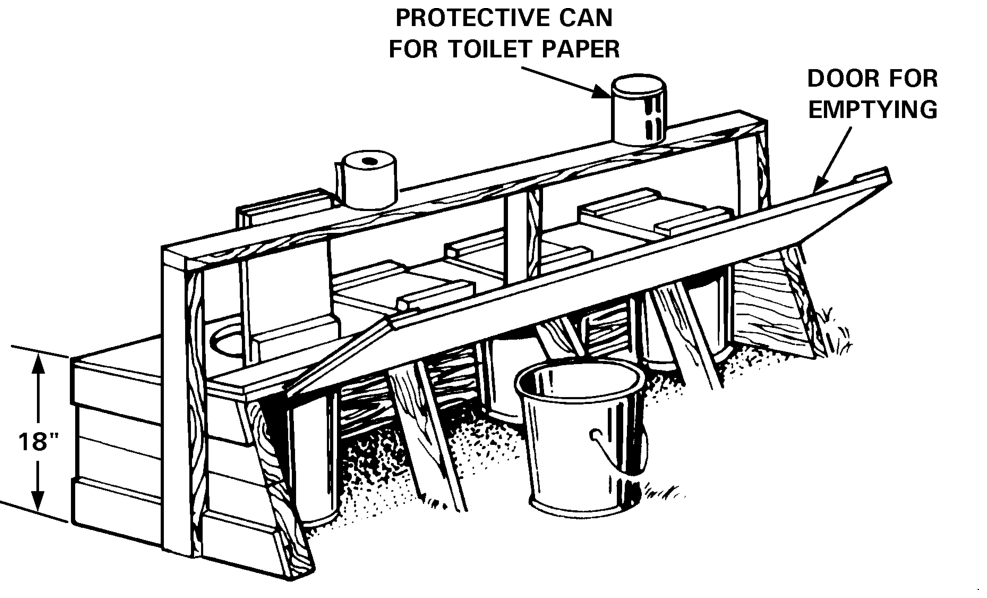
From U.S. Army FM 21-10, Field Hygiene and Sanitation (2000), p. A-42. Public domain; cropped. Not endorsed by the U.S. Army or Department of Defense.
The manual also has one small, practical habit: check under a field toilet seat before sitting, because spiders and scorpions shelter there. A bucket that has sat in a garage for a year deserves the same look.
Making it work for everyone
- Children: WREMO says to keep the gap between the seat and bucket as small as possible, to seal the normal toilet shut so no one uses it by habit, and to use pictures to show which bucket is which.
- People with limited mobility: WREMO suggests a commode with a bag in its pail, a chair with a hole cut over a bucket, or, as a last resort, the bag in the toilet bowl.
- Privacy: put the buckets in the bathroom or laundry room (WREMO). Outdoors, a tarp makes a screen (suggested).
- In the car: the National Weather Service's winter car kit includes a large empty can as an emergency toilet, with tissues, toilet paper and paper towels. See the car kit.
- Away from home: bags and a small bottle of sanitizer belong in a get-home bag and a bug-out bag too.
How much to store
CDC's archived guidance on sanitation in emergency responses (last reviewed in 2021) puts single-use toilet bags at about one bag per person per day. A shared two-bucket toilet uses far fewer, because the feces bag is changed every few days. The table is the Almanac's planning estimate from those figures, for a household of four.
| Supply | 3 days | 2 weeks | Basis |
|---|---|---|---|
| Heavy-duty 13-gallon bags, bag-in-bucket toilet (one per person per day, doubled) | 24 | 112 | CDC's one per person per day; NC DHHS's two layers |
| Heavy-duty 13-gallon bags, two-bucket toilet (changed every 3 days, doubled) | 2–4 | About 10, plus spares | WREMO's three days; Washington County's double bag |
| 5-gallon buckets with lids | 1–2 | 2, plus a third for anyone sick | NC DHHS, WREMO |
| Cover material | A small bag of sawdust or litter | Several large bags, or a source of dry leaves or shredded paper | WREMO: a cupful or handful after each use |
| Disposable gloves | 1 box | 1 box | Washington County |
| Household bleach | 1 bottle | 1 bottle | CERT; mix 1 part to 9 parts water to disinfect (CDC) |
| Toilet paper | Your normal use | Your normal use, plus extra | — |
Four people filling half a bag faster than every three days will use more; buy a full box of bags (suggested), since they also line trash cans.
Emergency toilet kit
- Two 5-gallon buckets with tight lids, labeled for urine and feces
- A snap-on toilet seat or a spare seat (optional)
- A box of heavy-duty 13-gallon garbage bags, and ties
- Cover material: sawdust, kitty litter, peat moss, shredded paper or dry leaves
- A cup or scoop for the cover material
- Toilet paper and moist towelettes
- Disposable gloves, and a bag for used ones
- Household bleach (unscented) and a marked bottle for 1-to-9 disinfectant
- Soap, a water jug with a spigot, and a towel for handwashing
- Hand sanitizer with at least 60% alcohol
- A secure, lidded outdoor bin for bagged waste
- Feminine supplies and diapers, with bags for them
- A printed copy of these steps, kept with the buckets
Keeping it ready
Store the buckets nested with the bags, seat, gloves and a bag of cover material inside, so the whole kit lives in one place. Check once a year that the bags haven't gone brittle and replace the bleach, which loses strength with age (see how to purify water). If you live where earthquakes or floods are likely, build the kit for WREMO's 30 days rather than three.
Where to go next
Clean hands are the other half of sanitation: see handwashing without running water. For the water side of an outage, see water at home and how to store water. After a flood, see floods before trusting the sewer again.
Sources
- NC Department of Health and Human Services — Toilet Use During an Emergency (October 2024)
- Washington County, Oregon, Emergency Management — Disaster Sanitation
- Wellington Region Emergency Management Office (New Zealand) — Emergency Toilets
- Wellington Region Emergency Management Office (New Zealand) — After a Large Earthquake, Don't Flush! (infographic)
- CDC — How to Prevent Cholera
- CDC — Potential Sanitation Solutions During an Emergency Response (archived, reviewed 2021)
- CDC — Guidelines for Personal Hygiene During an Emergency
- U.S. Army FM 21-10 — Field Hygiene and Sanitation (2000)
- FEMA — CERT Basic Training Participant Manual (2019), Unit 1, Disaster Supply Items
- Ready.gov — Build a Kit
- NWS — Winter Safety: Before a Storm
5.3 · Chapter 5, Sanitation & Hygiene
Handwashing without running water
When the water stops, the sink stops, and hands become the easiest way for illness to move through a household. A jug, a bucket and a bar of soap fix most of it. Here is how to set them up, which water to use, and where hand sanitizer falls short.
In an ordinary week, the sink does the work without anyone thinking about it. In an outage, a boil-water notice or a flood, it may not, and that is when people start eating with hands that have just emptied a bucket toilet, changed a diaper or cleaned up after a sick child. CDC says handwashing helps prevent both diarrheal and respiratory infections, the two kinds of illness that spread fastest through a household living in close quarters.
The fix is cheap and old. The Army's field hygiene manual, FM 21-10, treats a handwashing device at every latrine and every kitchen as standard equipment for soldiers living without plumbing. A household can do the same thing with a water jug, a bucket and a bar of soap.
Why handwashing matters more when the water is off
Germs move from people and surfaces to hands, and from hands into the mouth, eyes and nose, or onto food. CDC lists the routes: touching your face with unwashed hands, preparing or eating food with them, touching contaminated surfaces, and coughing or sneezing into them.
An emergency multiplies all of these at once. Toilets may be buckets (see emergency toilets). Food may be cooked on a camp stove outdoors and eaten from the pot. Water for cleaning is rationed, so people skip washing to save it. And illness is harder to treat when the clinics are closed. That is why FM 21-10 tells leaders to make handwashing at latrines mandatory, not merely available.
When to wash
CDC's list for everyday life is the same list you need in an emergency, and FM 21-10's field list overlaps it closely.
Key times to wash hands (CDC, FM 21-10)
- Before, during and after preparing food
- Before and after eating (FM 21-10 adds: before touching eating utensils)
- After using the toilet, including a bucket toilet
- After changing a diaper or cleaning up a child who has used the toilet
- Before and after caring for someone who is sick with vomiting or diarrhea
- Before and after treating a cut or wound
- After blowing your nose, coughing or sneezing
- After touching an animal, its food, treats or waste
- After touching garbage
- After handling anything that could carry germs, and often through the working day (FM 21-10)
If water is short, these are the moments to spend it on. The two that matter most in a household without plumbing are after the toilet and before food, because they sit at either end of the route that spreads diarrheal illness.
How to wash: CDC's five steps
CDC's handwashing handout gives five steps: wet, soap, scrub, rinse, dry (see Fig. 5-2). Its longer guidance explains what each step does.
- Wet your hands with clean water, warm or cold. CDC says the temperature doesn't matter: warm and cold water remove the same number of germs, and water would have to be hot enough to scald you before it killed them. In an outage, that means you don't need to heat wash water.
- Lather with soap, covering the backs of your hands, between your fingers and under your nails. CDC explains that a good lather forms tiny structures called micelles that trap germs, chemicals and dirt so the rinse can carry them away. The rubbing itself also does physical work.
- Scrub for at least 20 seconds. CDC says studies show 20 seconds of scrubbing removes harmful germs and chemicals, and shorter washing removes fewer. Humming "Happy Birthday" twice is CDC's timer.
- Rinse under a stream of clean water. A stream carries the loosened germs off your hands and away; a basin keeps them in the water.
- Dry completely with a clean towel or by air. CDC says germs spread more easily from wet hands.
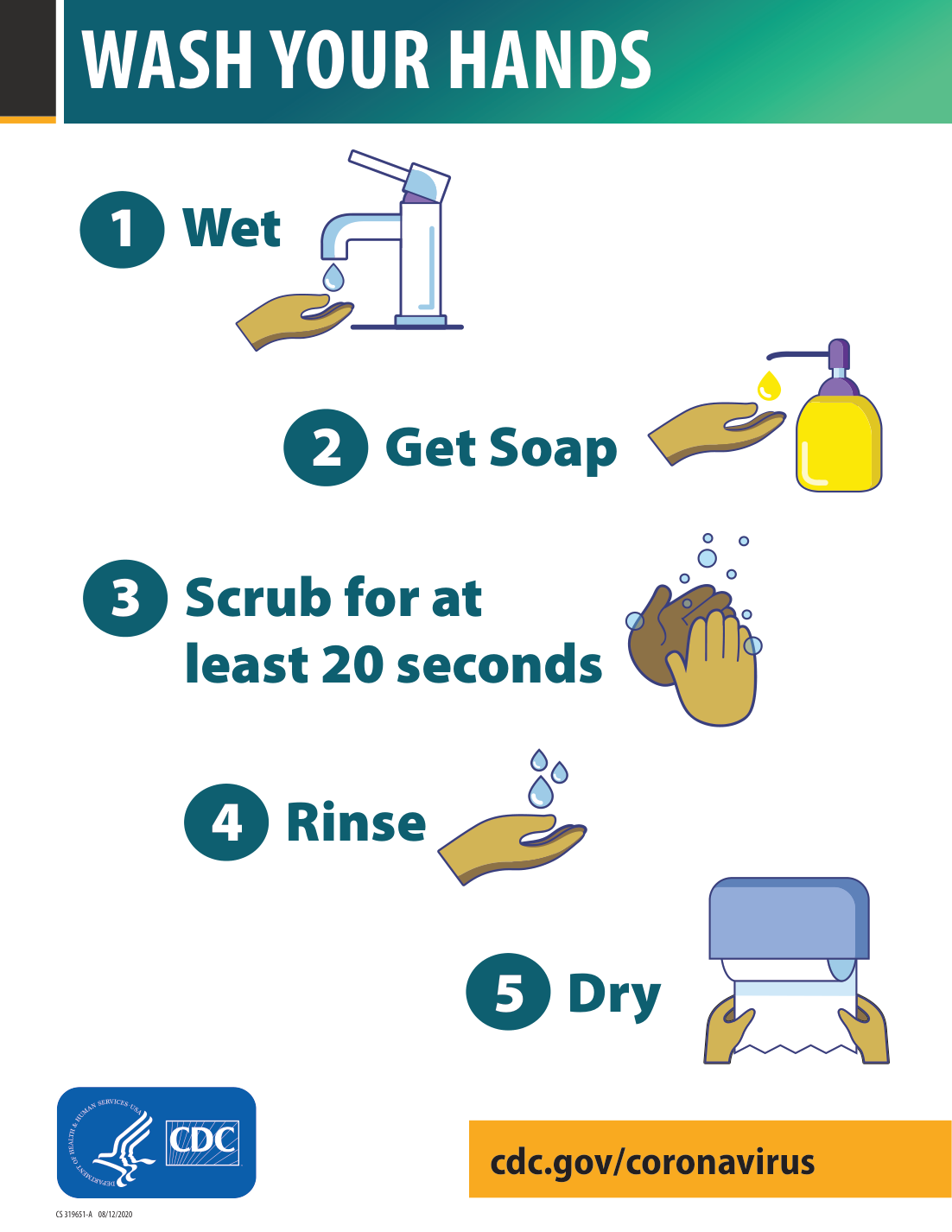
Source: Centers for Disease Control and Prevention, Wash Your Hands (2020). Use does not imply endorsement by CDC, ATSDR, HHS or the United States Government.
Which soap
Plain soap, bar or liquid. CDC says both work well, and that antibacterial soap gives no added benefit for people outside health care. A 2020 CDC document written for crowded, low-resource communities outside the U.S. during COVID-19 adds that bar, liquid and powdered soap all work, and that soapy water (water with enough powdered or liquid soap mixed in to foam when you rub your hands) can stand in for a bar, as long as a separate container of rinse water sits next to it.
FM 21-10 tells soldiers to stop using scented and perfumed soaps in the field, because they attract insects and can irritate skin. That is a good reason to stock an unscented bar in the kit.
Which water to use
You need less than you might think, but it has to be water you would be willing to have on your hands.
- Under a boil-water notice or a "do not drink" advisory: CDC says tap water may still be safe for handwashing. Follow what your water utility or health department says for your area.
- If local authorities or your doctor advise extra caution: CDC says to wash with water that has been boiled or disinfected. The methods and bleach doses are in how to purify water.
- With no clean running water and no soap or sanitizer: CDC says rinsing your hands with clear water still removes some germs. It is not as good as soap, but it is better than nothing. Water can be made safe for washing by boiling, by adding the right amount of disinfectant such as a mild bleach solution, or by filtering it.
- What not to use: CDC says to avoid cloudy water and water that may carry harmful chemicals or toxins, such as those from harmful algal blooms. It also says not to bathe in water that may hold sewage, toxic chemicals or floodwater. The same reasoning rules floodwater out for washing hands.
- Don't share a basin. CDC warns that water already used, for example for bathing, can carry germs that end up on your hands. Wash under a pour or a tap, not in a bowl of standing water.
If you are stretching a stored supply, keep washing water and drinking water in separate, labeled containers so no one dips a dirty hand or cup into the drinking supply. How to store water covers containers and amounts, and finding water at home covers the water already in your pipes and water heater.
Building a handwashing station
CDC's emergency hygiene page says that when clean tap water isn't available, you can set up a temporary handwashing station using a large water jug. It doesn't say how to build one. The most detailed CDC description we found is in the 2020 COVID-19 document mentioned above, which was written for crowded, low-resource communities abroad, not for U.S. households. Its list of what any station needs still fits a home station well. Paraphrased, a station should:
- let people wet and rinse their hands under a stream of running water;
- have soap or soapy water on hand;
- have a way to catch or drain the used water;
- supply single-use towels or paper towels where possible; and
- have a bin for the used towels.
It should also be sturdy and easy for children, older people and people with disabilities to use.
The jug-and-bucket station
The simplest version that meets all five points:
- Water: a food-grade water jug with a spigot (the kind sold for camping), set on a table, a sturdy box or the edge of a counter, with the spigot hanging over the edge.
- Catch bucket: a bucket underneath to catch the used water. Empty it before it is full, so it doesn't splash or tip.
- Soap: a bar on a dish or tied in a mesh bag to the jug handle so it stays off the ground (CDC's guidance suggests securing soap at shared stations with a cage or rope), or a pump bottle of liquid soap.
- Drying: paper towels and a lidded trash can or bag beside them. A household towel works if it stays clean; CDC says to change reusable towels when they look dirty or before they turn mildewy.
- Labels: mark the jug "washing water" if it isn't treated to drinking standard.
To use it: open the spigot just long enough to wet your hands, close it, soap and scrub for 20 seconds, then open it again to rinse. Closing the tap while you scrub is also what CDC's five steps say to do, and it saves most of the water.
When you don't have a jug with a tap
The same CDC document offers a fallback: a bucket of water and a cup or pitcher. Its drawback, which CDC names, is that you can't scrub under running water by yourself; a second person has to pour. In a household that is easy to arrange: one person pours a little water to wet, waits while the other soaps and scrubs, then pours again to rinse.
The same guidance pictures a bucket with a tap and a basin underneath to catch the used water, which is the jug station above, and a tippy tap, a low-cost hanging design it points to for places where many people share one station.
Where to put the stations
FM 21-10 says to put handwashing devices at both the latrines and the kitchen or food area, because those are the two places where germs get onto and off hands. The CDC document for crowded settings abroad makes the same point for households: have a station near the toilet.
FM 21-10 also says every handwashing and shower point should drain to a soakage pit, a hole in the ground that lets used water soak away instead of standing in puddles. For an Army field camp, it puts garbage and soakage pits at least 30 meters (about 100 feet) from the food service area. That distance is a military siting rule for a camp, not household guidance, and none of our sources gives a distance for a home. The idea behind it carries over: empty the catch bucket somewhere it can soak away, well clear of where you cook and of any well or water you collect, and don't leave it standing. Check local rules too; FM 21-10 itself tells units to follow local regulations on waste disposal.
FM 21-10's last instruction for the stations is simple and is the one most often forgotten: keep soap and water in them at all times. A station with an empty jug is worse than none, because people stop expecting it to work.
Hand sanitizer: what it does and doesn't do
Alcohol-based hand sanitizer is the right tool when there is no soap and water, and the wrong one when there is. CDC is clear on the order: soap and water first, sanitizer when they aren't available.
Choose 60% alcohol or more
CDC says to use a sanitizer with at least 60% alcohol, and to check the label to confirm it. Its research summary explains why: sanitizers with 60–95% alcohol kill germs better than those with less alcohol or non-alcohol formulas, and those under 60% may only slow germs' growth instead of killing them.
How to use it
- Put the amount the label says into the palm of one hand.
- Rub it over every surface of both hands, including between the fingers and the backs.
- Keep rubbing until your hands are dry, which CDC says takes about 20 seconds.
- Don't rinse it off or wipe it away before it dries. CDC says using too little or wiping it off early makes it less effective.
Where it falls short
| Situation | Sanitizer | Soap and water |
|---|---|---|
| Hands look clean, no water | Use it (60% alcohol or more) | Best, if available |
| Hands visibly dirty or greasy (gardening, cooking, fishing, camping) | May not work well | Use it |
| Norovirus, Cryptosporidium, C. difficile | Works less well | Works better |
| Pesticides, heavy metals such as lead, other chemicals | May not remove them | Use it, or follow poison control's instructions |
| Radioactive dust after a radiation emergency | Doesn't protect (Ready.gov) | Wash with soap and water |
Sources: CDC Hand Sanitizer Guidelines, CDC Hand Sanitizer Facts, Ready.gov Radiation Emergencies.
The third row matters most at home. Caring for someone with vomiting or diarrhea is exactly when sanitizer is weakest, so that is the time to use the wash station even if it costs water.
Hand sanitizer can poison children and catch fire
- Swallowing it is dangerous. FDA says drinking even a small amount can cause alcohol poisoning in a child. CDC says U.S. poison control centers took nearly 85,000 calls about children and hand sanitizer from 2011 to 2015. Keep it out of reach of children and pets, supervise young children when they use it (CDC), and avoid products packaged to look like food or drink or scented like food (FDA). If you suspect someone has swallowed it, MedlinePlus says to call Poison Control at 1-800-222-1222 right away. In a life-threatening emergency, call 911.
- It is flammable. FDA says to keep it away from heat and flame and to rub until your hands are completely dry before going near a stove, a candle, a heater, sparks or static. That is a real risk in an outage, when cooking and light both come from open flame. See cooking without power.
- Don't make your own. CDC does not recommend making or using homemade sanitizer, because the ingredients are easy to get wrong. Buy carefully, too: FDA warns that some products have been contaminated with potentially toxic types of alcohol, and its list of sanitizers consumers should not use includes products containing methanol. That list is no longer being updated (FDA now points to its recalls database), but its advice stands: if a label names no maker and the distributor won't say who made it, FDA recommends not using the product.
Wipes
CDC says hand sanitizing wipes with at least 60% alcohol do kill germs on hands. Baby wipes don't: CDC says they aren't designed to remove germs and may make hands look clean without reliably cleaning them. Disinfecting wipes are for surfaces, not skin, and CDC warns they may irritate it.
Cuts, wounds and diapers
Two jobs need extra care when water is short.
- Wounds. CDC says open cuts and rashes exposed to contaminated water can become infected, and some coastal waters carry Vibrio bacteria that infect wounds. Its advice: keep wounds out of floodwater and salt or brackish water, wash them well with soap and clean water, cover them with a waterproof bandage, and get medical care right away if a wound turns red, swollen or oozing. Wash your own hands before and after. Cleaning and dressing a wound is covered in wounds, cleaning and infection.
- Diapers. CDC notes that a microscopic amount of feces can carry millions of germs, which is why diaper changes need a wash afterward every time, emergency or not. Set up the changing spot next to the wash station, not on the table where food is served.
What not to do
- Don't skip the wash after the toilet or before food to save water. Those two are the ones to keep if you have to drop others.
- Don't wash in a shared basin of standing water (CDC).
- Don't use floodwater, cloudy water or water that may hold chemicals (CDC).
- Don't rely on sanitizer for dirty or greasy hands, or when someone in the house has diarrhea or vomiting (CDC).
- Don't wipe sanitizer off before it dries, and don't go near a flame until it has (CDC, FDA).
- Don't use baby wipes or surface wipes in place of washing (CDC).
- Don't make homemade sanitizer (CDC, FDA).
Handwashing kit for the household
- A food-grade water jug with a spigot, marked "washing water"
- A bucket to catch used water, and a second one as a spare
- Plain bar soap (unscented) and a bottle of liquid soap
- Paper towels, a trash bag or lidded can, and clean hand towels
- Alcohol-based hand sanitizer, at least 60% alcohol, stored out of children's reach
- Alcohol hand-sanitizing wipes (at least 60% alcohol) for the car and go-bags
- Bleach and a dropper to treat washing water if authorities advise it
- Waterproof bandages for cuts
- A second station's worth of supplies, so there can be one at the toilet and one at the kitchen
Stored soap and sanitizer get used up quickly once a station is running; add them to the household's rotation list so the stock stays full. For the rest of the sanitation setup, start with emergency toilets, and for the water itself, how to purify water.
Sources
- CDC — Guidelines for Personal Hygiene During an Emergency
- CDC — About Handwashing
- CDC — Hand Hygiene Frequently Asked Questions
- CDC — Hand Sanitizer Guidelines and Recommendations
- CDC — Hand Sanitizer Facts
- CDC — Wash Your Hands (handout, 2020)
- CDC — How to mitigate COVID-19 transmission in densely populated areas globally (2020; written for low-resource settings outside the U.S.)
- FDA — Safely Using Hand Sanitizer
- FDA — Hand sanitizers consumers should not use
- U.S. Army — FM 21-10, Field Hygiene and Sanitation (2000)
- Ready.gov — Radiation Emergencies
- MedlinePlus (NIH) — Poisoning
Terms used in this chapter
- boil-water notice
- An official notice that tap water should be boiled before use. Follow it: bring clear water to a rolling boil for 1 minute, or 3 minutes at high altitude. Boiling kills all three kinds of germs.
- CERT
- FEMA's Community Emergency Response Team program, which trains neighborhood volunteers in disaster first aid and scene size-up, to give life-saving care until professional responders arrive.
- cholera
- A diarrheal disease spread through contaminated water and food that can kill through dehydration within a few hours. CDC says many people with it can be fully rehydrated by drinking ORS.
- cover material
- Dry, carbon-based material such as sawdust, dry leaves, straw or shredded paper, a cupful or handful of it put over waste in an emergency toilet after each use to dry it and control odor.
- Cryptosporidium
- A protozoan parasite with oocysts 4–6 microns across. Boiling kills it, chlorine and iodine work poorly on it, chlorine dioxide is somewhat effective, and a filter of 1 micron or smaller removes it.
- food-grade
- Made for holding food or drinking water. CDC recommends FDA-approved food-grade water storage containers and suggests asking the manufacturer if you aren't sure a container qualifies.
- pail latrine
- The Army's field toilet for ground too hard to dig or a water table too high: a seat box set over a pail. FM 21-10 says pail latrines are emptied and cleaned daily.
- soakage pit
- A hole in the ground that lets used wash water soak away instead of standing in puddles. FM 21-10 says every handwashing and shower point should drain to one.
- tippy tap
- A low-cost hanging handwashing station, which CDC's 2020 guidance for crowded, low-resource settings points to for places where many people share one station.
- two-bucket toilet
- An emergency toilet that keeps urine and feces apart: urine in one bucket, diluted and poured on soil daily; feces in a bag-lined bucket, covered with dry material after each use.