Chapter 4 · Medical & First Aid
Tourniquets compared: which to buy, and how to spot a fake
A tourniquet is the one item in a kit that has to work the first time, under full force, in hands that are shaking. Here is which models the military's trauma committee recommends, how they differ, why cheap copies break, and how to practice without wearing out the real one.
Read first: Severe bleeding
When to call 911
Any bleeding bad enough for a tourniquet is a 911 call. Call (or have someone call) when you see the signs FEMA's CERT manual gives for life-threatening bleeding:
- Blood spurting or flowing steadily
- Blood pooling on the ground
- Blood soaking through clothing or bandages
- An amputated arm or leg
Then stop the bleeding. Once a tourniquet is on, leave it on: CERT says to leave it in place until EMS takes over, and the Army's ATP 4-02.11 says only medical personnel should remove it. The step-by-step application is on severe bleeding.
This page is about the device itself: which kind to buy, how the designs differ, how to tell a real one from a counterfeit, and how to store and practice with it. How to put one on is taught step by step in severe bleeding: pressure, packing and tourniquets, and it is best learned in a hands-on class (see the end of this page).
Why a commercial tourniquet
You can make a tourniquet from a belt or a strip of cloth and a stick. The sources are blunt about how well that works. The Army's first aid manual, ATP 4-02.11, says improvised tourniquets are much less effective than commercial ones, are hard to make and apply without a lot of practice, and should be an absolute last resort. Its list of risks: a band too narrow can damage skin, the bleeding may get worse or not be fully controlled, and an improvised one tends to loosen over time. FEMA's CERT manual says improvised tourniquets often fail.
A purpose-built tourniquet solves the problems that make improvised ones fail. Its strap is wide and doesn't stretch. Its mechanism, a rod or a ratchet, gives enough mechanical advantage to squeeze an artery shut. And it locks, so it doesn't unwind while the person is moved. ATP 4-02.11 calls the tourniquet the most vital lifesaving item in a first aid kit.
Who decides which tourniquets are recommended
The Committee on Tactical Combat Casualty Care (CoTCCC) is the Defense Department committee that sets the standard for battlefield trauma care. Among other things it keeps a list of recommended devices. The DoD STOP THE BLEED® program names the committee as its own reference: the body that reviews the evidence and publishes that list. The CoTCCC doesn't sell or make anything; inclusion on the list means the committee recommends a device for the military's use.
What the list says
The list is published on the Deployed Medicine website, which is where the Joint Trauma System's CoTCCC page links for it. Deployed Medicine says that since 14 December 2023 its content can only be read after signing in, so we did not read the current list. For this page we read the two most recent copies we could find in public: the 15 December 2021 edition, posted by the County of San Diego's EMS office (which has stamped its own "approved" labels on it), and the 1 August 2019 edition, on a third-party content server. Neither is an official DoD copy, and both are older than the current list. Their limb tourniquet sections are identical.
| Tourniquet (common name) | Type | Maker | On the CoTCCC list (2019 and 2021) | Accepted for DoD STOP THE BLEED® kits |
|---|---|---|---|---|
| Combat Application Tourniquet (C-A-T) Gen 7 | Windlass | North American Rescue | Yes (Gen 6 listed only until replaced by Gen 7) | Yes |
| SOF Tactical Tourniquet–Wide (SOFTT-W) | Windlass | TacMed Solutions | Yes | Yes |
| SAM Extremity Tourniquet (SAM XT) | Windlass with auto-locking buckle | SAM Medical | Yes | Yes |
| Tactical Mechanical Tourniquet (TMT) | Windlass | Alphapointe (per DoD) | Yes | Yes |
| Ratcheting Medical Tourniquet (RMT) Tactical | Ratchet | m2 inc. | Yes | No |
| TX2 Tourniquet | Ratchet | RevMedx | Yes | No |
| TX3 Tourniquet | Ratchet | RevMedx | Yes | No |
| Emergency Medical Tourniquet (EMT) | Pneumatic (inflatable) | Not named on the list | Yes, as a pneumatic limb tourniquet | No |
| Tactical Pneumatic Tourniquet 2" (TPT2) | Pneumatic (inflatable) | Not named on the list | Yes, as a pneumatic limb tourniquet | No |
Two caveats. First, the list may have changed since December 2021; the current one is behind the sign-in. The DoD STOP THE BLEED® program, writing in 2026, says all four of the tourniquets it accepts are on the CoTCCC list, which is consistent with the 2021 edition. Second, the list is written for military use by trained personnel. It is not a civilian approval.
The civilian shortlist
For a household, the more useful list is the DoD STOP THE BLEED® program's. It accepts four tourniquets for the kits sold under its name: the C-A-T, the SOFTT-W, the SAM XT and the TMT. It explains why: each is an FDA-regulated device from a maker registered and listed with FDA, each is on the CoTCCC list, and each is one that a member of the public can apply after a STOP THE BLEED® class. The program adds that FDA registration and listing are not FDA approval, and it does not recommend any of the four over the others.
All four are windlass types. If you are buying one tourniquet for a home or car kit, any of those four fits both lists.
Windlass, ratchet and auto-lock: how they differ
Every limb tourniquet does the same job: it closes the artery by squeezing the limb hard enough, all the way around (Fig. 4-3). They differ in how they get there.
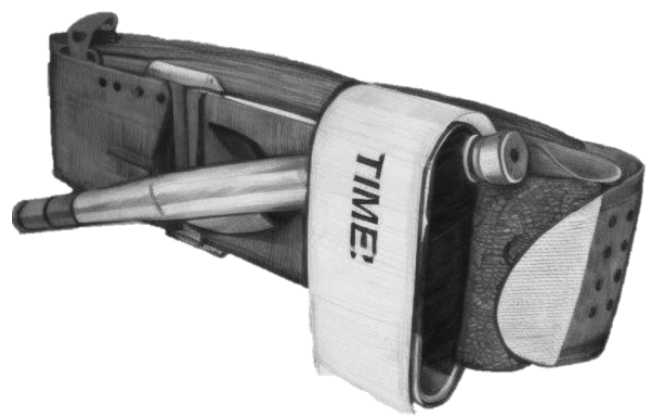
- The rod (the windlass) is twisted to tighten the strap until the bleeding stops, then locked in its clip.
- The white strap marked TIME is where the time it went on is written.
Fig. 4-5 from U.S. Army ATP 4-02.11, Casualty Response, Tactical Combat Casualty Care, and First Aid (23 March 2026), p. 48. Public domain; cropped. Not endorsed by the U.S. Army or Department of Defense.
Windlass. A strap goes around the limb and is pulled tight, then a rod (the windlass) is twisted to tighten an internal band further, and the rod is locked in a clip. ATP 4-02.11 describes the C-A-T's parts this way: the windlass rod for twisting, a clip to lock it, a safety strap over it, and a routing buckle the band runs through. The Army's steps stress pulling every bit of slack out of the strap before twisting, because a loose strap uses up the rod's turns before the artery closes.
Ratchet. Instead of a rod, a buckle with teeth ratchets the strap tighter, like a ski-boot buckle. RevMedx says its TX2 can be applied one-handed in under 30 seconds. ATP 4-02.11 names one-handed windlass and one-handed ratchet tourniquets as the tourniquets of choice for self-aid to an arm, because both can be applied quickly with one hand.
Auto-locking buckle. The SAM XT is a windlass tourniquet with a buckle that, according to SAM Medical, locks automatically once the strap reaches a set tension, taking out nearly all slack before you start twisting. SAM says slack is the main cause of failed applications, and its design aims to make the number of windlass turns predictable.
Opening buckle. Some designs let the strap come apart completely so it can be wrapped around a trapped limb instead of slid over a hand or foot. DoD lists this for the SOFTT-W and TMT; TacMed says its SOF buckle unhooks and rehooks for confined spaces and trapped limbs.
| Windlass (C-A-T, SOFTT-W, TMT) | Windlass with auto-lock buckle (SAM XT) | Ratchet (TX2, TX3, RMT) | |
|---|---|---|---|
| How it tightens | Strap pulled tight, then a rod twisted and locked | Buckle locks at set tension, then a rod twisted and locked | Toothed buckle ratchets the strap |
| One-handed on your own arm | Yes; DoD says each of the three can be applied one-handed | Not stated by the sources read | Yes, RevMedx says one-handed |
| In ATP 4-02.11 | Main type in military issue (C-A-T) | Not discussed by name | Named with windlass as a tourniquet of choice for self-aid |
| Accepted for DoD STOP THE BLEED® kits, as a tourniquet the public can apply after the class | Yes | Yes | No |
Width. A wider strap spreads the pressure. On the 2021 list the SOFTT-W's nomenclature gives a 1.5-inch strap; North American Rescue gives the C-A-T's strap as 1.5 inches; DoD describes the TMT as 2 inches wide. For improvised tourniquets, ATP 4-02.11 says to fold the material to about 1½ to 2 inches, which severe bleeding discusses alongside the AHA's 2-inch minimum.
Counterfeits, and why they fail
Counterfeit tourniquets are copies made to look like a recommended model, often down to the logo, but not made to its specification. They are a known, long-running problem.
- What happened in 2010. The Army warned in June 2010 that counterfeit C-A-Ts were being sold online and on the open market. One copy, called the E-CAT, was made in Hong Kong for about $8.50 each and was close enough to the real thing to be hard to tell apart. Army officials said its rod could bend to the point that it could not work, so it would not stop bleeding, and the Army warned that mistaking one for a genuine C-A-T could be fatal.
- Still happening. North American Rescue, which sells the C-A-T, says a large volume of Chinese-made counterfeits is reaching first responders and medical providers, that the fakes come in different packaging, and that they have been known to break. It says the genuine C-A-T is made only in the United States, and that a General Exclusion Order obtained with its partner CAT Resources lets U.S. Customs and Border Protection inspect and seize suspected counterfeits at import.
- The government's view in 2026. The DoD STOP THE BLEED® program says counterfeit tourniquets are common on online marketplaces and can fail under load.
Why it matters so much. A tourniquet is the one device that has to take full force at once. The windlass rod and its clip carry that force. A rod molded from weaker plastic can bend or snap at exactly the moment the artery is nearly closed, and the person applying it may not realize until the bleeding resumes. ATP 4-02.11 lists not tightening a tourniquet enough as one of the common errors; a fake that can't be tightened enough makes that error for you.
How to avoid one
- Buy from the maker or a seller it authorizes. The DoD program's advice is to buy from licensed sellers. The Army's 2010 advice to units was to order through approved supply channels, not cheap online listings.
- Be suspicious of a low price. In 2010 the Army gave the genuine C-A-T's unit cost as $27.28 against the counterfeit's $8.50. On the date we checked, the makers' own list prices for three of the four DoD-accepted models were $34.99 to $37.95 (comparison below; we did not check the TMT). A "real" one for much less deserves a hard look.
- Check the packaging and markings. DoD says to look more closely if the price or packaging seems off. North American Rescue's advice is to compare a suspect tourniquet side by side with a genuine one, including its packaging, and to contact the company if unsure.
- Know the stock number. The C-A-T's national stock number is 6515-01-521-7976 (on the CoTCCC list, the Army's 2010 notice and the maker's page); the SAM XT's black model is 6515-01-670-2240. A listing that gets these wrong is a warning sign, though a counterfeiter can copy a number too.
- If you already own one you doubt, replace it. Don't rely on a tourniquet you wouldn't trust on your own leg.
Training tourniquets
You need to practice. The Army's target for soldiers in combat, in ATP 4-02.11, is bleeding stopped within one minute and the tourniquet secured within three; speed like that comes only from repetition. But the tourniquet in your kit should be the one that has never been stressed.
That is what training tourniquets are for. North American Rescue sells a fully working Gen 7 C-A-T colored blue (its "Trainer Blue," item 30-0033) to mark it as a training device, so trainers and real tourniquets can't be mixed up; the real ones come in tactical black and rescue orange. The DoD program's class pages describe hands-on practice on a training limb with training equipment.
Our practical suggestion, not a source's rule: buy a trainer (or use the class's), practice with it until the steps are automatic, and keep the real one sealed in the kit. If you practice with your real one, inspect it afterward and replace it if anything is bent, frayed or slow to lock.
Storage and carry
- Where you can reach it. ATP 4-02.11 says tourniquets should be kept easily accessible in a standard location, and not at the bottom of a pack, so an injured person can reach and apply their own. At home, that means the trauma kit in a known place; in a car, somewhere you can reach from the driver's seat or beside the first aid kit.
- Check it yearly. The American College of Surgeons advises checking bleeding-control kits once a year for expired or damaged supplies. RevMedx states its TX2 has no expiration date. North American Rescue says the C-A-T has no shelf life as long as it stays unused in its protective packaging and is stored somewhere dry, dark and climate-controlled. The SAM XT and SOF pages we read didn't state a shelf life. Check the package and the maker's instructions for use.
- One per person at risk, and a spare. The Army's Generation II IFAK carries two C-A-Ts. CERT's steps say to place a second tourniquet if the bleeding doesn't stop, and ATP 4-02.11 notes a second may be needed especially for severe thigh wounds.
Tourniquets compared
All four models are on the 2021 CoTCCC recommended list; the first three are among the four the DoD STOP THE BLEED® program accepts for public kits. Buy from the maker or an authorized seller, because counterfeits are common online. Specs and prices are the makers' own, as published on the date shown.
North American Rescue
Combat Application Tourniquet (C-A-T) Gen 7
- Type
- Windlass, single routing buckle, windlass clip and strap
- Strap width
- 1.5 in
- Open length
- 37.5 in
- Weight
- 2.7 oz
- NSN
- 6515-01-521-7976
- Colors
- Tactical black (30-0001), rescue orange (30-0023); trainer blue (30-0033) is for practice only
- Accepted for DoD STOP THE BLEED® kits
- Yes
- Price on maker site
- As low as $34.99 (listing for item 30-0001-s)
SAM Medical
SAM XT Tourniquet, metal windlass (XT600)
- Type
- Windlass with TRUFORCE auto-locking buckle
- Buckle range
- Locks within 5.75 to 32.5 in circumference
- Colors
- Tactical black, hi-viz orange, hi-viz blue
- NSN
- 6515-01-670-2240 (black)
- Accepted for DoD STOP THE BLEED® kits
- Yes
- Price on maker site
- $37.95
TacMed Solutions
SOF® Tourniquet (wide)
- Type
- Windlass, aircraft-grade aluminum rod; buckle unhooks for trapped limbs
- Size
- 5.5 x 2 x 1.75 in folded in package
- Weight
- 3.7 oz
- NSN
- 6515-01-696-4522
- Name
- DoD and the CoTCCC call the model SOFTT-W; the 2019 and 2021 CoTCCC lists give it NSN 6515-01-587-9943, a different number from the maker's; we could not confirm why
- Accepted for DoD STOP THE BLEED® kits
- Yes (as SOFTT-W)
- Price on maker site
- $34.99
RevMedx
TX2 Ratcheting Tourniquet
- Type
- Ratcheting buckle, nylon strap
- One-handed
- Maker says under 30 seconds
- Expiration
- Maker says no expiration date
- Accepted for DoD STOP THE BLEED® kits
- No (on the CoTCCC list)
- Availability
- Unavailable on the date checked
- Price on maker site
- $39.95
Specs are the makers’ published figures, read November 3, 2026. “Used” marks gear the editor has used; the rest is compared on specs only. How we compare gear.
What not to do
- Don't buy a tourniquet from an unknown online seller at a bargain price. That is where counterfeits are sold (Army, NAR, DoD).
- Don't stock an improvised tourniquet instead of a real one. The Army calls improvised tourniquets much less effective and a last resort.
- Don't train with the tourniquet you'll rely on. Use a trainer and keep the real one ready.
- Don't loosen or remove a tourniquet once it has stopped the bleeding; CERT and the Army both leave that to EMS and medical staff. See severe bleeding.
- Don't put the tourniquet at the bottom of a bag. ATP 4-02.11 says to keep it where it can be reached fast.
Where to get trained
The equipment is the easy part. Choosing between these models matters far less than knowing how to use the one you have.
- STOP THE BLEED® class. The DoD program's training page says the class runs about an hour, mostly hands-on, teaching direct pressure, wound packing and tourniquet application, and is typically free or at cost. Licensed classes are listed on the DoD STOP THE BLEED® training page and the American College of Surgeons' Stop the Bleed training page; the ACS FAQ says most courses take no more than 90 minutes and there is no minimum age.
- CERT. FEMA's Community Emergency Response Team course teaches tourniquets as part of disaster bleeding control; see the participant manual, Unit 3.
- Our suggestion: ask the instructor whether you can practice with the same model you carry, so the class trains your hands for that design.
Sources
- U.S. Department of Defense STOP THE BLEED® Program — Tourniquets
- U.S. Department of Defense STOP THE BLEED® Program — Training
- U.S. Department of Defense STOP THE BLEED® Program — Equipment: what to know before you buy (September 25, 2026)
- Committee on Tactical Combat Casualty Care — CoTCCC Recommended Devices & Adjuncts, as of 15 Dec 2021 (copy hosted by County of San Diego EMS)
- Committee on Tactical Combat Casualty Care — CoTCCC Recommended Devices & Adjuncts, as of 01 Aug 2019 (copy on the learning-media.allogy.com content server)
- Joint Trauma System — CoTCCC Guidelines (links to the recommended devices list on Deployed Medicine)
- Deployed Medicine — CoTCCC Recommended Devices & Adjuncts (sign-in notice)
- U.S. Army — ATP 4-02.11, Casualty Response, Tactical Combat Casualty Care, and First Aid (2026), Chapter 4
- FEMA — CERT Basic Training Participant Manual (2019), Unit 3
- U.S. Army — Bogus tourniquets could endanger lives in combat situations (June 10, 2010)
- North American Rescue — General Exclusion Order Blocks Importation of Counterfeit Tourniquets
- North American Rescue — Combat Application Tourniquet (C-A-T)
- North American Rescue — C-A-T Product Information Sheet (REV021226)
- SAM Medical — SAM XT Tourniquet
- TacMed Solutions — SOF® Tourniquet
- RevMedx — TX2 Ratcheting Tourniquet
- American College of Surgeons — Stop the Bleed: FAQ
- American College of Surgeons — Stop the Bleed: Get Trained