The Minuteman Almanac
Field Manual
Chapter 9
Communications
Radio services and licenses, weather radio, a household radio plan, antennas, ham, mesh and satellite.
Edition of November 3, 2026 · 6 articles
This manual is rebuilt whenever the chapter changes; the current edition is always at minutemanalmanac.com/print/communications/. It is for planning and learning, not medical, legal or electrical advice. In an emergency, follow official instructions.
Contents
- 9.1GMRS, FRS, MURS, CB or ham: which radio service fits a household plan
- 9.2How to get a GMRS license, step by step
- 9.3NOAA Weather Radio: how it works and how to choose a receiver
- 9.4The household radio plan, in full
- 9.6Getting an amateur (ham) radio license
- 9.11Emergency alerts on your phone, and texting when networks are busy
9.1 · Chapter 9, Communications
GMRS, FRS, MURS, CB or ham: which radio service fits a household plan
When phones go down, a household needs a way to reach its own people across a neighborhood. Five radio services can do it, each with different rules. Here is what each allows, why range is rarely what the box says, and how to put a simple plan on paper.
A cell phone depends on towers, power and network links that a hurricane, wildfire or long outage can take down. A pair of two-way radios doesn't depend on any of that. One radio talks straight to another, with nothing in between.
The catch is that "walkie-talkie" covers five different radio services in the United States, each set up by the Federal Communications Commission (FCC) with its own channels, power limits and license rules. Buying the right radio starts with knowing which service it belongs to.
The five services side by side
All figures below are from the FCC's rules (47 CFR Parts 95 and 97). Where the FCC's summary pages and the rule text differ, the rule text is used.
| FRS | GMRS | MURS | CB | Amateur (ham) | |
|---|---|---|---|---|---|
| License | None (licensed by rule) | Yes, issued to an individual; no exam | None (licensed by rule) | None (licensed by rule) | Yes, after a written exam |
| Cost | None | $35, 10 years | None | None | $35 FCC fee, 10 years |
| Who may use it | Anyone, any age | Licensee (18 or older) and immediate family of any age | Anyone, any age | Anyone, any age | Licensed operators, any age; others may speak with a licensed control operator present |
| Channels / band | 22 channels, 462–467 MHz (UHF) | 30 channels, 462–467 MHz (UHF); shares FRS's 22 | 5 channels, 151–154 MHz (VHF) | 40 channels, 26.965–27.405 MHz | 29 small bands allocated internationally, spread across the spectrum |
| Power limit | 2 W ERP on channels 1–7 and 15–22; 0.5 W ERP on 8–14 | Up to 50 W transmitter output on the main channels (mobile, base, repeater); 5 W ERP on 462 MHz interstitials; 0.5 W ERP on 467 MHz interstitials | 2 W transmitter output | 4 W carrier (AM/FM); 12 W peak envelope (SSB) | Up to 1,500 W peak envelope; less on some bands and for some license classes |
| Antenna | Built in, can't be removed | May be detachable (handhelds that send data must have a fixed antenna) | External antenna allowed, up to 60 ft above ground or 20 ft above its structure | External antenna allowed, same 60 ft / 20 ft limit | Your own design, within station rules |
| Repeaters | No | Yes | No (prohibited) | None in the rules | Yes |
| Typical use | Short-range family and group talk | Family network across a neighborhood or town, with or without a repeater | Short-range voice, data, telemetry and remote control | Personal and business talk, help for highway travelers | Self-training and experimentation; contact from local to worldwide |
A few points the table can't hold:
- FRS and GMRS share frequencies. Every one of FRS's 22 channels is also a GMRS channel. An FRS radio and a GMRS radio on the same channel can talk to each other. The difference is power, antenna and the extra eight GMRS repeater channels. The GMRS license guide has the full channel map.
- Combination radios are gone. Since September 30, 2019, no one may make, import or sell a radio certified for both FRS and GMRS. Older "FRS/GMRS" radios are treated as FRS radios if they stay within FRS channels and power, and as GMRS radios (needing a license) if they don't.
- CB channel 9 is for emergencies and traveler help only. Nothing else may be sent on it. CB conversations are limited to five minutes, followed by at least a one-minute break on that channel, except during emergencies or when helping a traveler.
- CB operators may use a handle (an on-air nickname). GMRS and ham operators must identify with an FCC call sign. MURS doesn't require station identification at all.
- No amplifiers on CB. The rules forbid any external power amplifier on a CB radio, with no exceptions.
Which service fits which job
- Kids and grandparents who just need to reach the house: FRS. No license and nothing to set up. Expect up to about two miles on the 2-watt channels in good conditions.
- A household that wants range and a backup plan: GMRS. One $35 license covers the licensee's immediate family. Handhelds commonly run 5 watts, mobile radios in a car or at home can run far more, and repeaters can carry a signal across a town.
- A property with outbuildings or a long driveway: MURS. It needs no license, it allows an external antenna (which the FCC says can stretch range to ten miles or more), and it may carry data and remote-control signals as well as voice. Its five channels are on VHF, separate from the FRS/GMRS channels.
- The road: CB. Its rules are built around personal use and help for highway travelers, with channel 9 set aside for emergencies and traveler assistance.
- Contact beyond your town: amateur radio. It is the only one of the five built for contact beyond your area; the FCC notes that amateurs around the world talk directly and through relay systems and satellites. It takes study and an exam. The Technician license is the usual starting point: a 35-question exam on which 26 correct answers pass.
Why range is rarely what the box says
Packages print "36 miles" or "38 miles." The FCC's own figures are more sober: it says FRS usually reaches less than half a mile on the 0.5-watt channels and up to about two miles on the 2-watt channels, MURS usually reaches less than a few miles (ten or more with an external antenna), and GMRS covers one to twenty-five miles depending on the type of station, the terrain and whether a repeater is in use.
The gap comes from three things.
1. Antenna height comes first
The frequencies used by FRS, GMRS and MURS (VHF and UHF) travel essentially in straight lines. They don't follow the curve of the earth, so the ground falls away beneath the signal as distance grows. National Weather Service engineers describe the same effect for their own VHF broadcasts: past a certain distance the radio wave simply overshoots the receiver, and the higher the antenna, the better the reception.
That is why two hikers on facing ridges can talk for miles while two people on the same street, holding radios at chest height between houses, may lose each other within a few blocks. Raising an antenna, whether by standing on a deck, going upstairs or mounting a base antenna on a roof, often helps more than any extra power (Fig. 9-1).

- A handheld held at about 5 feet reaches about 3 miles to its radio horizon.
- The same radio on an antenna 30 feet up reaches about 7.7 miles. Two stations both at 30 feet can reach about 15 miles over flat ground, because their horizons add.
- Hills and buildings block VHF and UHF signals. More power doesn't get through; height or a repeater does.
- The radio horizon is where the straight path meets the curve of the earth. It lies a little beyond the visible horizon, because the air bends radio waves slightly.
Drawn for The Minuteman Almanac. Distances from the standard radio-horizon approximation, about 1.41 × the square root of the antenna height in feet, in miles. The bending that carries the radio horizon past the visible one is described in U.S. Navy NEETS Module 10, p. 2-22.
2. Terrain and buildings block the path
Anything solid between two antennas absorbs or reflects the signal. Hills, dense woods and the steel and concrete of a city all cut range sharply; open water and flat ground extend it. The FCC's guide notes that MURS range varies with antenna height, terrain and weather, and the same is true of every service.
3. Power helps, but less than you'd think
More power pushes a signal farther, but it can't push it through a hill or over the horizon. Raising an antenna above the obstacles can do more than extra watts. This is also why a GMRS repeater, an antenna placed high on a tower or hilltop that receives on one frequency and rebroadcasts on another, can stretch a 5-watt handheld across a town. FRS radios can't use repeaters because they can't transmit on the repeater input channels.
What range claims mean
Maker range figures assume ideal conditions: line of sight, often from one high point to another. Treat them as a ceiling, not a promise. Test your own radios from the places you'd actually stand.
Write a one-page household radio plan
Radios sitting in a drawer are not a plan. A plan is a single sheet that everyone in the house has read, with a copy in each kit and one taped inside a cabinet door. Keep it to one page, so it gets read.
Who carries which radio
List each person and the radio they carry. Note which radios need a license (GMRS) and whose license covers them. Children and other family members can operate under a parent's GMRS license, so write the call sign on the sheet. Mark which radios use rechargeable packs and which take AA batteries, because that decides what you need to stock. A portable power station can keep packs charged through a long outage.
Primary and backup channels
Pick one primary channel and one backup. Write them down by number and frequency, because makers count channels differently: one FRS radio in the comparison below advertises 36 channels, though FRS has only 22 frequencies. If a privacy code (a CTCSS or DCS tone) is used, write that down too, and set every radio in the house the same way.
If everyone in the house has a GMRS or FRS radio, choose a primary from the channels both kinds can use at full FRS power (channels 1–7 or 15–22). Avoid channels 8–14 for anything important; FRS radios are limited to half a watt there.
Check-in times
Agree on times when everyone turns radios on and listens, even if nothing is happening. A common pattern is a few minutes at the top of each hour during an emergency, or at set times such as 8 a.m., noon and 6 p.m. to save batteries. Practice once a month on an ordinary day: everyone checks in from where they'd actually be, and you learn where the radios fail.
A meeting point if radios fail
Radios run out of batteries, get dropped and lose range. Name a meeting place near home (a neighbor's porch, the end of the street) and one outside the neighborhood (a relative's house, a church, a school). Write a time window: "If we can't reach each other, go to the meeting point and wait until the next even hour."
Who to listen to
Add a line for official information: your local NOAA Weather Radio frequency and county code (see the weather radio guide), and the local AM or FM stations that carry emergency broadcasts. Several of the handhelds compared below include a weather-radio receiver.
One-page household radio plan
- Each person's name, the radio they carry, and its battery type
- GMRS licensee name and call sign (if any radio is GMRS)
- Primary channel: number, frequency and privacy code
- Backup channel: number, frequency and privacy code
- Repeater (if used): name, output frequency and tone
- Check-in times during an emergency
- Monthly practice day
- Meeting point near home
- Meeting point outside the neighborhood, with a time window
- Out-of-area contact person and phone number
- NOAA Weather Radio frequency and your county's SAME code
- Local emergency broadcast stations (AM and FM)
- Where the spare batteries and chargers are kept
- A copy of this sheet in every go-bag and one posted at home
Put the sheet with your 72-hour kit and review it whenever someone moves, gets a new phone number or a new radio.
Rules worth knowing before you key up
- Emergencies come first. On GMRS and CB, any channel may be used for emergency messages and help to travelers, and operators must give emergency traffic priority on every channel. Ham rules likewise allow any means of communication when life or property is in immediate danger and normal systems are down.
- No business advertising, music or entertainment on GMRS or CB, and no coded messages on GMRS (the common "10 codes" are allowed).
- Use certified radios. FRS, GMRS, MURS and CB radios must be FCC-certified for that service. Operating a radio that isn't certified for the service, or one that requires a license you don't hold, can bring fines or seizure of the equipment.
- Don't modify. FRS radios must have built-in antennas, and CB radios may not be modified to raise power.
GMRS handheld radios compared
GMRS radios need an FCC license ($35, covers your immediate family); the FRS pair at the end needs none. Range figures are the makers' best-case claims; the FCC puts typical GMRS range at 1 to 25 miles. Specs are the makers' own, as published on the date shown.
Midland
GXT1000 GMRS Walkie Talkie 2-Pack (GXT1000VP4)
- Service
- GMRS (license required)
- Channels (maker's count)
- 22 channels plus 28 extra channels
- Privacy codes
- 142
- Transmit power
- Not stated on the product page
- Weather radio
- NOAA weather alert with weather scan
- Water resistance
- JIS4 (light rain and splashing)
- Maker's range claim
- 36 miles in open areas with little or no obstruction
- In the box
- 2 radios, rechargeable packs, desktop charger, AC and DC adapters, 2 boom-mic headsets
- Price on maker site
- $99.99 for two
BTECH
GMRS-PRO
- Service
- GMRS (license required)
- Transmit power
- 1 W / 3 W / 5 W
- Repeaters
- Supported, with split tones
- Memory channels
- 180 (6 banks of 30)
- Text and location
- Off-grid texting, GPS and compass
- Weather radio
- NOAA alerts
- Water resistance
- IP67 (submersible to 1 m for 30 minutes)
- Battery
- 2,600 mAh, USB-C charging
- Price on maker site
- $154.89 each
Midland
GXT67 Pro GMRS 5-Watt Walkie Talkie (GXT67PRO)
- Service
- GMRS (license required)
- Transmit power
- 5 W
- Repeaters
- Repeater capable; 8 GMRS repeater channels with split tones
- Channels (maker's count)
- Up to 99, including 22 standard GMRS/FRS channels and up to 49 user-defined
- Privacy codes
- 142
- Weather radio
- NOAA weather alert
- Water resistance
- IP67 waterproof and dustproof
- Battery
- Up to 4-day battery life, 4-hour rapid charge (maker's figures)
- Price on maker site
- $219.99 each
Midland
T71 X-Talker FRS Walkie Talkie 2-Pack (T71VP3)
- Service
- FRS only: no license needed (not a GMRS radio)
- Channels (maker's count)
- 36 (FRS itself has 22 frequencies)
- Privacy codes
- 121
- Transmit power
- Hi/Lo settings (FRS caps power at 2 W ERP)
- Weather radio
- Weather alert with weather scan
- Repeaters
- No (FRS radios cannot use repeaters)
- Maker's range claim
- Up to 38 miles
- Price on maker site
- $99.99 for two
Specs are the makers’ published figures, read November 2, 2026. “Used” marks gear the editor has used; the rest is compared on specs only. How we compare gear.
Sources
- eCFR — 47 CFR Part 95, Personal Radio Services (FRS Subpart B, CB Subpart D, GMRS Subpart E, MURS Subpart J)
- eCFR — 47 CFR Part 97, Amateur Radio Service
- FCC — General Mobile Radio Service (GMRS)
- FCC — Family Radio Service (FRS)
- FCC — Multi-Use Radio Service (MURS)
- FCC — Citizens Band Radio Service (CBRS)
- FCC — Amateur Radio Service
- FCC — Personal Radio Services (consumer guide)
- FCC — Personal Service and Amateur Application Fees
- NWS Albuquerque — NOAA Weather Radio reception
- U.S. Navy — NEETS Module 10, Wave Propagation, Transmission Lines, and Antennas, p. 2-22
9.2 · Chapter 9, Communications
How to get a GMRS license, step by step
One $35 license, no exam, good for ten years, and it covers your whole immediate family. Here is how to file it on the FCC's own system, what the license lets you do, and the GMRS channel map in plain terms.
The General Mobile Radio Service (GMRS) is the most useful radio service for most households: more power than the license-free Family Radio Service (FRS), removable antennas, and access to repeaters that can carry a handheld's signal across a town. In exchange, the FCC requires a license. Getting one is done online, costs $35, and involves no test.
This guide follows the FCC's own filing instructions and the rules in 47 CFR Part 95, Subpart E. If you're still deciding between GMRS and the other services, start with which radio service fits a household plan.
Who can get a license and who it covers
- Age and eligibility. You must be at least 18 and not a representative of a foreign government. New GMRS licenses go only to individuals; businesses can't get new ones. (A few licenses issued to businesses before July 31, 1987, are grandfathered and can be renewed.)
- Your immediate family is covered. The licensee may let immediate family members operate the licensee's GMRS radios. The rule defines immediate family as spouse, children, grandchildren, stepchildren, parents, grandparents, stepparents, brothers, sisters, aunts, uncles, nieces, nephews and in-laws. The FCC's GMRS page notes that family members can operate regardless of age.
- You're responsible. The licensee answers for how every radio on the license is used, including by minors. The rules say operators under 18 are not held personally responsible for misuse of a GMRS repeater or base station; the licensee is.
- Anyone, in an emergency. A licensee may let anyone use a GMRS radio when needed to send an emergency message.
- Friends and neighbors need their own. Someone outside your immediate family needs a license of their own to transmit on GMRS radios, though they can use an FRS radio on the shared channels without one.
What it costs and how long it lasts
| Item | Figure | Source |
|---|---|---|
| New license application fee | $35 (fee code PRAM) | FCC fee filing guide, effective May 23, 2025 |
| Regulatory fee | None (listed as N/A) | FCC fee filing guide |
| Renewal fee | $35 (fee code PRAN) | FCC fee filing guide |
| License term | 10 years from grant or renewal | 47 CFR 95.1705(e); FCC GMRS page |
| Renewal window | From 90 days before expiration up to the expiration date | FCC GMRS page |
| After it expires | You must apply for a new license | FCC GMRS page |
| Deadline to pay after filing | 10 calendar days | FCC GMRS filing instructions |
The FCC's current fee page and the fee rule (47 CFR 1.1102) both show $35 for personal licenses such as GMRS. If you read a higher figure elsewhere, it's out of date. ULS calculates the fee when you file, so the amount it shows is the one to pay.
Step by step: filing on the FCC's system
You file through the FCC's Universal Licensing System (ULS) and pay through its registration and payment system, CORES. The FCC no longer mails paper licenses, so you'll need a working email address.
Step 1: Create an FCC username account
Go to the FCC's CORES site and create a username account. This is just a login. The FCC's filing instructions say you need both a username account and an FCC Registration Number (FRN) to file and pay.
Step 2: Get an FRN (or link the one you have)
An FRN is the number that identifies you to the FCC. Once logged in to CORES, register for a new FRN, or link an existing one to your username. If you already hold any FCC wireless license (a ham license, for example), you already have an FRN; you can find it by searching your call sign in the ULS license search.
Step 3: Log in to the ULS License Manager
Go to the ULS License Manager login page and sign in with your FRN and password, or your username account password.
Step 4: Apply for a new license
- On the left side of the page, click Apply for a New License.
- From the radio service list, choose ZA - General Mobile Radio Service (GMRS).
- Click Continue and work through the pages, entering your contact details. A valid email address is required; it's how the FCC sends your license.
- On the Summary page, review everything and click Continue to Certify.
- On the Certification page, type your first and last name in the boxes. Typing your name is your signature. The Title box is optional. Click Submit.
Step 5: Pay the fee
ULS calculates the fee and shows a Continue to CORES for Payment Completion button. Pay online. The FCC says payment must arrive within 10 calendar days of filing.
Step 6: Watch for the grant and download the license
Your application appears in the ULS Application Search the next business day (two business days if you filed on a weekend or federal holiday). When the license is granted, the FCC emails a link to download the official copy. You can also download it later from License Manager, where the License At A Glance page shows your call sign, grant date and expiration date, and offers renewal once you're within 90 days of expiration.
GMRS license, start to finish
- FCC username account created in CORES
- FRN registered (or existing FRN linked to the username)
- Logged in to ULS License Manager
- Applied for a new license: ZA - General Mobile Radio Service (GMRS)
- Name, address and a working email entered
- Signed by typing your name on the Certification page
- $35 paid through CORES within 10 calendar days
- Application found in ULS Application Search
- License downloaded from the emailed link and saved with your plan
- Call sign written on your household radio plan and on each radio
- Renewal reminder set for 90 days before expiration (10 years out)
Using your call sign
Your license comes with a call sign. GMRS rules (47 CFR 95.1751) say each station must identify by transmitting that call sign:
- At the end of a single transmission or a series of transmissions, and
- Every 15 minutes during a series of transmissions that runs longer than 15 minutes.
The call sign must be given by voice in English, or in Morse code as an audible tone. You may add a unit number after it, which helps a family keep track of who is talking (for example, your call sign followed by "unit 2"). Everyone in the family operating under your license uses your call sign.
Some uses aren't allowed on GMRS at any time: messages tied to illegal activity, false or deceptive messages, coded messages (the common "10 codes" are allowed), music or entertainment, advertising, and continuous transmissions except for the immediate safety of life or property. Distress words like "Mayday" are reserved for a vehicle, ship or aircraft in immediate danger. Any GMRS channel may be used for emergency messages and traveler assistance, and every operator must give emergency messages priority.
How the FRS and GMRS channels fit together
GMRS has 30 channels: 16 "main" channels and 14 "interstitial" channels (the ones that sit between the main channels). FRS has 22 channels, and every FRS channel is also a GMRS channel, shared between the two services. That's why an FRS radio and a GMRS radio set to the same channel can talk to each other.
The difference is in the power each service may use on each channel, and in eight GMRS-only channels used to reach repeaters.
| FRS/GMRS channel | Frequencies (MHz) | GMRS power limit | FRS power limit | Repeaters |
|---|---|---|---|---|
| 1–7 (462 MHz interstitial) | 462.5625 to 462.7125 | 5 W ERP (mobile, handheld, base) | 2 W ERP | No |
| 8–14 (467 MHz interstitial) | 467.5625 to 467.7125 | 0.5 W ERP, handhelds only | 0.5 W ERP | No |
| 15–22 (462 MHz main) | 462.5500 to 462.7250 | 50 W transmitter output (mobile, base, repeater); 15 W transmitter output for fixed stations | 2 W ERP | Yes: repeaters transmit here |
| GMRS-only (467 MHz main) | 467.5500 to 467.7250 | 50 W transmitter output (mobile); 15 W transmitter output for fixed stations | Not allowed | Yes: radios transmit here to reach a repeater |
How to read it:
- The higher-power channels are 15–22. These eight 462 MHz main channels allow up to 50 watts of transmitter output from mobile, base and repeater stations; the interstitial limits are ERP (effective radiated power), per 47 CFR 95.1767. The rule sets that 50-watt limit for mobile, repeater and base stations and doesn't give a separate number for handhelds; the handhelds compared below top out at 5 watts.
- Channels 1–7 allow 5 watts effective radiated power for GMRS radios.
- Channels 8–14 are low power for everyone: half a watt, and in GMRS only handhelds may use them. Don't make one of these your household's primary channel.
- Each 467 MHz main channel sits exactly 5 MHz above a 462 MHz main channel, and that pair is how a repeater works. Your radio transmits on the 467 MHz channel; the repeater receives it and rebroadcasts on the paired 462 MHz channel. Handheld and mobile radios may transmit on the 467 MHz main channels only to work through a repeater or for brief tests. Radios usually label these as repeater channels (the GXT67 Pro below lists "8 GMRS repeater channels"), but numbering varies by maker.
- FRS radios can't reach repeaters, because they can't transmit on the 467 MHz main channels.
Using a repeater
A GMRS repeater belongs to a licensee, who decides who may use it. The rules let a licensee open a repeater to anyone or limit it to specific people, so ask the owner before you use one. The FCC also says GMRS repeaters may not be linked to each other over the internet or another network to extend coverage; a network connection is allowed only to control a repeater remotely.
Text and location data
Since 2017, GMRS handhelds may send short digital messages: location information, a request for another radio's location, or a brief text to one specific radio. Each data burst is limited to one second, no more than once every 30 seconds, and data may not be sent on the 467 MHz main channels. Handhelds that send data must have a permanently attached antenna.
Before you buy a radio
- Buy a radio certified for GMRS (it will say so). Radios sold as combined FRS/GMRS units haven't been allowed for sale since September 30, 2019.
- If you already own an older "FRS/GMRS" radio, the FCC treats it as an FRS radio, usable without a license, if it stays within FRS channels and power limits. If it exceeds those or can transmit on the 467 MHz main channels, it's a GMRS radio and needs a license.
- A radio that receives NOAA Weather Radio is worth having; see the weather radio guide.
GMRS handheld radios compared
GMRS radios need an FCC license ($35, covers your immediate family); the FRS pair at the end needs none. Range figures are the makers' best-case claims; the FCC puts typical GMRS range at 1 to 25 miles. Specs are the makers' own, as published on the date shown.
Midland
GXT1000 GMRS Walkie Talkie 2-Pack (GXT1000VP4)
- Service
- GMRS (license required)
- Channels (maker's count)
- 22 channels plus 28 extra channels
- Privacy codes
- 142
- Transmit power
- Not stated on the product page
- Weather radio
- NOAA weather alert with weather scan
- Water resistance
- JIS4 (light rain and splashing)
- Maker's range claim
- 36 miles in open areas with little or no obstruction
- In the box
- 2 radios, rechargeable packs, desktop charger, AC and DC adapters, 2 boom-mic headsets
- Price on maker site
- $99.99 for two
BTECH
GMRS-PRO
- Service
- GMRS (license required)
- Transmit power
- 1 W / 3 W / 5 W
- Repeaters
- Supported, with split tones
- Memory channels
- 180 (6 banks of 30)
- Text and location
- Off-grid texting, GPS and compass
- Weather radio
- NOAA alerts
- Water resistance
- IP67 (submersible to 1 m for 30 minutes)
- Battery
- 2,600 mAh, USB-C charging
- Price on maker site
- $154.89 each
Midland
GXT67 Pro GMRS 5-Watt Walkie Talkie (GXT67PRO)
- Service
- GMRS (license required)
- Transmit power
- 5 W
- Repeaters
- Repeater capable; 8 GMRS repeater channels with split tones
- Channels (maker's count)
- Up to 99, including 22 standard GMRS/FRS channels and up to 49 user-defined
- Privacy codes
- 142
- Weather radio
- NOAA weather alert
- Water resistance
- IP67 waterproof and dustproof
- Battery
- Up to 4-day battery life, 4-hour rapid charge (maker's figures)
- Price on maker site
- $219.99 each
Midland
T71 X-Talker FRS Walkie Talkie 2-Pack (T71VP3)
- Service
- FRS only: no license needed (not a GMRS radio)
- Channels (maker's count)
- 36 (FRS itself has 22 frequencies)
- Privacy codes
- 121
- Transmit power
- Hi/Lo settings (FRS caps power at 2 W ERP)
- Weather radio
- Weather alert with weather scan
- Repeaters
- No (FRS radios cannot use repeaters)
- Maker's range claim
- Up to 38 miles
- Price on maker site
- $99.99 for two
Specs are the makers’ published figures, read November 2, 2026. “Used” marks gear the editor has used; the rest is compared on specs only. How we compare gear.
Sources
- FCC Wireless Licensing Knowledge Base — New General Mobile Radio Service (GMRS) Filing Instructions
- FCC — Applying for a New License in the Universal Licensing System (ULS)
- FCC — Personal Service and Amateur Application Fees (effective May 23, 2025)
- FCC — General Mobile Radio Service (GMRS)
- FCC — Family Radio Service (FRS)
- FCC ULS License Manager Help — License At A Glance (GMRS)
- eCFR — 47 CFR Part 95 Subpart E, General Mobile Radio Service
- eCFR — 47 CFR 95.563, FRS channels
- eCFR — 47 CFR 1.1102, application fees
9.3 · Chapter 9, Communications
NOAA Weather Radio: how it works and how to choose a receiver
A weather radio is the one alarm in the house that wakes you for a tornado warning at 3 a.m. without needing the internet or a cell signal. Here is what it carries, how to program it for your county, and what separates a good receiver from a poor one.
NOAA Weather Radio (NWR) is a network of radio stations run by the National Weather Service (NWS). Each station broadcasts straight from the nearest NWS forecast office, around the clock: warnings, watches, forecasts and other hazard information, 24 hours a day, seven days a week.
What makes it different from a phone alert or the TV is the receiver. A weather radio sits silent on a nightstand or kitchen counter until a warning is issued for your county, then sounds an alarm loud enough to wake the house. It needs no internet, no cell signal and, with batteries in it, no wall power.
What it broadcasts
The network has more than 1,000 transmitters covering all 50 states, the adjacent coastal waters, Puerto Rico, the U.S. Virgin Islands and the U.S. Pacific territories.
Between alerts, each station broadcasts continuous weather information for its area, including forecasts. When a warning is issued, it goes out on the same broadcast.
NWS calls it an "All Hazards" network because it carries more than weather. Working with the FCC's Emergency Alert System (EAS) and with state and local officials, it broadcasts:
- Natural hazards such as earthquakes, forest fires and volcanic activity
- Technological hazards such as chemical releases, oil spills and nuclear power plant emergencies
- Public safety and national emergencies, including AMBER alerts and 911 outages
Non-weather messages are sent at the request of local or state officials, who give the text to the local NWS office; NWS says it doesn't originate those messages itself.
The seven frequencies
Every NWR station uses one of seven VHF frequencies. Ordinary AM/FM radios can't receive them, which is why you need a weather radio, a radio with a "weather band," or a scanner.
| Channel | Frequency (MHz) |
|---|---|
| 1 | 162.400 |
| 2 | 162.425 |
| 3 | 162.450 |
| 4 | 162.475 |
| 5 | 162.500 |
| 6 | 162.525 |
| 7 | 162.550 |
Channel numbering varies between radios; the frequency is what counts. The NWS station search lists which frequency serves your area.
How SAME alerts work
One transmitter can cover several counties, so a radio that simply sounded for every alert on its station would also wake you for storms that will never reach you.
SAME (Specific Area Message Encoding) solves that. Every warning, watch and non-weather emergency goes out with a short digital code that says what the message is, which counties it covers and when it expires. A SAME receiver programmed with your county stays quiet for everyone else's alerts. When one matches your county, it switches on, sounds a 1050 Hz alarm tone (NWS broadcasts it for 10 seconds), and plays the message. The same coding is used by the Emergency Alert System on broadcast radio and TV.
Reading a SAME code
Each county (or parish, independent city or marine area) has a six-digit code:
| Digits | Meaning |
|---|---|
| 1st | 0 = the whole county. 1–9 = one part of the county (see below) |
| 2nd–3rd | The state or territory (its federal FIPS number) |
| 4th–6th | The county (its FIPS number within the state) |
For example, the NWS listing gives Duval County, Florida, as 012031 and Clay County, Florida, as 012019: 0 for the whole county, 12 for Florida, then the county number.
Some counties are split into parts so an alert can target only the affected area. The first digit then shows which part: 1 northwest, 2 north, 3 northeast, 4 west, 5 central, 6 east, 7 southwest, 8 south, 9 southeast. A county can have from two to nine parts, and not every digit is used. Programming the code with a 0 first covers the whole county. Only some NWS offices use these partial-county codes; check with yours before entering one.
How to find your code
- Online: the NWS county listing at weather.gov/nwr/counties. Pick your state and find your county. Some counties are served by more than one transmitter and appear on more than one row.
- By phone: call 1-888-NWR-SAME (1-888-697-7263) and follow the voice menu.
- By text: text "Go" to 1-888-697-7263 (message and data rates may apply).
Enter the code in your receiver following its manual. Many receivers accept more than one code, so you can add a neighboring county you drive through or one where family lives. The Midland WR120 and WR400 compared below each accept up to 25.
Program the right station, not the loudest one
NWS cautions against tuning a SAME receiver to a station just because it comes in louder or clearer. If that station doesn't carry alerts for your county, the radio will stay silent when your warning goes out. Use the frequency the county listing gives for your county.
What gets the alarm, and the weekly test
Not every message sounds the alarm. NWS reserves the SAME code and 1050 Hz tone for the most urgent threats to life and property, hazards serious enough to justify waking people up or interrupting what they're doing. Each forecast office decides, in line with its state's EAS plan. A sample of the event codes a receiver may show:
| Code | Event |
|---|---|
| TOR | Tornado Warning |
| SVR | Severe Thunderstorm Warning |
| FFW | Flash Flood Warning |
| HUW | Hurricane Warning |
| SSW | Storm Surge Warning |
| EWW | Extreme Wind Warning |
| WSW | Winter Storm Warning |
| BZW | Blizzard Warning |
| TSW | Tsunami Warning |
| FRW | Fire Warning |
| HMW | Hazardous Materials Warning |
| SPW | Shelter in Place Warning |
| EVI | Evacuation Immediate |
| CEM | Civil Emergency Message |
| CDW | Civil Danger Warning |
| CAE | Child Abduction Emergency |
| TOA / SVA | Tornado Watch / Severe Thunderstorm Watch |
| RWT / RMT | Required Weekly Test / Required Monthly Test |
NWS stations normally run their alarm test every Wednesday between 10 a.m. and noon local time. If your radio is set to alert on tests, that's an easy way to confirm it still works and its batteries are good. It's also a natural moment for a household radio check (see writing a household radio plan).
What to look for in a receiver
NWS doesn't make, sell or endorse receivers. It does recommend radios carrying the Public Alert and NWR All Hazards logos. Public Alert is a standard (CTA-2009-C) written by the Consumer Technology Association with NWS. A Public Alert radio must have SAME, the tone alarm and battery backup.
| Feature | What it does | Why it matters | Required for Public Alert? |
|---|---|---|---|
| SAME | Alerts only for the counties you program | Fewer false alarms from storms outside your area | Yes |
| Tone alarm | Sounds when a warning goes out, even with the volume off | Wakes you at night | Yes |
| Battery backup | Keeps the radio working when power fails | The radio keeps working through a power outage | Yes |
| Selectable alerts | Lets you turn off alarms for events that don't affect you | Keeps the important ones from being ignored | Optional |
| External antenna jack | Connects an outside or better antenna | Helps where reception is weak | Not listed |
| Accessory jack | Connects strobe lights, bed shakers and similar devices | For people who are deaf, hard of hearing or deep sleepers | Optional (required on institutional models) |
NWS gives standalone receivers a price range of about $20 to over $100. It also notes that the cheapest models tend to have reception problems. NWS says a standalone weather radio may work best if you want to be alerted day or night; a multi-band radio (AM/FM, shortwave or another radio with a weather band) suits people who only want to tune in to the broadcast.
Before you buy, check the Consumer Product Safety Commission's site for weather radio recalls, as NWS suggests.
On Public Alert claims
The product cards below report whether the maker's own page claims Public Alert certification. We have not checked those claims against a certification list. Look for the Public Alert logo on the radio or its box.
Hand-crank and multi-power radios
For a go-bag or a long outage, a hand-crank radio adds what a tabletop alert radio doesn't: it can be powered by cranking or sunlight when batteries run out, and both compared below include a flashlight. The trade-off is that neither maker's page lists SAME county programming or Public Alert certification, so they can't be set to sound only for your county the way a SAME bedside radio can. A sensible pairing is a SAME alert radio at home and a crank radio in the 72-hour kit.
Getting good reception
NWS puts reliable reception at about 40 miles from a transmitter on level terrain (its Albuquerque office says 40 to 50 miles). The signal travels in a straight line, so the curve of the earth, hills and buildings all cut it short.
- Location matters a lot. Moving the radio a few feet, putting it near a window facing the transmitter, or taking it upstairs can turn a weak signal into a strong one.
- Keep it away from electronics that cause interference.
- Terrain changes everything. Hills, mountains, forests and city buildings reduce range; large bodies of salt water and higher elevation increase it.
- Add an antenna. A radio with an external antenna jack can use an outdoor VHF antenna or an existing TV antenna. NWS describes a simple homemade antenna: two-conductor wire run up a wall toward the ceiling, split into a T with each arm at least 18 inches long. Its Albuquerque office notes the signal is vertically polarized, so a vertical antenna should do better than a horizontal one, and higher is better.
Outdoor antennas and lightning
NWS's Albuquerque office warns that an outdoor antenna must be protected against lightning by grounding it, and suggests asking a local electronics or radio dealer how to ground it properly before you mount one.
Set up a weather radio
- Find your county's six-digit SAME code (weather.gov/nwr/counties or 1-888-697-7263)
- Find the frequency that serves your county and set the radio to it
- Enter your county code, plus any neighboring counties you want
- Put in fresh backup batteries and note the date
- Place it where you sleep, near a window, away from other electronics
- Choose which events sound the alarm (leave warnings on)
- Listen for the Wednesday test between 10 a.m. and noon to confirm it works
- Write the frequency and code on your household radio plan
GMRS handhelds often include a weather-radio receiver as well; see how to get a GMRS license if you're building out family radios.
NOAA weather radios compared
For the bedside, look for SAME county programming, a tone alarm and battery backup (the Public Alert features). For a go-bag, a crank radio keeps working without batteries. Specs are the makers' own, as published on the date shown.
Midland
WR120 NOAA Weather and Emergency Alert Radio (WR120B)
- Type
- Tabletop alert radio
- SAME
- Yes, 25 programmable locations
- Public Alert
- Certified (maker's claim)
- Alarm
- 90 dB siren; selectable alert tone (high/medium/low); color-coded alert lights
- Battery backup
- 3 AA (not included)
- Other
- Alert override, time and alarm clock
- Price on maker site
- $54.99
Midland
WR400 Deluxe NOAA Weather Alert Radio
- Type
- Tabletop alert radio with AM/FM
- SAME
- Yes, up to 25 counties
- Public Alert
- Certified (maker's claim)
- Alarm
- Selectable alert tone siren (high/medium/low); color-coded alert lights
- Battery backup
- 4 AA (not included)
- Other
- AM/FM radio, dual alarm clock, USB charging
- Price on maker site
- $109.99
Midland
ER310 Portable Emergency Crank Weather Radio
- Type
- Hand-crank emergency radio
- SAME
- Not listed on the product page
- Public Alert
- Not claimed
- Alerts
- NOAA weather alerts sound when issued on the local channel
- Power
- Hand crank, solar, 3,500 mAh lithium-ion battery (up to 45 hours, maker's figure), or 6 AA backup (not included)
- Other
- 1,400-lux LED flashlight with SOS beacon, ultrasonic dog whistle
- Size
- 8.0 x 3.4 x 2.4 in
- Price on maker site
- $89.99
Kaito
KA500 Solar Crank Emergency Weather Alert Radio
- Type
- Hand-crank emergency radio with AM/FM/shortwave
- SAME
- Not listed on the product page
- Public Alert
- Not claimed
- Alerts
- 7 preset NOAA weather channels with alerts
- Power
- Hand crank, adjustable solar panel, built-in Ni-MH pack, 3 AA (not included), or AC/DC adapter or USB
- Other
- Flashlight, 5-LED reading lamp, USB output to charge a phone
- Weight
- 1.7 lb
- Price on maker site
- $54.99
Specs are the makers’ published figures, read November 2, 2026. “Used” marks gear the editor has used; the rest is compared on specs only. How we compare gear.
Sources
- NWS — NOAA Weather Radio
- NWS — NOAA Weather Radio receiver information
- NWS — Using NWR SAME
- NWS — SAME non-zero (partial county) codes
- NWS — SAME location codes by state and county
- NWS — SAME code listing (all counties)
- NWS — NWR SAME/EAS event codes
- NWS — NWR warning alarm policy
- NWS — Weekly alarm tests
- NWS — Non-weather emergency messages on NWR
- NWS — Reception problems
- NWS — NWR Specific Area Message Encoding (SAME)
- NWS Albuquerque — NOAA Weather Radio reception
9.4 · Chapter 9, Communications
The household radio plan, in full
Radios in a drawer are not a plan. A plan says who carries which radio, which channel to try first and second, when everyone listens, what the words mean, and where to go when the radios fail. Here is how to build one and fit it on a card.
The guide to radio services ends with a short, one-page radio plan. This is the full version: the reasoning behind each line of that sheet, the choices you'll have to make, and a card you can print and put in every kit.
It sits inside a bigger document. FEMA's family emergency communication plan (FEMA P-1094) starts from the question every household eventually asks: what if something happens and we aren't together? Its answer is a written plan, because phones and computers can be unreliable in a disaster and the power may be off. A radio plan is the part of that plan that still works when the phone networks don't. Write the household plan first, or alongside this one, so the meeting places and contacts match.
Why radios need a plan of their own
A phone call needs only a number. A radio call needs both people to have agreed, in advance, on four things: the channel, the settings, the time, and the words. Without that agreement, two family members holding working radios can still miss each other completely. One is on channel 3, the other on channel 15; one listens at the top of the hour, the other turned the radio off to save the battery.
The plan settles all of that before anyone needs it. It also says what to do when the radios fail, because they will: batteries run down, hills block signals, and a radio left in a car is no help to someone at school.
A photograph appears here on the website.
The layers, in the order to try them
FEMA's advice is to text first, call briefly if you must, and have other ways to reach each other ready. The FCC gives the same order. A radio plan adds layers below the phone, ending with places to go when nothing else works.
| Layer | Works when | Fails when | Notes from the sources |
|---|---|---|---|
| 1. Text message | Cell network is up but busy | Network is down or the phone is dead | FEMA: a text needs far less bandwidth than a call and may send itself once capacity returns |
| 2. Brief phone call | Network has room | Lines are jammed | FCC: keep calls short, wait 10 seconds before redialing |
| 3. Out-of-town contact | Long-distance lines work when local ones don't | That person can't be reached | FEMA: a long-distance call may be easier than one across town |
| 4. FRS or GMRS radio | Family is within radio range | Out of range, battery dead, terrain in the way | No network needed; GMRS needs a license |
| 5. Amateur (ham) radio | Licensed members, a repeater or a clear path | No licensed operator at one end | Longest reach of the household options; needs an exam |
| 6. Meeting place | Everything above has failed | Never, if everyone knows the place and the time | FEMA lists four: indoor, neighborhood, out of neighborhood, out of town |
The rest of this page is about layers 4 to 6. Phone alerts covers the phone layers in detail.
Step 1: Who carries which radio
Start with people, not radios. List everyone in the household and, for each, where they usually are during the day: work, school, a care home, a route they drive. FEMA's plan asks for the same thing for schools, child care, caregivers and workplaces, along with each one's own emergency plan and pick-up arrangements, because a disaster can strike during school or work hours.
Then assign radios.
| Person | Usual location | Radio | License it runs under | Battery type | Role |
|---|---|---|---|---|---|
| (name) | Home | GMRS handheld | Licensee's GMRS call sign | Rechargeable pack + AA tray | Lead: sends meeting-place decisions |
| (name) | Office, 6 miles | GMRS mobile in car | Same call sign | Car power | Checks in from the car |
| (name) | School | FRS handheld | None needed | AA | Listens at check-in times |
| (name) | Home | Ham dual-band handheld | Their own ham call sign | Rechargeable | Reaches the out-of-area link |
Three choices on this table matter most.
Pick a lead person. FEMA's plan suggests deciding who will be the lead person to send out information about the meeting place. In radio terms, that person runs the check-ins: calls each name in turn, notes who answered, and passes on decisions. Pick a backup lead too.
Match radios to licenses. FRS radios need no license. GMRS radios do, but one license covers the licensee's immediate family; see how to get a GMRS license. Ham radios need each operator to hold a license of their own; see getting an amateur license. Write the call signs on the card.
Match batteries to supplies. A radio that takes AA cells can run on what's in the kitchen drawer; one with a proprietary pack needs a charger and power. Note which is which, and where the spares and chargers live. A portable power station or a small solar setup can keep packs charged through a long outage.
Step 2: Channels, written two ways
Choose a primary channel and a backup channel, and write each down by number and by frequency. Makers number channels differently, so "channel 15" on one brand may not be channel 15 on another. The frequency is what the radios actually use.
The 22 FRS channels are also GMRS channels, shared between the two services, so FRS and GMRS radios on the same frequency can talk to each other. Their power limits differ by channel group:
| Channels | Frequencies (MHz) | FRS power limit | Good choice for a family primary? |
|---|---|---|---|
| 1–7 | 462.5625, .5875, .6125, .6375, .6625, .6875, .7125 | 2 W ERP | Yes |
| 8–14 | 467.5625, .5875, .6125, .6375, .6625, .6875, .7125 | 0.5 W ERP | No: too weak for anything important |
| 15–22 | 462.5500, .5750, .6000, .6250, .6500, .6750, .7000, .7250 | 2 W ERP | Yes (GMRS radios may run more power here) |
Frequencies and limits are from 47 CFR 95.563 and 95.567. The GMRS license guide has the GMRS power limits and the repeater channels.
A sensible pattern is a primary on one group and a backup on the other, for example a primary in channels 1–7 and a backup in 15–22. If one channel is busy with neighbors or interference, the backup is in a different part of the band.
Privacy codes are not privacy
Most FRS and GMRS radios offer "privacy codes" (CTCSS or DCS tones). The FCC's rules describe these sub-audible tones as signals for selective calling and for opening a receiver's squelch. All they do is decide which signals your radio lets you hear. Anyone else on the same frequency can still hear you. The rules also say every Personal Radio Service channel is shared, with no one given exclusive use, and the FCC will not certify any new radio for these services with voice scrambling or other features that obscure speech if its application was filed on or after December 27, 2017.
So use a privacy code if it cuts out chatter from other users, but write it on the card and set every radio in the house the same way. A radio set to the wrong code will sit silent while the rest of the family talks.
Repeater and ham channels
If your household uses a GMRS repeater, write down its name, its output frequency and its tone, and get the owner's permission first (the GMRS guide explains why). If anyone holds a ham license, add a ham simplex frequency. The ARRL band plan lists 146.52 MHz as the national simplex calling frequency on 2 meters and 446.00 MHz as the national simplex frequency on 70 centimeters. Because those frequencies are well known, they are a natural place to call, but they are not yours alone; pick a less busy simplex frequency for routine family traffic if your area has one.
Step 3: Check-in times
Radios only connect people who are listening at the same moment. A check-in schedule is how a household makes that happen without everyone keeping their radio on all day and running the batteries flat.
Decide three things:
- When the plan starts. For example: when a warning is issued, when the power has been out for an hour, or when phones stop working. Write the trigger on the card so nobody waits to be told.
- When everyone listens. A short window at fixed times, such as the first five minutes of every hour during the first day, then at 8 a.m., noon and 6 p.m. after that. The longer an emergency runs, the more batteries matter.
- What to do if someone doesn't answer. Try again at the next window, then try the backup channel, then go to the meeting place at the agreed time.
| Phase | Listening window | Channel order | If someone is missing |
|---|---|---|---|
| First 24 hours | :00 to :05 every hour | Primary, then backup | Lead calls again at :30 |
| After the first day | 8:00, 12:00, 18:00 | Primary, then backup | After two missed windows, go to the meeting place |
| Radios not working | — | — | Neighborhood meeting place at the next even hour |
These times are an example, not a rule from any source. Choose times your household will actually keep, and write them down.
A note on keeping it short: the FCC's general rule for these services is to keep transmissions to the minimum length needed (47 CFR 95.357), and its emergency advice for phones is the same. Short check-ins leave the channel free for anyone with an emergency and save batteries on both ends.
Step 4: Plain-language status words
Short, agreed phrases save time on a crowded channel. Secret code words do not belong on the air, and the rules say so.
- GMRS is for two-way plain-language voice communications (47 CFR 95.1731) and forbids coded messages or messages with hidden meanings; the common "10 codes" are the one exception the rule names (47 CFR 95.1733). A family code word, such as a made-up word that secretly means "come and get me," is a coded message.
- Amateur radio forbids messages encoded to obscure their meaning (47 CFR 97.113).
- FRS rules have no coded-message clause of their own, but FRS shares its channels with GMRS, and plain words are just as quick. One card in plain English works on all three.
So the status words on your card should be plain English that anyone listening would understand. Their job is speed and clarity, not secrecy. Don't add a duress word or any phrase whose real meaning differs from what it says.
| Say | Meaning |
|---|---|
| "All OK, at home" | Safe, at home, no help needed |
| "All OK, at (place)" | Safe, at a named place; FEMA's example text is "I'm OK. At library" |
| "Moving to (place)" | Leaving now, heading to a named place |
| "Need pickup at (place)" | Safe but stuck; someone should come |
| "Need help, (what)" | Injured or in danger; say what and where |
| "Going to meeting place" | Radios aren't working well; meet at the agreed place and time |
| "Checking in, nothing new" | Heard you, no change |
Spelling names and numbers
Street names and numbers get garbled over a weak radio signal. The FAA's Aeronautical Information Manual gives the international (ICAO) phonetic alphabet that pilots and controllers use for single letters and difficult words, and amateur rules encourage a phonetic alphabet when giving a call sign.
| A Alfa | B Bravo | C Charlie | D Delta | E Echo | F Foxtrot | G Golf |
|---|---|---|---|---|---|---|
| H Hotel | I India | J Juliett | K Kilo | L Lima | M Mike | N November |
| O Oscar | P Papa | Q Quebec | R Romeo | S Sierra | T Tango | U Uniform |
| V Victor | W Whiskey | X Xray | Y Yankee | Z Zulu |
The same manual says to speak most numbers digit by digit ("one zero" for 10) and to say "point" for a decimal point in a frequency. It gives "niner" for 9 and "fife" for 5, which help when a signal is noisy.
Step 5: What a check-in sounds like
Every GMRS station must give its call sign at the end of a transmission or series of transmissions, and every 15 minutes during a long exchange; a unit number may follow the call sign (47 CFR 95.1751). Ham stations must identify at the end of each communication and at least every 10 minutes (47 CFR 97.119). The FRS rules (Subpart B of Part 95) set no identification requirement. Adding unit numbers to the card ("unit 1" for the lead, "unit 2" and so on) gives everyone a short name to use on the air.
A check-in might run like this, with the lead calling each unit in turn:
- Lead: "Unit 2, this is unit 1." (Wait.)
- Unit 2: "Unit 1, unit 2. All OK, at the office. Leaving at three."
- Lead: "Unit 2, copy, all OK, leaving at three." Repeating the key facts back catches mistakes.
- Lead calls the next unit, and so on down the list.
- Lead ends with the license call sign and "unit 1."
Listen for a few seconds before you transmit, in case someone else is using the channel.
Step 6: When the radios fail
FEMA's plan names four meeting places, and each fits a different failure:
- Indoor: where everyone goes for protection in high winds, such as a small interior room without windows on the lowest floor, or a safe room or storm shelter.
- In your neighborhood: where you meet if you have to leave home, such as a big tree, the mailbox at the end of the driveway, or a neighbor's house.
- Outside your neighborhood: where you meet if you can't get home, such as a library, community center, house of worship or a friend's home.
- Outside your town: where you meet if you can't reach the other places, or if the household is apart when the area is told to evacuate. Everyone should know the address and how they'd get there.
On the radio card, pair each place with a time rule, such as "If we can't reach each other, go to the neighborhood meeting place at the next even hour and wait 30 minutes." A time rule turns "meet at the library" into something two people can actually do without talking.
Add the out-of-town contact: one person outside the area whom everyone calls or texts with their status. FEMA and the FCC both recommend one, because that person can relay news between family members who can't reach each other directly.
Emergencies come first
If someone is hurt or in danger, call 911 first if any phone works; FEMA's plan says everyone, including children, should know how and when to call 911. The first five minutes covers what to do while help is on the way.
If no phone works, the radio rules make room for you. Any GMRS channel may be used for emergency messages, and every GMRS operator must give emergency traffic priority on every channel (47 CFR 95.1731). Amateur rules say nothing in them prevents using any means of radio communication for the immediate safety of life or protection of property when normal systems aren't available (47 CFR 97.403). Say clearly what is wrong and exactly where you are.
Charging radios and phones in a car
FEMA's plan suggests a car charger as backup power, and warns that the car must be somewhere well ventilated, not in a closed garage, to avoid carbon monoxide poisoning. A running engine in an enclosed space can kill. The same goes for any generator used to charge batteries: see generator safety.
Practicing the plan
FEMA's plan suggests practicing by having each person send a text or call the out-of-town contact, sending a group text, gathering everyone at the indoor and neighborhood meeting places, and talking through how each person would reach the farther places. It recommends reviewing and practicing at least once a year, or whenever information changes.
A radio drill fits the same day. Everyone goes where they'd usually be at that hour, turns on their radio at the agreed time, and the lead runs a full check-in on the primary channel, then the backup. Note who couldn't be heard and from where. Those gaps are the reason to practice: you learn that the school is out of range before you need it. A NOAA Weather Radio test morning is an easy recurring reminder.
After the drill, do what FEMA suggests: talk about what worked, what didn't, and what needs updating, and print new copies if anything changed.
What not to do
- Don't rely on one channel or one radio. Have a backup channel, a backup lead and a meeting place.
- Don't use secret codes. GMRS forbids coded messages and hidden meanings (10 codes excepted), and ham rules forbid messages encoded to obscure their meaning. Plain words are faster anyway.
- Don't assume a privacy code keeps you private. It only filters what you hear.
- Don't leave the card on a phone. FEMA's point about writing numbers on paper is that a dead or lost phone takes its contacts with it.
- Don't transmit on a service you aren't licensed for. GMRS needs a license for the family; ham needs one for each operator.
- Don't make the plan so complicated that a child or a frightened adult can't follow it. One card, short lines.
The printable card
Print this, fill it in, and put a copy in every 72-hour kit, get-home bag and car, with one posted at home. FEMA's card (FEMA P-1095) holds the household contacts, school and workplace plans, an "In Case of Emergency" contact, the out-of-town contact, the four meeting places and important numbers; this card adds the radio lines.
Household radio card
- Plan starts when: (trigger, such as a warning, an outage over an hour, or phones down)
- Lead (unit 1) and backup lead
- Each person: name, unit number, radio, battery type
- GMRS licensee and call sign; ham call signs, if any
- Primary channel: number, frequency, privacy code
- Backup channel: number, frequency, privacy code
- GMRS repeater (if used): name, output frequency, tone, owner's permission
- Ham simplex frequency (if licensed)
- Check-in windows: first 24 hours, then after the first day
- What to do after a missed check-in
- Status words: all OK, moving to, need pickup, need help, going to meeting place
- Indoor, neighborhood, out-of-neighborhood and out-of-town meeting places, with a time rule
- Out-of-town contact: name, mobile, email
- NOAA Weather Radio frequency and county code
- Local AM and FM emergency stations
- Where the spare batteries and chargers are kept
- Date the card was last checked
Review the card whenever someone changes schools or jobs, gets a new radio or phone number, or moves. The household plan and this card should always tell the same story.
Sources
- FEMA — Create Your Family Emergency Communication Plan (FEMA P-1094, July 2018; copy hosted by U.S. Army Garrison Fort Riley)
- FEMA — Family Emergency Communication Plan fillable card (FEMA P-1095, July 2017)
- Ready.gov — Make a Plan
- FCC — Tips for Communicating in an Emergency
- eCFR — 47 CFR Part 95, Personal Radio Services (95.333, 95.357, 95.359, 95.377, 95.381, 95.563, 95.567, 95.1731, 95.1733, 95.1751)
- eCFR — 47 CFR Part 97, Amateur Radio Service (97.113, 97.119, 97.403)
- ARRL — Band Plan
- FAA — Aeronautical Information Manual, Chapter 4 Section 2, Radio Communications Phraseology and Techniques (4-2-7, 4-2-8)
9.6 · Chapter 9, Communications
Getting an amateur (ham) radio license
Amateur radio is the one household radio service that can reach beyond your town, and the only one that asks you to pass an exam. The entry license takes one 35-question test. Here is what it covers, what it costs, how the filing works, and what to do with it once you have a call sign.
Most household radios reach across a neighborhood. Amateur radio can reach much farther. The FCC describes the service as being for qualified people of any age who are interested in radio purely for personal reasons and not for profit: for self-training, talking with each other, and technical experimenting. Millions of operators worldwide talk directly and through relay systems and satellites.
That reach is why it earns a place in a household plan, and why the FCC asks for something the other services don't: an exam. The good news is that the entry license, Technician Class, takes one written test of 35 questions, drawn from a published question pool. If you're still deciding which radio service fits, start with which radio service fits a household plan.
How ham radio differs from GMRS
| GMRS | Amateur (ham) | |
|---|---|---|
| Exam | None | Yes: Technician is one 35-question test |
| Who's covered | Licensee plus immediate family | Each operator holds their own license |
| FCC fee | $35, 10 years | $35, 10-year term |
| Minimum age | 18 for the licensee | None: "any age" (FCC) |
| Radios | Must be FCC-certified for GMRS | FCC equipment certification generally doesn't apply to amateur transmitters |
| Bands | 30 channels near 462–467 MHz | Many bands; Technicians get every amateur band above 50 MHz plus some HF |
| Identification | Call sign at the end and every 15 minutes | Call sign at the end and at least every 10 minutes |
Two of those rows change how a family uses it. Every person who transmits needs a license of their own, though an unlicensed person may speak over a ham radio when a licensed control operator is present at the controls and supervising (47 CFR 97.115). And the radios are far more flexible: the FCC says its equipment certification program doesn't generally apply to amateur transmitters, and amateurs design, build, modify and repair their own stations. The GMRS license guide covers the family license.
The three license classes
The FCC issues three classes to new operators; no new Novice or Advanced licenses are granted (47 CFR 97.17). Each class needs one or more written exam elements:
| Class | Exam elements | Element size and pass mark | What it adds |
|---|---|---|---|
| Technician | Element 2 | 35 questions; 26 correct to pass | All amateur bands above 50 MHz, plus small HF segments |
| General | Elements 2 and 3 | Element 3: 35 questions; 26 to pass | Large parts of the HF bands |
| Amateur Extra | Elements 2, 3 and 4 | Element 4: 50 questions; 37 to pass | All amateur privileges |
Figures are from 47 CFR 97.501 and 97.503. No Morse code test is required for any class; the rules list only written elements. The FCC says most new operators start at Technician and may later move up to General or Amateur Extra. Examiners give credit for the class you already hold, so you don't retake those exams to upgrade.
What a Technician license lets you do
The rules give Technicians every amateur band from 6 meters up: 50–54 MHz, 144–148 MHz (2 meters), 222–225 MHz, 420–450 MHz (70 centimeters) and higher (47 CFR 97.301). ARRL's summary puts it as all amateur frequencies above 30 MHz, which comes to the same thing because there are no amateur bands between 30 and 50 MHz.
On HF, Technicians also get four narrow segments: parts of 80, 40 and 15 meters, and 28.0–28.5 MHz on 10 meters. Voice is permitted only in the 28.3–28.5 MHz part of that 10-meter segment (47 CFR 97.305). The other segments are used for Morse code (CW) and, on 10 meters, data.
A photograph appears here on the website.
For a household, 2 meters and 70 centimeters are the practical bands. They are where local repeaters, emergency nets and most handheld radios operate.
Step by step: from study to call sign
1. Study the question pool
Every exam question comes from a public pool, and each pool must contain at least ten times the number of questions on a single exam (47 CFR 97.523). The current Technician pool is for exams on and after July 1, 2026, and is valid through June 30, 2030, per ARRL. The NCVEC Question Pool Committee, which writes it, released it on December 18, 2025, and issued errata on February 19, 2026, correcting four questions. Study from a guide built on this pool, not an older one.
The pool covers FCC rules, operating practice, radio theory, electrical safety and the parts of a station. ARRL's page lists practice exams, downloadable pools, local classes and a free beginner's ebook. Practice tests matter: they show you the exam's format and which subjects you're weakest on.
2. Get an FRN before exam day
You must have an FCC Registration Number (FRN) before you sit the exam, ARRL says. New applicants create an FCC username account and register in CORES, the FCC's registration system, to get one. You'll also need a working email address, because that is how the FCC sends payment instructions and the license. If you already hold a GMRS license, you already have an FRN.
3. Find an exam session
Exams are given by teams of at least three accredited volunteer examiners (VEs) at a session coordinated by a Volunteer Examiner Coordinator (VEC) (47 CFR 97.509). To give a Technician exam, a VE must hold a General, Advanced or Extra license and be at least 18. ARRL's locator lists both in-person and online sessions, which it says are given regularly. Confirm the date and time with the session administrator before you go.
4. Bring what the session asks for
ARRL VEC's list, for its own sessions:
Exam day
- Your FRN (mandatory)
- One legal photo ID, or two other forms of ID if you have no photo ID
- Any existing license or certificate (CSCE) you hold, if upgrading
- Two No. 2 pencils with erasers and a pen (in-person sessions)
- A calculator with its memory cleared, if you want one (no phones or tablets)
- The exam fee in check, money order or cash, as the session requires
Every applicant also answers the FCC's basic qualification question about felony convictions on the application form.
5. Take the exam
VEs watch you throughout. If you pass, they give you a Certificate of Successful Completion of Examination (CSCE) and file your application with the FCC through their VEC. Under the rules, examiners credit an element shown on a CSCE for 365 days after you passed it (47 CFR 97.505). If you pass more than one element in a session, one application goes in for the highest class earned.
6. Pay the FCC fee
After the VEC files, the FCC emails a link with payment instructions. ARRL says you have 10 calendar days from when the application file number is issued to pay the $35 fee through CORES; you don't have to wait for the email if you look up your pending application by FRN. If you miss the window, the FCC dismisses the application, but you don't retest: the VEC can refile it while your CSCE is valid.
After payment and processing, the FCC sends a second email with a link to your official license. ARRL says that link is good for 30 days, so download and save the license when it arrives.
7. Get on the air
Your call sign is assigned in sequence (47 CFR 97.17); you may later pay $35 for a vanity call sign if you want to choose one. You may transmit once your license and call sign appear in the FCC's license database: the rules require the station's operator to be named in a license grant on that database (47 CFR 97.5, 97.7).
What it costs
| Item | Amount | Source |
|---|---|---|
| FCC application fee, new license | $35 (fee code PRAM) | FCC fee guide, effective May 23, 2025 |
| FCC renewal fee | $35 | FCC fee guide |
| Vanity call sign | $35 | FCC fee guide |
| Upgrade to a higher class | No FCC fee | ARRL, FCC application fee page |
| Exam session fee (ARRL VEC) | $15 | ARRL, FCC application fee page |
| Exam session fee, other VECs | Usually $15 or less | ARRL, what to bring |
| Under-18 candidates (ARRL VEC) | $5 exam fee; ARRL reimburses the one-time $35 FCC fee once ARRL VEC receives the completed reimbursement form | ARRL, what to bring |
| License term | 10 years | 47 CFR 97.25 |
The rules let examinees reimburse VEs and VECs for their out-of-pocket costs of giving the exam, which is what the session fee is (47 CFR 97.527). It is paid to the exam team; the $35 is paid only to the FCC. ARRL tells exam teams not to collect the FCC fee.
Rules you'll use every time you transmit
- Identify. Give your call sign at the end of each communication and at least every 10 minutes during one, by voice in English or by Morse code. The rules encourage a phonetic alphabet to make it clear (47 CFR 97.119).
- Use the least power that works. An amateur station must use the minimum transmitter power needed (47 CFR 97.313).
- No business, no music, no hidden meanings. No communications for pay or for an employer (with narrow exceptions, including emergency drills), no music, no messages encoded to obscure their meaning, no obscene language, and no false signals (47 CFR 97.113).
- No broadcasting. Amateur stations may not broadcast to the public, with an exception for information about immediate safety of life or property passed to broadcasters when no other means is available.
- Emergencies override everything. Nothing in the rules prevents an amateur station from using any means it has for the immediate safety of human life and protection of property when normal communication systems aren't available (47 CFR 97.403).
Your first radio
For most new Technicians the first radio is a dual-band handheld: 2 meters and 70 centimeters, about 5 watts. It works simplex (radio to radio) and through local repeaters, which receive on one frequency and retransmit on another from a high site. Technicians may use repeaters and may even be the control operator of one (47 CFR 97.205).
Things to weigh, all visible on the makers' own pages in the cards below:
- Analog FM or digital. Every maker page below that names its modes lists analog FM. Some radios add a digital voice mode: D-STAR on the Icom and Kenwood below, C4FM on the Yaesu FT5DR. They are different systems, so check what your local repeaters use before paying for one.
- APRS and GPS. Some radios can send your position and short text messages over APRS, a packet system. Useful for a family, but only when the others have compatible radios and licenses.
- Water resistance and batteries. An IP rating tells you how much rain or immersion a radio is built for. Check whether an AA battery case is available as an option for long outages.
- Weather radio. Several receive NOAA weather broadcasts. That doesn't replace a SAME bedside weather radio, but it's a useful backup in a kit.
- Frequency coverage. Some low-cost imported radios can transmit well outside the ham bands, for example from 136 to 174 MHz and 400 to 520 MHz. The FCC's Enforcement Bureau has warned that a two-way VHF/UHF radio able to operate outside the amateur bands may not be imported, advertised, sold or used in the United States unless it holds FCC equipment certification. Only a radio that can transmit on amateur frequencies alone is exempt. Before you buy, the FCC says to check that the radio is either labeled as FCC-compliant or works only on amateur frequencies. Even with certification, a ham license authorizes you to transmit only on amateur frequencies; it doesn't make a radio legal on GMRS, FRS or business channels. One radio below, the UV-PRO, states on its maker page that it is certified under FCC Part 90 (land mobile) and for amateur use, and is not certified for GMRS. The other four are sold as amateur transceivers.
Two frequencies to know
The ARRL band plan lists 146.52 MHz as the national simplex calling frequency on 2 meters and 446.00 MHz as the national simplex frequency on 70 centimeters. They're where you call when you don't know who else is around. Put whichever your household will use in the household radio plan.
Ham radio handhelds for a new Technician compared
All need an amateur license to transmit. Every one covers 2 meters and 70 centimeters; the differences are digital modes, GPS/APRS, toughness and price. Radios that can transmit outside the ham bands are listed only where the maker states FCC certification. Specs are the makers' own, as published on the date shown; prices appear only where the maker's page lists one.
Yaesu
FT-65R
- Bands
- 2 m / 70 cm dual band
- Transmit power
- 5 W / 2.5 W / 0.5 W
- Modes
- Analog FM
- Weather radio
- WX channels with severe weather alert
- Battery
- 1,950 mAh Li-ion, over 9 hours (maker's figure); optional 2,500 mAh
- Charger
- 3.5-hour rapid charger included
- Warranty
- 3 years
- Price on maker site
- Not listed
BTECH
UV-PRO
- Bands
- VHF/UHF dual band; receives 108–136 MHz airband
- Transmit power
- Up to 7 W peak, selectable
- Certification (maker's statement)
- FCC Part 90 plus amateur use; not certified for GMRS
- GPS / APRS
- Onboard GPS, APRS tracking and messaging, Bluetooth KISS TNC
- Memory channels
- 180 (6 banks of 30)
- Weather radio
- NOAA weather alerts
- Water resistance
- IP67 (1 m for 30 minutes)
- Battery
- 2,600 mAh, USB-C charging on the battery
- Price on maker site
- $164.89
Yaesu
FT5DR
- Bands
- 144/430 MHz dual band
- Transmit power
- 5 W
- Modes
- C4FM digital and analog FM; WIRES-X portable node
- GPS / APRS
- 66-channel GPS receiver; 1200/9600 bps APRS
- Receive coverage
- 0.5–999.99 MHz (A band), 108–580 MHz (B band)
- Water resistance
- IPX7
- Battery
- 2,200 mAh Li-ion
- Warranty
- 3 years
- Price on maker site
- Not listed
Icom
ID-52A PLUS
- Bands (USA transmit)
- 144–148 MHz and 430–450 MHz
- Transmit power
- 5 W / 2.5 W / 1 W / 0.5 W / 0.1 W
- Modes
- D-STAR digital and analog FM
- GPS
- Built-in GPS, D-PRS position reporting
- Bluetooth
- Yes, including Terminal and Access Point modes with Android
- Memory channels
- 1,000
- Water resistance
- IPX7
- Operating time
- 7.25 hours FM with supplied BP-272 (maker's figure)
- Weather radio
- Weather channel receive
- Price on maker site
- Not listed
Kenwood
TH-D75A
- Bands
- 144/220/430 MHz tri-band
- Transmit power
- 5 / 2 / 0.5 / 0.05 W
- Modes
- D-STAR digital and analog FM
- GPS / APRS
- GPS with track log; APRS with standalone digipeater and messaging
- Receive coverage
- 0.1–524 MHz on band B, including SSB and CW
- Bluetooth
- Yes (HSP/SPP)
- Water resistance
- IP54/55
- Battery
- 7.4 V, 1,820 mAh Li-ion; USB-C charging
- Price on maker site
- Not listed
Specs are the makers’ published figures, read November 3, 2026. “Used” marks gear the editor has used; the rest is compared on specs only. How we compare gear.
Emergency service: what the license opens up
A license lets you talk; joining a group teaches you to be useful in a disaster. Three programs are open to licensed amateurs.
| Program | Run by | What members do | How to join |
|---|---|---|---|
| ARES (Amateur Radio Emergency Service) | ARRL, through local groups | Register their qualifications and equipment with local ARES leadership for public-service communications when disaster strikes, including when storms knock out cell towers and networks | Registration form to the local Emergency Coordinator; any licensed amateur is eligible, ARRL member or not |
| RACES (Radio Amateur Civil Emergency Service) | Local or state civil defense (emergency management) organizations, under FCC rules | Civil defense communications authorized by that organization; drills limited to one hour a week, with longer exercises allowed twice a year with state approval | Enroll with your local emergency management agency |
| SKYWARN | National Weather Service | Trained storm spotters report severe weather to NWS; 350,000 to 400,000 trained spotters | Free training of about two hours, through local NWS offices or online |
SKYWARN doesn't require a ham license; NWS invites anyone interested in public service, and NWS and ARRL have a memorandum of understanding. ARES training requirements vary by local group, so ask the Emergency Coordinator what yours expects; ARRL offers an emergency communications course.
Even if you never join a group, local nets are worth finding. A net is a scheduled on-air gathering on a set frequency; your local ARES group or radio club can tell you which ones meet near you. Our suggestion: listen to a local net, then check in. It is a low-stakes way to learn how your radio and antenna perform from home before you need them.
Getting the household involved
- One licensee isn't a network. A ham radio helps the family most when at least two people can use it: one at home, one away. Ages don't stand in the way; the FCC says the service is for qualified people of any age.
- Unlicensed family can speak under the supervision of a licensed control operator who is present (47 CFR 97.115), which is a good way to show a teenager what the exam opens up.
- Use both services. GMRS for everyday family talk, ham for range and for linking to emergency groups. The radio plan card has room for both.
- Don't forget the phones. The first alert usually arrives on a phone; see phone alerts.
Upgrading later
General Class adds large parts of the HF bands (47 CFR 97.301(d)), the bands that carry contacts beyond the local area. It is one more 35-question exam, with no FCC fee to upgrade, and your Technician credit carries over. Upgrading once you've spent some time on 2 meters means you'll know what you want the extra bands for.
Sources
- FCC — Amateur Radio Service
- FCC — Enforcement Advisory No. 2018-03: two-way VHF/UHF radios (DA 18-980, September 24, 2018)
- FCC — Personal Service and Amateur Application Fees (effective May 23, 2025)
- eCFR — 47 CFR Part 97, Amateur Radio Service (97.5, 97.7, 97.17, 97.25, 97.113, 97.115, 97.119, 97.205, 97.301, 97.305, 97.313, 97.403, 97.407, 97.501, 97.503, 97.505, 97.509, 97.523, 97.527)
- ARRL — Getting Licensed
- ARRL — What to Bring to an Exam Session
- ARRL — FCC Application Fee
- ARRL — Question Pools
- NCVEC — 2026–2030 Technician Question Pool
- ARRL — Band Plan
- ARRL — Amateur Radio Emergency Service (ARES)
- NWS — SKYWARN Storm Spotter Program
9.11 · Chapter 9, Communications
Emergency alerts on your phone, and texting when networks are busy
The loud, strange tone on every phone in the room is a Wireless Emergency Alert, and it is the fastest warning most households will get. Here is how the system works, what each alert type means, which settings to check, and how to reach family when the network is jammed.
Almost every household already owns an emergency alert receiver: the phone in someone's pocket. When a tornado warning, flash flood warning or evacuation order goes out for your area, a compatible phone sounds a tone no ordinary text can make and shows a short message. You don't sign up for it and you don't pay for it.
The same phone becomes much less reliable a few minutes later, when everyone tries to call everyone else. This page covers both halves: how the alerts reach you and which settings to check, and how to get messages through when the network is busy.
How an alert gets to your phone
Wireless Emergency Alerts (WEA) are short emergency messages that authorized officials send to compatible phones in a targeted area. The FCC says the WARN Act set up WEA in 2008, it went live in 2012, and it has since been used nearly 96,000 times. It is a partnership among FEMA, the FCC and the wireless companies, and carriers take part voluntarily; all the major ones do.
The path runs like this (see Fig. 9-4):
- An alerting authority writes the message. That can be the National Weather Service, a state or local emergency manager, police, the National Center for Missing and Exploited Children, FEMA's Administrator or the President. FEMA says more than 2,000 federal, state, local, tribal and territorial authorities use its system.
- FEMA's IPAWS checks and routes it. The Integrated Public Alert and Warning System, set up in 2006, authenticates the message and sends it down several paths at once: WEA to phones, the Emergency Alert System to radio and TV, NOAA Weather Radio, and local systems such as sirens and digital road signs. FEMA says the content and timing of an alert are up to the alerting authority; FEMA doesn't review, edit, approve or disapprove alerts that public safety agencies send.
- Your carrier broadcasts it from the cell towers covering the target area, mainly by cell broadcast, FEMA says. That is a different technology from a text message, which is why an alert can get through when texts and calls are stuck.
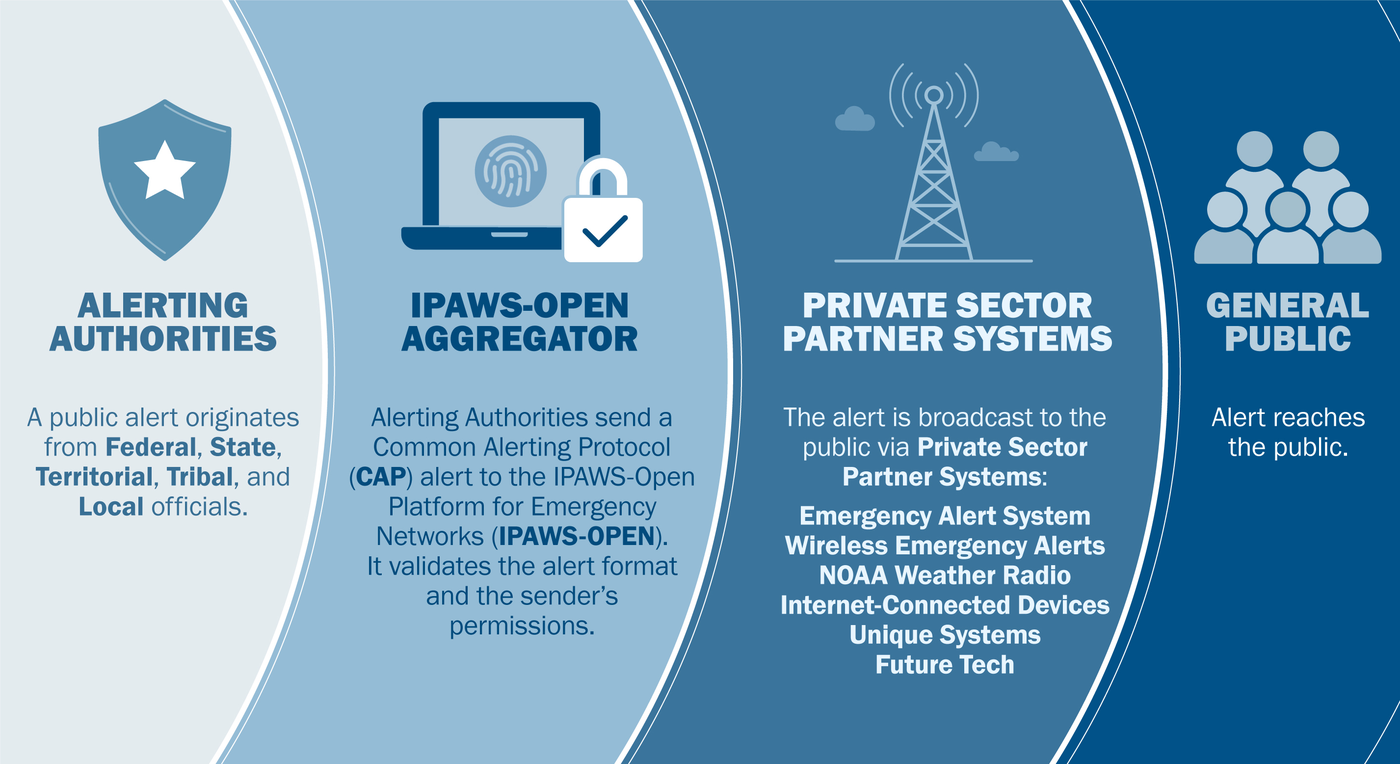
FEMA, Integrated Public Alert and Warning System infographic. Public domain; cropped. Not endorsed by FEMA.
Because it is broadcast to an area, every compatible phone in range receives it, including visitors and roaming phones. WEA doesn't track your location. If you drive into an area where an alert is still active, your phone should receive it when you arrive.
The alert types
| Alert type | What it's for | Can you turn it off? |
|---|---|---|
| National Alert (formerly Presidential) | A national emergency; issued by the President, the President's designee or FEMA's Administrator | No. Phones must always show it |
| Imminent Threat Alert | A threat to life or property that is extreme or severe, needs action now or within the hour, and is observed or likely, such as dangerous weather or an order to evacuate | Yes, carriers may offer an opt-out |
| AMBER Alert | A child abduction meeting the Justice Department's criteria; four kinds, from family abduction to endangered runaway | Yes |
| Public Safety Message | Advice that can save lives or property, sent only alongside one of the alerts above; less severe than an Imminent Threat | Yes |
| State/Local WEA Test | Tests by state and local officials; the message says it's a test | Off unless you opt in |
The categories and the opt-out rules are from the FCC's WEA rules (47 CFR 10.280, 10.350 and 10.400), FEMA and the FCC's consumer guide. Congress, in the WARN Act, let carriers offer a way to block every type except National Alerts.
One exception to "tests are opt-in": the rules allow up to two public awareness tests per county per year that reach phones by default, provided officials announce them in advance and say in the message, where they can, that it is only a test.
Which weather warnings go to phones
Not every National Weather Service warning becomes a WEA. NWS sends only its most urgent ones:
- Tsunami, Tornado, Hurricane, Typhoon, Storm Surge, Extreme Wind, Dust Storm and Snow Squall Warnings
- Severe Thunderstorm Warnings only when the damage threat is "destructive"
- Flash Flood Warnings only when the damage threat is "considerable" or "catastrophic"
So a phone alert is a strong signal to act, but its absence doesn't mean all is well. Watches and lower-level warnings reach you through a NOAA Weather Radio, local media and weather apps. NWS advises following any action the alert gives and checking TV, radio, NOAA Weather Radio or another trusted source for details.
What an alert looks and sounds like
The FCC's rules fix the sound so that it can't be mistaken for anything else. A WEA-capable phone plays one long tone of two seconds and two short tones of one second each, with half-second gaps, and repeats the whole pattern twice. On phones that can play two tones at once, the signal combines two pitches, 853 Hz and 960 Hz; phones that can play only one use 960 Hz. The vibration follows the same long-short-short pattern. The FCC notes this helps people with hearing or vision disabilities. Using the tone outside a real alert, an authorized test or an official public service announcement is against the rules.
The message itself:
- Carries five parts: what the event is, the area affected, the recommended action, when it expires, and who sent it. (National Alerts are exempt from that list.)
- Is short. Up to 360 characters on newer phones and networks. Senders must also supply a 90-character version for older phones, which is all an older 3G phone shows, NWS says.
- May be in Spanish as well as English; the language you see depends on your phone and its settings.
- May contain a link or phone number. FEMA asks officials to put the key information in the text itself, so read the message even if the link won't load.
- Stays on the phone. Newer phones keep alerts for at least 24 hours or until you delete them, so you can reread one.
- Waits for your call to end. A phone may not let an alert interrupt a call in progress; FEMA says the alert is delayed until the call ends.
How precise the area is
Since December 2019 carriers must deliver an alert to the whole target area drawn by officials with no more than a tenth of a mile (528 feet) of overshoot, on phones that support it. That capability relies on newer phones; the FCC cites a wireless industry estimate that about 83 percent of smartphones supported it in 2023. Older WEA phones still receive alerts, but for a rougher area, so you may get an alert that doesn't quite apply to your street. Treat it as meant for you until you've checked.
Older sources disagree
FEMA's Know Your Alerts and Warnings sheet (FEMA P-1093, July 2018) describes WEA as free 90-character messages in three categories: Presidential, AMBER and Imminent Threat. That was right when it was printed. FEMA's current WEA page and the FCC's rules describe the 2019 changes: 360 characters, Spanish-language alerts, and the added Public Safety Message and opt-in test categories. Rely on the newer description.
Check your phone's settings
Government alerts are normally on by default. The point of checking is to make sure nobody in the house turned them off to stop the noise, and to know where the switches are.
| Phone | Where the settings are | Notes from the maker |
|---|---|---|
| iPhone | Settings > Notifications, scroll to the bottom, Government Alerts | Turn each alert type on or off; some can't be turned off. Test Alerts are U.S.-only and off by default (iOS 15.4 or later). On iOS 26.2 or later, Enhanced Safety Alerts (earthquake and imminent threat alerts that Apple delivers over Wi-Fi and cellular data) appear under Enhanced Alerts |
| Android | Settings > Notifications > Wireless emergency alerts | Turn alert types on or off and set their sound and vibration; you can also find past alerts. Some steps need Android 12 or later, and menus differ between phone makers |
What to set:
Phone alert settings for every phone in the house
- Imminent threat or "Emergency" alerts: on
- Public Safety alerts: on
- AMBER alerts: on (FEMA says they exist so the community can help find a missing child)
- Test alerts: on for at least one phone, so you know your carrier is delivering
- Older phones: ask your carrier whether they're WEA-capable; the FCC says the tightest targeting needs newer phones
- Children's phones: set up the same way; Ready.gov encourages parents to talk with children about what an alert means
If an alert doesn't arrive
FEMA lists the usual reasons a phone misses an alert: weak cell signal; being on a call; the phone off, in airplane mode or connected to a VPN; the phone not connected to a tower that's broadcasting the alert, or that tower being out of service; or the alert type switched off. Some older phones can't receive WEA at all; Ready.gov says some carriers label the setting "Government Alerts" or "Emergency Alert Messages," and that your carrier can tell you whether your phone is supported. FEMA says a phone that keeps repeating the same alert may be stuck in a loop and can be fixed by turning it off and on.
Other ways alerts reach you
A phone is one receiver. FEMA and Ready.gov describe several more, and a household should have at least two.
| Channel | How you get it | Sign-up needed? | Limits |
|---|---|---|---|
| WEA | Compatible phone | No | Only the most urgent alerts; needs a working tower |
| Emergency Alert System | Broadcast radio and TV, cable, satellite | No | You have to be listening or watching |
| NOAA Weather Radio | Weather radio receiver | No | Needs a receiver programmed for your county |
| Local opt-in alerts | Text or email from your county or city | Yes | Small text-message costs may apply, FEMA says |
| Enhanced telephone notification (such as reverse 911) | Calls to landlines, and to mobiles if you opt in | Sometimes | Check with local emergency management |
| Outdoor sirens | Heard outdoors | No | Not designed to be heard indoors; some old sirens no longer work |
| School, work and community systems | Lists, texts, emails | Usually | Only as good as your current contact details |
| FEMA app | Smartphone app | Download | NWS alerts for up to five locations |
Two of these need action now. Sign up for your county's alerts: FEMA suggests searching your town, city or county name with the word "alerts," or calling your local emergency management office. And get a NOAA Weather Radio for the bedroom, which sounds an alarm for warnings in your county.
FEMA also points to PBS WARN, a backup path for delivering WEAs if IPAWS's connection to the carriers is ever cut. FEMA says every WEA sent through IPAWS is received and displayed on the PBS WARN website.
When the network is busy: text first
In an emergency far more people try to use their phones at once, and the FCC says that surge can congest the network. FEMA's plan puts the practical answer in two words: text first. A text needs far less bandwidth than a call, and it may be stored and sent automatically once capacity returns. The FCC adds that in many cases a text will go through when a call won't, and texting leaves more room for emergency calls.
The FCC's and FEMA's other advice, in order of usefulness:
- Keep calls short. Say only what matters, to emergency workers or family. It frees the network and saves battery.
- Wait 10 seconds before redialing. The FCC explains that redialing too fast resends data before the network has cleared the last attempt, which adds to the jam.
- Try another path. If the mobile call fails, try a text or email, or a landline if you have one. Spreading demand across networks reduces congestion overall.
- Use one out-of-town contact. FEMA says a long-distance call may get through when one across town won't, because local lines jam. Everyone reports to that one person.
- Save your battery. Dim the screen, close apps you don't need, use airplane mode when you don't need the network, and skip videos and games, which also eases congestion.
- Have backup power. Charged batteries, a car charger and a solar charger. A portable power station can recharge phones through an outage.
- Keep a corded phone. The FCC says cordless phones usually won't work in a power outage; FEMA recommends a landline and analog phone, with battery backup if it's cordless.
- Forward the home line. If you evacuate and have call forwarding, forward your home number to your mobile.
- Don't text or call while driving without a hands-free device; the FCC suggests placing calls while the vehicle is stopped.
What to say in a text: FEMA's example is "I'm OK. At library." Who you are, that you're safe, where you are. Make a group list of the people you'd text in an emergency now, while there's no hurry.
Charging a phone in the car
FEMA's plan warns that if you charge a phone in your car, the car must be in a well-ventilated area, not a closed garage, to avoid carbon monoxide poisoning. Running an engine in an enclosed space can kill. See generator safety for the same hazard with generators.
Calling and texting 911
Call if you can. The FCC says a voice call gives a 911 center more information and is always the preferred way to reach 911. Text-to-911 is available only where the local 911 center has chosen to accept texts; the FCC publishes a list of those areas, updated monthly. If you text 911 where it isn't available, your carrier must send an automatic "bounce-back" message telling you to use another method, so you don't wrongly believe your text went through. People who are deaf, hard of hearing or speech disabled can use a TTY or a relay service where text isn't available.
FEMA's plan says everyone, children included, should know how and when to call 911, and to call only for a life-threatening emergency. The first five minutes covers what to do while you wait for help.
When phones don't work at all
FEMA's plan warns that mobile phones and computers may be unreliable in a disaster and that the power may be out. That is what the rest of the Communications chapter is for: a household radio plan with FRS or GMRS radios, a ham license for longer reach, and a weather radio for warnings. The long power outages page sets out what fails first.
Before the next storm
- Alert settings checked on every phone in the house
- County and city alerts signed up for, on at least two phones
- NOAA Weather Radio programmed for your county, batteries fresh
- Group text list made: household plus out-of-town contact
- "In Case of Emergency" (ICE) contact saved on every phone, as FEMA suggests
- Important numbers written on paper, in wallets and kits
- Car charger, battery pack or power station charged
- A corded landline phone, if you have a landline
- Everyone knows: text first, keep calls short, wait 10 seconds to redial
Sources
- FCC — Wireless Emergency Alerts (WEA)
- FEMA — Wireless Emergency Alerts
- FEMA — Integrated Public Alert and Warning System
- FEMA — IPAWS 101 fact sheet (January 2024)
- Ready.gov — Emergency Alerts
- Ready.gov — Know Your Alerts and Warnings (FEMA P-1093, July 2018)
- eCFR — 47 CFR Part 10, Wireless Emergency Alerts
- NWS — Weather warnings on the go (Wireless Emergency Alerts)
- FCC — Tips for Communicating in an Emergency
- FEMA — Create Your Family Emergency Communication Plan (FEMA P-1094, July 2018; copy hosted by U.S. Army Garrison Fort Riley)
- FCC — Text to 911: What You Need to Know
- Apple Support — Government, Emergency, and Enhanced Safety Alerts on iPhone
- Google Android Help — Get help during an emergency with your Android phone
Terms used in this chapter
- amateur radio
- The licensed radio service built for self-training and contact from local to worldwide. A written exam is required, the FCC fee is $35 for 10 years, and the Technician license is the usual start.
- ARES
- Amateur Radio Emergency Service: ARRL's local groups of licensed hams who register their skills and equipment for public-service communications in a disaster. Any licensed amateur is eligible.
- bug-out bag
- A packed evacuation bag, one per person, light enough to carry on foot or on public transit. Ready.gov calls it a go-bag. If you leave by car, bring the home kit along with it.
- call sign
- The identifier issued with a GMRS or ham license. A GMRS station must transmit it at the end of a transmission and every 15 minutes during a longer series, by voice in English or in Morse code.
- carbon monoxide
- A poison gas in generator exhaust that you can't see or smell. The CPSC says a generator in an enclosed space can produce deadly levels within minutes, and the gas can linger for hours.
- CB
- Citizens Band: a license-free service with 40 channels at 26.965–27.405 MHz and a 4 W carrier limit (12 W peak envelope on SSB). Channel 9 is only for emergencies and help for travelers.
- CSCE
- Certificate of Successful Completion of Examination: what volunteer examiners give you when you pass an amateur exam element. Examiners credit an element shown on it for 365 days.
- Emergency Alert System
- The path that carries emergency alerts over broadcast radio and TV, cable and satellite. It needs no sign-up, but it only reaches you if you are listening or watching.
- ERP
- Effective radiated power: a limit measured at what the antenna radiates, not at the transmitter. FRS and the GMRS interstitial channels are limited this way, such as 5 W ERP for GMRS on channels 1–7.
- flash flood
- Water rising fast over low ground, typically within 6 hours of heavy rain, a dam or levee failure, or a jam breaking. The NWS says a mountain creek 6 inches deep can be 10 feet deep in under an hour.
- FRN
- The number that identifies you to the FCC. You need it, along with a CORES username account, to file for and pay for a GMRS license. Anyone who already holds an FCC wireless license has one.
- FRS
- A license-free radio service with 22 channels, all shared with GMRS. Antennas are built in, power is 2 W ERP on most channels and 0.5 W on channels 8–14, and it can't use repeaters.
- GMRS
- A licensed two-way radio service with 30 channels at 462–467 MHz. One $35 FCC license, with no exam, lasts 10 years and covers the licensee's immediate family. Repeaters are allowed.
- Hurricane Warning
- National Weather Service alert that hurricane conditions are expected somewhere in the area. It is issued 36 hours before tropical-storm-force winds are anticipated.
- ICE
- An emergency contact saved in a mobile phone under the name "In Case of Emergency" or "ICE". FEMA suggests one in every phone so that someone helping you can find who to call.
- interstitial
- The 14 GMRS channels that sit between the 16 main channels: channels 1–7 at 462 MHz (5 W ERP for GMRS) and 8–14 at 467 MHz (0.5 W ERP, handhelds only). Repeaters don't use them.
- IPAWS
- FEMA's Integrated Public Alert and Warning System, set up in 2006. It authenticates an official's alert and sends it at once to phones, radio and TV, NOAA Weather Radio and local systems such as sirens.
- MURS
- A license-free VHF radio service with 5 channels at 151–154 MHz and a 2-watt limit. External antennas are allowed and repeaters are not; it can carry data and remote-control signals as well as voice.
- National Alert
- The phone alert type for a national emergency, issued by the President, the President's designee or FEMA's Administrator. Formerly called Presidential; phones must always show it.
- NOAA Weather Radio
- A National Weather Service network of more than 1,000 transmitters broadcasting warnings, watches and forecasts around the clock on seven VHF frequencies, plus non-weather emergencies.
- out-of-town contact
- One person outside your area whom everyone in the household calls or texts with their status. FEMA's reason: a long-distance call may get through when one across town won't.
- phonetic alphabet
- Code words for letters (Alfa, Bravo, Charlie and so on) used to spell names and call signs clearly over a weak signal. The FAA's manual gives the international (ICAO) version pilots use.
- privacy code
- A sub-audible CTCSS or DCS tone set on an FRS or GMRS radio. It only decides which signals your radio lets you hear; anyone else on the same frequency can still hear you.
- Public Alert
- A weather-radio standard (CTA-2009-C) written by the Consumer Technology Association with NWS. A Public Alert receiver must have SAME, a tone alarm and battery backup. NWS recommends radios with the logo.
- repeater
- A station with its antenna high on a tower or hilltop that receives on one frequency and rebroadcasts on another, carrying a handheld's signal across a town. GMRS allows them; FRS and MURS don't.
- SAME code
- A six-digit code for a county or part of one. A weather radio programmed with it sounds only for alerts covering that area. A first digit of 0 means the whole county; the rest are state and county FIPS numbers.
- shelter in place
- Staying inside where you are, in a room chosen for the danger, rather than going out into what is happening outside, and waiting there until officials give the all-clear.
- simplex
- Radio to radio on one frequency, with no repeater between. The ARRL band plan gives 146.52 MHz as the national simplex calling frequency on 2 meters and 446.00 MHz as the national simplex frequency on 70 centimeters.
- storm surge
- The abnormal rise of water caused by a storm, over and above the predicted tide, as the NHC defines it. The NHC stresses that surge can reach many miles inland.
- Technician Class
- The entry amateur (ham) license: one 35-question written exam, Element 2, with 26 correct to pass. It gives every amateur band from 6 meters (50 MHz) up, plus small HF segments.
- text-to-911
- Texting 911 instead of calling. It works only where the local 911 center accepts texts; elsewhere the carrier sends a bounce-back message. The FCC says a voice call is always preferred.
- tone alarm
- A weather radio's alarm that sounds when a warning goes out, even with the volume off. NWS broadcasts a 1050 Hz tone for 10 seconds to set it off, and reserves it for the most urgent threats.
- volunteer examiner
- A licensed ham accredited to give amateur exams. Teams of at least three run each session under a coordinator; to give a Technician exam, each must hold General or higher and be at least 18.
- WEA
- Wireless Emergency Alerts: short emergency messages officials send to every compatible phone in a targeted area, with no sign-up. Set up by the WARN Act in 2008, they went live in 2012.