Chapter 9 · Communications
Getting an amateur (ham) radio license
Amateur radio is the one household radio service that can reach beyond your town, and the only one that asks you to pass an exam. The entry license takes one 35-question test. Here is what it covers, what it costs, how the filing works, and what to do with it once you have a call sign.
Read first: Radio services
Most household radios reach across a neighborhood. Amateur radio can reach much farther. The FCC describes the service as being for qualified people of any age who are interested in radio purely for personal reasons and not for profit: for self-training, talking with each other, and technical experimenting. Millions of operators worldwide talk directly and through relay systems and satellites.
That reach is why it earns a place in a household plan, and why the FCC asks for something the other services don't: an exam. The good news is that the entry license, Technician Class, takes one written test of 35 questions, drawn from a published question pool. If you're still deciding which radio service fits, start with which radio service fits a household plan.
How ham radio differs from GMRS
| GMRS | Amateur (ham) | |
|---|---|---|
| Exam | None | Yes: Technician is one 35-question test |
| Who's covered | Licensee plus immediate family | Each operator holds their own license |
| FCC fee | $35, 10 years | $35, 10-year term |
| Minimum age | 18 for the licensee | None: "any age" (FCC) |
| Radios | Must be FCC-certified for GMRS | FCC equipment certification generally doesn't apply to amateur transmitters |
| Bands | 30 channels near 462–467 MHz | Many bands; Technicians get every amateur band above 50 MHz plus some HF |
| Identification | Call sign at the end and every 15 minutes | Call sign at the end and at least every 10 minutes |
Two of those rows change how a family uses it. Every person who transmits needs a license of their own, though an unlicensed person may speak over a ham radio when a licensed control operator is present at the controls and supervising (47 CFR 97.115). And the radios are far more flexible: the FCC says its equipment certification program doesn't generally apply to amateur transmitters, and amateurs design, build, modify and repair their own stations. The GMRS license guide covers the family license.
The three license classes
The FCC issues three classes to new operators; no new Novice or Advanced licenses are granted (47 CFR 97.17). Each class needs one or more written exam elements:
| Class | Exam elements | Element size and pass mark | What it adds |
|---|---|---|---|
| Technician | Element 2 | 35 questions; 26 correct to pass | All amateur bands above 50 MHz, plus small HF segments |
| General | Elements 2 and 3 | Element 3: 35 questions; 26 to pass | Large parts of the HF bands |
| Amateur Extra | Elements 2, 3 and 4 | Element 4: 50 questions; 37 to pass | All amateur privileges |
Figures are from 47 CFR 97.501 and 97.503. No Morse code test is required for any class; the rules list only written elements. The FCC says most new operators start at Technician and may later move up to General or Amateur Extra. Examiners give credit for the class you already hold, so you don't retake those exams to upgrade.
What a Technician license lets you do
The rules give Technicians every amateur band from 6 meters up: 50–54 MHz, 144–148 MHz (2 meters), 222–225 MHz, 420–450 MHz (70 centimeters) and higher (47 CFR 97.301). ARRL's summary puts it as all amateur frequencies above 30 MHz, which comes to the same thing because there are no amateur bands between 30 and 50 MHz.
On HF, Technicians also get four narrow segments: parts of 80, 40 and 15 meters, and 28.0–28.5 MHz on 10 meters. Voice is permitted only in the 28.3–28.5 MHz part of that 10-meter segment (47 CFR 97.305). The other segments are used for Morse code (CW) and, on 10 meters, data.
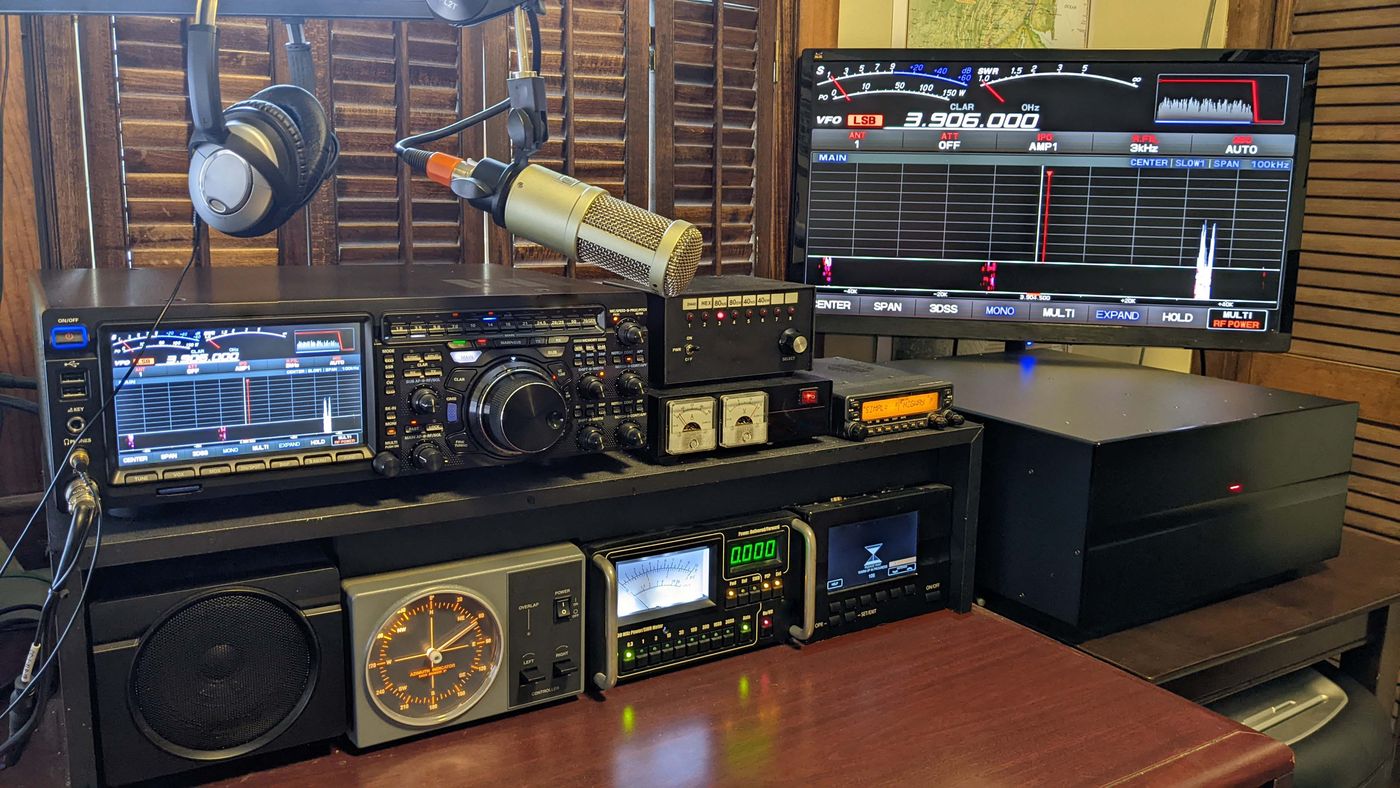
Photo: iStock.
For a household, 2 meters and 70 centimeters are the practical bands. They are where local repeaters, emergency nets and most handheld radios operate.
Step by step: from study to call sign
1. Study the question pool
Every exam question comes from a public pool, and each pool must contain at least ten times the number of questions on a single exam (47 CFR 97.523). The current Technician pool is for exams on and after July 1, 2026, and is valid through June 30, 2030, per ARRL. The NCVEC Question Pool Committee, which writes it, released it on December 18, 2025, and issued errata on February 19, 2026, correcting four questions. Study from a guide built on this pool, not an older one.
The pool covers FCC rules, operating practice, radio theory, electrical safety and the parts of a station. ARRL's page lists practice exams, downloadable pools, local classes and a free beginner's ebook. Practice tests matter: they show you the exam's format and which subjects you're weakest on.
2. Get an FRN before exam day
You must have an FCC Registration Number (FRN) before you sit the exam, ARRL says. New applicants create an FCC username account and register in CORES, the FCC's registration system, to get one. You'll also need a working email address, because that is how the FCC sends payment instructions and the license. If you already hold a GMRS license, you already have an FRN.
3. Find an exam session
Exams are given by teams of at least three accredited volunteer examiners (VEs) at a session coordinated by a Volunteer Examiner Coordinator (VEC) (47 CFR 97.509). To give a Technician exam, a VE must hold a General, Advanced or Extra license and be at least 18. ARRL's locator lists both in-person and online sessions, which it says are given regularly. Confirm the date and time with the session administrator before you go.
4. Bring what the session asks for
ARRL VEC's list, for its own sessions:
Exam day
- Your FRN (mandatory)
- One legal photo ID, or two other forms of ID if you have no photo ID
- Any existing license or certificate (CSCE) you hold, if upgrading
- Two No. 2 pencils with erasers and a pen (in-person sessions)
- A calculator with its memory cleared, if you want one (no phones or tablets)
- The exam fee in check, money order or cash, as the session requires
Every applicant also answers the FCC's basic qualification question about felony convictions on the application form.
5. Take the exam
VEs watch you throughout. If you pass, they give you a Certificate of Successful Completion of Examination (CSCE) and file your application with the FCC through their VEC. Under the rules, examiners credit an element shown on a CSCE for 365 days after you passed it (47 CFR 97.505). If you pass more than one element in a session, one application goes in for the highest class earned.
6. Pay the FCC fee
After the VEC files, the FCC emails a link with payment instructions. ARRL says you have 10 calendar days from when the application file number is issued to pay the $35 fee through CORES; you don't have to wait for the email if you look up your pending application by FRN. If you miss the window, the FCC dismisses the application, but you don't retest: the VEC can refile it while your CSCE is valid.
After payment and processing, the FCC sends a second email with a link to your official license. ARRL says that link is good for 30 days, so download and save the license when it arrives.
7. Get on the air
Your call sign is assigned in sequence (47 CFR 97.17); you may later pay $35 for a vanity call sign if you want to choose one. You may transmit once your license and call sign appear in the FCC's license database: the rules require the station's operator to be named in a license grant on that database (47 CFR 97.5, 97.7).
What it costs
| Item | Amount | Source |
|---|---|---|
| FCC application fee, new license | $35 (fee code PRAM) | FCC fee guide, effective May 23, 2025 |
| FCC renewal fee | $35 | FCC fee guide |
| Vanity call sign | $35 | FCC fee guide |
| Upgrade to a higher class | No FCC fee | ARRL, FCC application fee page |
| Exam session fee (ARRL VEC) | $15 | ARRL, FCC application fee page |
| Exam session fee, other VECs | Usually $15 or less | ARRL, what to bring |
| Under-18 candidates (ARRL VEC) | $5 exam fee; ARRL reimburses the one-time $35 FCC fee once ARRL VEC receives the completed reimbursement form | ARRL, what to bring |
| License term | 10 years | 47 CFR 97.25 |
The rules let examinees reimburse VEs and VECs for their out-of-pocket costs of giving the exam, which is what the session fee is (47 CFR 97.527). It is paid to the exam team; the $35 is paid only to the FCC. ARRL tells exam teams not to collect the FCC fee.
Rules you'll use every time you transmit
- Identify. Give your call sign at the end of each communication and at least every 10 minutes during one, by voice in English or by Morse code. The rules encourage a phonetic alphabet to make it clear (47 CFR 97.119).
- Use the least power that works. An amateur station must use the minimum transmitter power needed (47 CFR 97.313).
- No business, no music, no hidden meanings. No communications for pay or for an employer (with narrow exceptions, including emergency drills), no music, no messages encoded to obscure their meaning, no obscene language, and no false signals (47 CFR 97.113).
- No broadcasting. Amateur stations may not broadcast to the public, with an exception for information about immediate safety of life or property passed to broadcasters when no other means is available.
- Emergencies override everything. Nothing in the rules prevents an amateur station from using any means it has for the immediate safety of human life and protection of property when normal communication systems aren't available (47 CFR 97.403).
Your first radio
For most new Technicians the first radio is a dual-band handheld: 2 meters and 70 centimeters, about 5 watts. It works simplex (radio to radio) and through local repeaters, which receive on one frequency and retransmit on another from a high site. Technicians may use repeaters and may even be the control operator of one (47 CFR 97.205).
Things to weigh, all visible on the makers' own pages in the cards below:
- Analog FM or digital. Every maker page below that names its modes lists analog FM. Some radios add a digital voice mode: D-STAR on the Icom and Kenwood below, C4FM on the Yaesu FT5DR. They are different systems, so check what your local repeaters use before paying for one.
- APRS and GPS. Some radios can send your position and short text messages over APRS, a packet system. Useful for a family, but only when the others have compatible radios and licenses.
- Water resistance and batteries. An IP rating tells you how much rain or immersion a radio is built for. Check whether an AA battery case is available as an option for long outages.
- Weather radio. Several receive NOAA weather broadcasts. That doesn't replace a SAME bedside weather radio, but it's a useful backup in a kit.
- Frequency coverage. Some low-cost imported radios can transmit well outside the ham bands, for example from 136 to 174 MHz and 400 to 520 MHz. The FCC's Enforcement Bureau has warned that a two-way VHF/UHF radio able to operate outside the amateur bands may not be imported, advertised, sold or used in the United States unless it holds FCC equipment certification. Only a radio that can transmit on amateur frequencies alone is exempt. Before you buy, the FCC says to check that the radio is either labeled as FCC-compliant or works only on amateur frequencies. Even with certification, a ham license authorizes you to transmit only on amateur frequencies; it doesn't make a radio legal on GMRS, FRS or business channels. One radio below, the UV-PRO, states on its maker page that it is certified under FCC Part 90 (land mobile) and for amateur use, and is not certified for GMRS. The other four are sold as amateur transceivers.
Two frequencies to know
The ARRL band plan lists 146.52 MHz as the national simplex calling frequency on 2 meters and 446.00 MHz as the national simplex frequency on 70 centimeters. They're where you call when you don't know who else is around. Put whichever your household will use in the household radio plan.
Ham radio handhelds for a new Technician compared
All need an amateur license to transmit. Every one covers 2 meters and 70 centimeters; the differences are digital modes, GPS/APRS, toughness and price. Radios that can transmit outside the ham bands are listed only where the maker states FCC certification. Specs are the makers' own, as published on the date shown; prices appear only where the maker's page lists one.
Yaesu
FT-65R
- Bands
- 2 m / 70 cm dual band
- Transmit power
- 5 W / 2.5 W / 0.5 W
- Modes
- Analog FM
- Weather radio
- WX channels with severe weather alert
- Battery
- 1,950 mAh Li-ion, over 9 hours (maker's figure); optional 2,500 mAh
- Charger
- 3.5-hour rapid charger included
- Warranty
- 3 years
- Price on maker site
- Not listed
BTECH
UV-PRO
- Bands
- VHF/UHF dual band; receives 108–136 MHz airband
- Transmit power
- Up to 7 W peak, selectable
- Certification (maker's statement)
- FCC Part 90 plus amateur use; not certified for GMRS
- GPS / APRS
- Onboard GPS, APRS tracking and messaging, Bluetooth KISS TNC
- Memory channels
- 180 (6 banks of 30)
- Weather radio
- NOAA weather alerts
- Water resistance
- IP67 (1 m for 30 minutes)
- Battery
- 2,600 mAh, USB-C charging on the battery
- Price on maker site
- $164.89
Yaesu
FT5DR
- Bands
- 144/430 MHz dual band
- Transmit power
- 5 W
- Modes
- C4FM digital and analog FM; WIRES-X portable node
- GPS / APRS
- 66-channel GPS receiver; 1200/9600 bps APRS
- Receive coverage
- 0.5–999.99 MHz (A band), 108–580 MHz (B band)
- Water resistance
- IPX7
- Battery
- 2,200 mAh Li-ion
- Warranty
- 3 years
- Price on maker site
- Not listed
Icom
ID-52A PLUS
- Bands (USA transmit)
- 144–148 MHz and 430–450 MHz
- Transmit power
- 5 W / 2.5 W / 1 W / 0.5 W / 0.1 W
- Modes
- D-STAR digital and analog FM
- GPS
- Built-in GPS, D-PRS position reporting
- Bluetooth
- Yes, including Terminal and Access Point modes with Android
- Memory channels
- 1,000
- Water resistance
- IPX7
- Operating time
- 7.25 hours FM with supplied BP-272 (maker's figure)
- Weather radio
- Weather channel receive
- Price on maker site
- Not listed
Kenwood
TH-D75A
- Bands
- 144/220/430 MHz tri-band
- Transmit power
- 5 / 2 / 0.5 / 0.05 W
- Modes
- D-STAR digital and analog FM
- GPS / APRS
- GPS with track log; APRS with standalone digipeater and messaging
- Receive coverage
- 0.1–524 MHz on band B, including SSB and CW
- Bluetooth
- Yes (HSP/SPP)
- Water resistance
- IP54/55
- Battery
- 7.4 V, 1,820 mAh Li-ion; USB-C charging
- Price on maker site
- Not listed
Specs are the makers’ published figures, read November 3, 2026. “Used” marks gear the editor has used; the rest is compared on specs only. How we compare gear.
Emergency service: what the license opens up
A license lets you talk; joining a group teaches you to be useful in a disaster. Three programs are open to licensed amateurs.
| Program | Run by | What members do | How to join |
|---|---|---|---|
| ARES (Amateur Radio Emergency Service) | ARRL, through local groups | Register their qualifications and equipment with local ARES leadership for public-service communications when disaster strikes, including when storms knock out cell towers and networks | Registration form to the local Emergency Coordinator; any licensed amateur is eligible, ARRL member or not |
| RACES (Radio Amateur Civil Emergency Service) | Local or state civil defense (emergency management) organizations, under FCC rules | Civil defense communications authorized by that organization; drills limited to one hour a week, with longer exercises allowed twice a year with state approval | Enroll with your local emergency management agency |
| SKYWARN | National Weather Service | Trained storm spotters report severe weather to NWS; 350,000 to 400,000 trained spotters | Free training of about two hours, through local NWS offices or online |
SKYWARN doesn't require a ham license; NWS invites anyone interested in public service, and NWS and ARRL have a memorandum of understanding. ARES training requirements vary by local group, so ask the Emergency Coordinator what yours expects; ARRL offers an emergency communications course.
Even if you never join a group, local nets are worth finding. A net is a scheduled on-air gathering on a set frequency; your local ARES group or radio club can tell you which ones meet near you. Our suggestion: listen to a local net, then check in. It is a low-stakes way to learn how your radio and antenna perform from home before you need them.
Getting the household involved
- One licensee isn't a network. A ham radio helps the family most when at least two people can use it: one at home, one away. Ages don't stand in the way; the FCC says the service is for qualified people of any age.
- Unlicensed family can speak under the supervision of a licensed control operator who is present (47 CFR 97.115), which is a good way to show a teenager what the exam opens up.
- Use both services. GMRS for everyday family talk, ham for range and for linking to emergency groups. The radio plan card has room for both.
- Don't forget the phones. The first alert usually arrives on a phone; see phone alerts.
Upgrading later
General Class adds large parts of the HF bands (47 CFR 97.301(d)), the bands that carry contacts beyond the local area. It is one more 35-question exam, with no FCC fee to upgrade, and your Technician credit carries over. Upgrading once you've spent some time on 2 meters means you'll know what you want the extra bands for.
Sources
- FCC — Amateur Radio Service
- FCC — Enforcement Advisory No. 2018-03: two-way VHF/UHF radios (DA 18-980, September 24, 2018)
- FCC — Personal Service and Amateur Application Fees (effective May 23, 2025)
- eCFR — 47 CFR Part 97, Amateur Radio Service (97.5, 97.7, 97.17, 97.25, 97.113, 97.115, 97.119, 97.205, 97.301, 97.305, 97.313, 97.403, 97.407, 97.501, 97.503, 97.505, 97.509, 97.523, 97.527)
- ARRL — Getting Licensed
- ARRL — What to Bring to an Exam Session
- ARRL — FCC Application Fee
- ARRL — Question Pools
- NCVEC — 2026–2030 Technician Question Pool
- ARRL — Band Plan
- ARRL — Amateur Radio Emergency Service (ARES)
- NWS — SKYWARN Storm Spotter Program