Chapter 13 · Security & Safety
Scams after a disaster: how to check and report them
After a storm, flood or fire, the people at your door are not all there to help. Most scams follow a few patterns, and a few checks catch nearly all of them. Here is what to look for, how to pay, and who takes the report.
Read first: Documents
The days after a disaster are when people are most likely to be cheated. You are tired, the house is damaged, insurance and aid forms are piling up, and you need help quickly. That is exactly the moment the Federal Trade Commission (FTC) says scammers pick, because they are counting on you to sign before you check.
The good news is that disaster scams are not clever. Nearly all of them come down to one of three requests: pay now, pay in a way that can't be undone, or hand over your personal information. Learn to notice those three, check before you pay, and report what you see, and you will avoid most of them.
This page covers the common schemes, the checks that catch them, how to pay for repairs safely, and where each kind of report goes. It is about protecting your household, not about who is to blame.
The three warning signs
Every source on this page returns to the same signals. If you see one, slow down. If you see two, walk away.
- Pressure to act now. A discount only if you sign today, a promise of immediate cleanup, an "inspection" that has to happen before you can call anyone. The FTC lists a sign-today discount among the classic signs of a repair scam, and its disaster infographic warns against anyone promising immediate clean-up.
- A payment you can't get back. Wire transfers, gift cards, payment apps, cryptocurrency and cash. The FTC's guidance says money sent these ways is very hard to recover, and the FTC, Justice Department and Consumer Financial Protection Bureau said in their joint 2024 warning that only scammers insist on them.
- A request for personal or financial information. Social Security numbers, bank account numbers, card numbers, your FEMA registration number. The FTC's disaster infographic says only scammers will claim to be officials and then demand money or account numbers.
Why these three? Because each one removes the time or the record you would need to fight back. Pressure removes the time to check. Cash and gift cards remove the paper trail. Your Social Security number lets someone apply for aid in your name.
Fake contractors and cleanup crews
Repair scams come first in every FTC disaster guide on this page. The FTC's infographic describes the pattern: someone arrives promising quick cleanup or debris removal, quotes a high price, wants payment up front, and may not have the skills to finish the job.
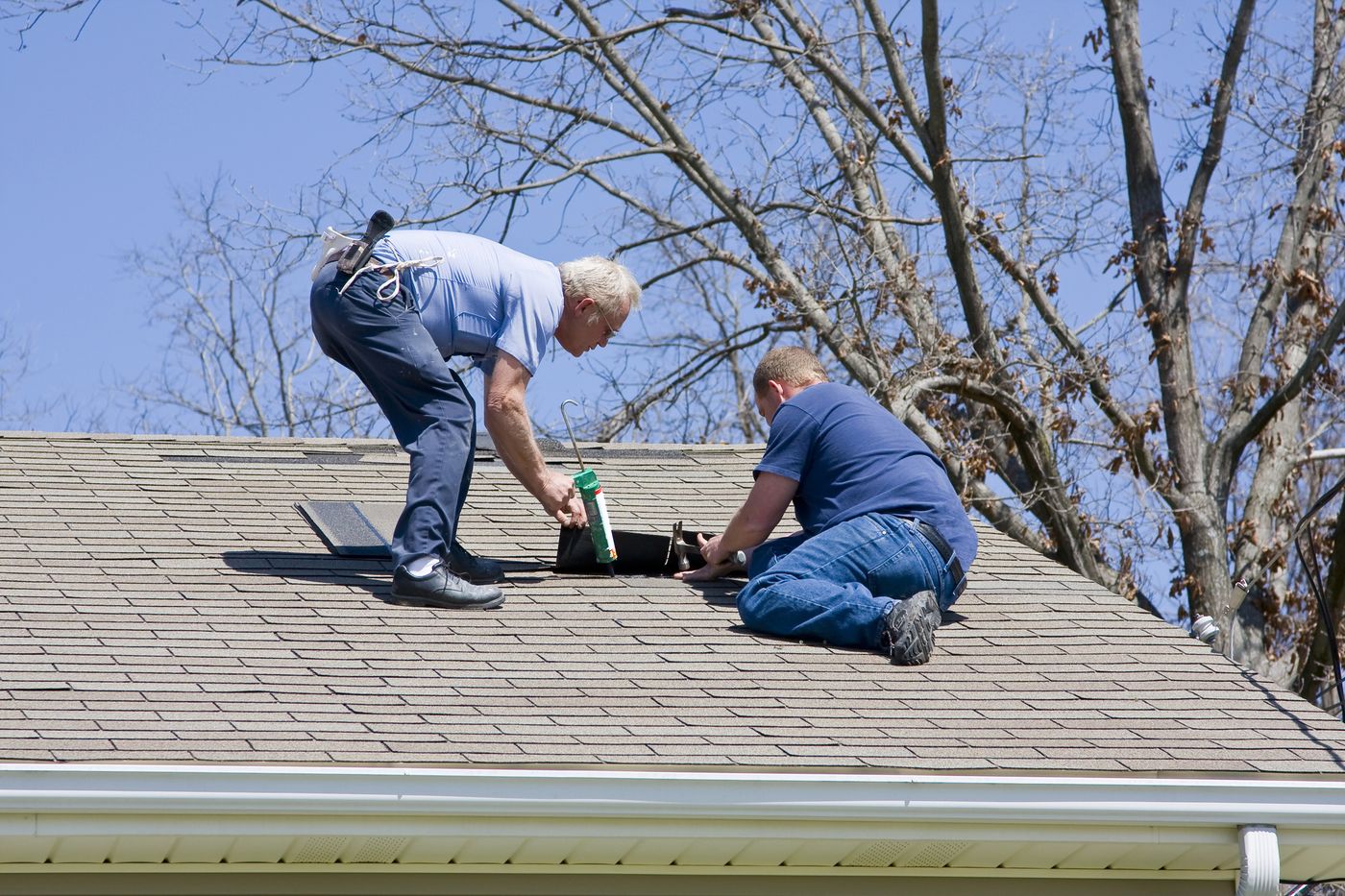
Photo: iStock.
Signs of a repair scam
The FTC's list of warning signs, in its September 2025 guidance:
- They say you don't need a license for the work.
- They offer a discount only if you sign right away.
- They ask you to sign your insurance check over to them.
- They want the full price before they start.
- They insist on wire transfer, gift card, payment app, cryptocurrency or cash.
- They ask you to sign a contract with blanks in it.
- They steer you toward a lender they know.
- They say they can get you FEMA money for a fee.
How to check a contractor
Do these before anyone starts work, and before you pay anything.
- Confirm the license with your state or county licensing office (FTC). A license means the contractor has met the state's rules and can be found again if something goes wrong.
- Get proof of insurance (FTC). If a worker is hurt on your roof or damages a neighbor's house, the contractor's insurance, not yours, should pay.
- Search the name with words like "scam," "review" and "complaint," and read reviews on sites you trust (FTC). Ask a local home builders' association whether it has complaints on file.
- Get several written estimates. Each should describe the work, materials, completion date, price and contact information. The FTC says not to take the cheapest bid automatically and to ask the contractor to explain any big price gap.
- Prefer local and known. FEMA advises hiring licensed or verified local contractors with solid references.
The written contract
The FTC says contract requirements vary by state but to ask for one anyway. It should include:
- the contractor's name, address, phone number and license number (where the state requires one)
- estimated start and finish dates
- a payment schedule
- every spoken promise about the work, labor and materials
- a written notice of your right to cancel within three business days if you signed it at your home or anywhere other than the seller's permanent place of business
- no blank spaces that could be filled in later
FEMA adds two things to ask for: a detailed written description of the work and written guarantees.
Your insurance check
Two pieces of FTC advice protect your insurance money. First, don't rely on a contractor to tell you what your policy covers; ask your insurer. Second, don't sign the check over to a contractor. Instead, the FTC suggests asking your bank or credit union about a "Certificate of Completion" arrangement, Under it, the bank releases money one finished stage at a time, and only once you have signed off. Your money moves only as the work gets done.
How to pay for repairs
The payment method is your last line of defense. If the work is never done, a credit card charge can be disputed. Cash cannot.
| Safer | Avoid | |
|---|---|---|
| Method | Credit card or check (FTC) | Wire transfer, gift card, payment app, cryptocurrency, cash (FTC) |
| Down payment | A reasonable amount you negotiate (FTC); FEMA says no more than half the repair cost | Full payment before work begins |
| Final payment | Only when the work is finished and you're satisfied (FTC) | Paying in full on a promise |
| Records | Keep every invoice and receipt (FTC) | Verbal agreements |
Sources differ on the down payment. FEMA gives a firm ceiling: don't pay more than half of the repair cost up front. The FTC doesn't give a number. It says to negotiate a reasonable amount and notes that some states limit how much a contractor may demand, so your state consumer protection agency can tell you the local rule. The stricter of the two, your state's limit or FEMA's half, is the safer guide.
FEMA impostors
After a declared disaster, people posing as FEMA staff go door to door, call and text. They offer grants or inspections for a fee, usually in cash, according to the FTC. Some are after your money; others want your personal details so they can claim aid in your name.
What real FEMA staff will and won't do
- No fees, ever. FEMA says it will never ask you to pay to apply for assistance or to receive an inspection. The FTC adds debris removal, grants, help with applications and appeals to the list. FEMA's Disaster Fraud page says DHS, the SBA and other federal agencies don't charge for disaster assistance either.
- No bank details. FEMA inspectors won't ask for your bank account information (FTC, FEMA).
- No registration number. A real inspector won't ask for your nine-digit FEMA registration number, because FEMA already has it (FEMA).
- A badge with a photo. FEMA staff and contractors wear an official badge with their name and photo and should show identification if you ask (FTC, FEMA). Scammers can fake badges and FEMA-branded clothing, so a badge alone proves little.
- No roof climbing. FEMA says its inspectors don't climb on roofs or enter crawl spaces.
- No cold contact. FEMA contacts only people who reached out to it or applied, and it never texts demanding money or personal information (FTC).
If you're unsure, check through a number you looked up yourself. Call the FEMA Helpline at 800-621-3362, which FEMA lists as open daily from 7 a.m. to 11 p.m. Eastern. Don't use a number the visitor or the text message gives you.
If someone applied in your name
FEMA describes two situations:
- An inspector arrives and you never applied. Tell the inspector you didn't apply.
- You get a FEMA letter about an application you didn't file. Call the FEMA Helpline at 800-621-3362.
In both cases, go to IdentityTheft.gov for a step-by-step recovery plan (FEMA, FTC). The FTC's 2022 alert warns of callers posing as FEMA who ask people to "verify" a registration they never made; treat that call as a scam.
Ready.gov adds a broader rule worth remembering: the government won't call, text or message you on social media about money you owe or payments you're due, and you shouldn't click links in texts or emails from people you don't know.
Utility and inspector impostors
Fake utility workers operate all year, but the FTC says they become more active after storms. They call or knock, say your meter or equipment has to be fixed or replaced, and want payment. The FTC's advice: don't pay, ask to see identification, and confirm who they are before doing anything. Our suggestion for confirming: call the number printed on your own utility bill, not one the visitor gives you.
This matters for safety as well as money. Only the gas company or a licensed professional should restore gas service; see shutting off gas, water and electricity for who turns what back on.
Rental listing scams
If your home is uninhabitable, you may be looking for a rental fast, and so are many other people. The FTC's disaster infographic warns against anyone who tells you to wire money or asks for a security deposit or rent before you've met them or signed a lease. A real landlord can show you the unit and put the terms on paper first.
Charity scams
Disasters bring out generosity, and scammers set up fake charities, sometimes with names close to real ones, the FTC and Justice Department warned in 2024. The FTC's July 2025 advice for giving after a disaster:
- Give to charities you know, ideally ones with a record of disaster work.
- Research any charity yourself, especially when the request comes through social media. The FTC names the BBB Wise Giving Alliance (Give.org) and CharityWatch, and suggests finding out how much of your gift reaches the people it's meant to help.
- Don't pay by cash, gift card, wire or cryptocurrency. A credit card gives you more protection.
- Check text-to-donate numbers by calling the charity at a number from its own website.
Crowdfunding
Money given through a crowdfunding campaign goes to the organizer, not directly to the people it's for (FTC). Before giving, the FTC suggests finding out who started the campaign and who receives the money, asking the friend who shared it what they actually know, and running a reverse image search on the photos: scammers often reuse photos and stories from other campaigns. Gifts to individuals are not tax deductible, even if the organizer means to pass the money on to a charity. If you want a deduction, give to a registered charity, which you can confirm with the IRS Tax Exempt Organization Search tool. Giving directly through the charity's own website avoids platform fees.
Price gouging
Price gouging is charging excessive prices for necessities during a declared emergency. It is mostly a state matter: whether it's illegal, what counts, and who enforces it depend on where you live. The 2024 federal warning said the FTC would work with state enforcers on it.
Two examples show how much the rules vary:
| Texas | Florida | |
|---|---|---|
| When it applies | After a disaster declared by the governor or the president | During a state of emergency declared by the governor |
| What it covers | Fuel, food, medicine, lodging, building materials, construction tools and other necessities | Essential commodities such as lumber, ice, water, chemicals, generators and shelter; also hotel and rental rates |
| The test | Exorbitant or excessive prices that take advantage of the declaration | A "gross disparity" from the average price over the 30 days before the emergency, unless the seller can show its own costs or market trends rose |
| Not covered | High prices alone, since businesses generally set their own prices | Non-essential luxury goods such as alcohol and cigarettes |
| Penalty | Prosecuted under the state's Deceptive Trade Practices Act | Civil penalties of $1,000 per violation, up to $25,000 for multiple violations in 24 hours |
| Report to | Texas Attorney General consumer complaint | Florida Attorney General: 1-866-9NO-SCAM, online or the No Scam app |
Both states make the same point: a high price is not automatically gouging. What makes it illegal is a sharp increase on a necessity during a declared emergency. Your own state's attorney general can tell you the rule where you live.
What evidence to keep
The Florida Attorney General's office asks for evidence before you file, gathered only when it's safe. Its list works anywhere:
Price-gouging evidence
- Photos of advertised prices, price tags, signs and receipts
- Copies of estimates, invoices and bills
- The price of the same product at other sellers nearby, if you can safely check
- Product details: name, brand, size or quantity, maker, model number and price
- The name and address of the seller
- Receipts from stores you normally use, showing what you paid before the emergency
- For a room: the advertised rate, the booking confirmation, the final bill, the room type and how you booked
- For lumber: size, grade, thickness and quality
Florida's office also makes a practical point: stocking your emergency kit before the season starts is one of the best defenses, because the cheapest supplies sell out first. That is the case for a household pantry and a stocked 72-hour kit bought in calm weather.
Flood-damaged cars
After hurricanes and floods, damaged cars are sometimes cleaned up and sold out of state, the FTC warns. If you're replacing a vehicle after a disaster, or buying a used car anywhere in the months after one, check before you buy:
- Look and smell. Mud or sand under the seats and dashboard, rust around the doors, loose or stained carpet, and a smell of mold or of strong cleaner covering something up.
- Run the VIN through the National Insurance Crime Bureau's free VINCheck. The FTC notes it only shows flood damage if the car was insured when it happened, so a clean result isn't proof.
- Get a history report from vehiclehistory.gov for title and odometer information.
- Have an independent mechanic inspect it. Water damage can slowly ruin electrical and mechanical systems.
If you suspect a seller hid flood damage from you, the FTC says to report it to the NICB, the FTC and your state attorney general.
Where to report
Report even when you avoided the scam, so the agencies that investigate know it is happening. The Justice Department's referral list sends each kind of fraud to the agency with the expertise to handle it.
| What happened | Where to report |
|---|---|
| Any scam: contractors, impostors, rental listings, fake charities, utility impostors | FTC at ReportFraud.ftc.gov (FTC), or 1-877-FTC-HELP (DOJ) |
| Someone used your identity, including to apply for aid | IdentityTheft.gov (FTC, FEMA), or 1-877-ID-THEFT (DOJ) |
| Fraud involving FEMA or other DHS programs, including FEMA impostors | DHS Office of Inspector General hotline, 1-800-323-8603 (DOJ), or online at oig.dhs.gov/hotline (DOJ, FEMA); FEMA also takes reports by email, fax and mail through its Disaster Fraud page |
| A FEMA letter for an application you didn't file | FEMA Helpline, 800-621-3362 (FEMA) |
| Price gouging | Your state attorney general (Texas, Florida, FTC) |
| A problem contractor you can't resolve | Your state attorney general or local consumer protection office, local media "Call for Action" lines, legal services groups (FTC) |
| A crowdfunding campaign | The platform's reporting page first, then the FTC and the attorney general of the state where the organizer lives (FTC) |
| A problem with a local charity | Your state's charity regulator (FTC) |
| Disaster relief or insurance scams sent through the mail | U.S. Postal Inspection Service, 1-800-372-8347 (DOJ) |
| Disaster-related housing fraud or discrimination | HUD Office of Inspector General, 1-800-347-3735 (DOJ) |
| SBA disaster loan fraud | SBA Office of Inspector General (DOJ) |
| A seller who hid flood damage on a car | NICB, the FTC and your state attorney general (FTC) |
| Other criminal fraud | Local police; the FBI at tips.fbi.gov (DOJ) |
Routes that have changed. The Justice Department's National Center for Disaster Fraud closed on March 31, 2026; its page now sends tips straight to the agencies in the table above. Some older FEMA pages still give a disaster fraud phone line, and FEMA's Disaster Fraud page (June 2026) still links to the closed center's complaint form. Use the routes in the table instead. FEMA's current page gives no fraud phone line; it lists email, fax, mail, the DHS Inspector General and state consumer protection offices.
If a job goes wrong, the FTC suggests trying first to settle it with the contractor directly, following up any phone call with a letter sent by certified mail, return receipt requested, and keeping a copy. That letter becomes your record if the dispute goes further.
Prepare now, so there's less to fall for
Most of the defenses against disaster scams are cheaper to set up before the disaster:
Before the next storm
- Insurance policy numbers, your agent's phone number and claim instructions stored with your important documents, so you call your insurer, not whoever knocks
- A home inventory with photos, so a contractor's claim about "what was there" can be checked
- The FEMA Helpline (800-621-3362) and your utility's phone number in your household plan
- The FEMA app on your phone, which the FTC recommends for official disaster information
- A credit card kept for emergency repairs, since it carries dispute rights cash doesn't
- Names of two or three licensed local contractors you've checked in calm weather
- Your state attorney general's consumer complaint page bookmarked
- A word with older relatives and neighbors: the FTC suggests passing scam warnings along to friends and family
When the disaster comes, the order is the same as for any recovery: safety first, then your insurer, then FEMA through its own number or DisasterAssistance.gov, then contractors you've checked. See hurricanes and floods for the hazards themselves.
Sources
- FTC — How To Avoid Scams After Weather Emergencies and Natural Disasters (September 2025)
- FTC — Picking Up the Pieces After a Disaster (infographic, 2020)
- FTC — Spot and avoid FEMA impersonators (July 14, 2025)
- FTC — FEMA impersonators and identity theft (June 23, 2022)
- FTC — Four ways to avoid scams after a weather-related disaster (February 7, 2025)
- FTC — Help the people affected by flooding in Texas — not a scammer (July 10, 2025)
- FTC — Donating Through Crowdfunding, Social Media, and Fundraising Platforms (September 2025)
- FTC — How to steer clear of a flood-damaged car (November 15, 2022)
- FTC, DOJ and CFPB — Warning on scams and price gouging after hurricanes and other disasters (October 9, 2024)
- FEMA — Disaster Fraud (updated June 26, 2026)
- FEMA — Rumor: It costs money for an inspection or to apply for assistance (February 13, 2025)
- U.S. Department of Justice — National Center for Disaster Fraud (closure notice and referral list)
- Ready.gov — Financial Preparedness (updated March 13, 2026)
- Texas Attorney General — How to Spot and Report Price Gouging
- Florida Attorney General — Price Gouging
- Florida Attorney General — Tips for Avoiding Price Gouging and Gathering Gouging Evidence